


Your shopping cart is empty!
Peruvian ground cherry "Alkekengi"

Sale

Physalis peruvianum L.
Discount vegetable seeds (shelf life 12.2026)
2.04€ 3.41€
Ex Tax: 1.65€
Ex Tax: 1.65€
Peruvian ground cherry - Physalis peruvianum L. is an exotic vegetable culture for non-heated plastic houses.
With simple agriculture technologies gives very delicious fruits even.
Fruits taste like the mixture of strawberry, kiwi and grapefruit, are very reach in B vitamins, pectins, ferrum and carotinoides.
This culture is a precious and delicious dietetic product. Fruits can be kept up to 3 months, are ideally fresh and processed.
With simple agriculture technologies gives very delicious fruits even.
Fruits taste like the mixture of strawberry, kiwi and grapefruit, are very reach in B vitamins, pectins, ferrum and carotinoides.
This culture is a precious and delicious dietetic product. Fruits can be kept up to 3 months, are ideally fresh and processed.
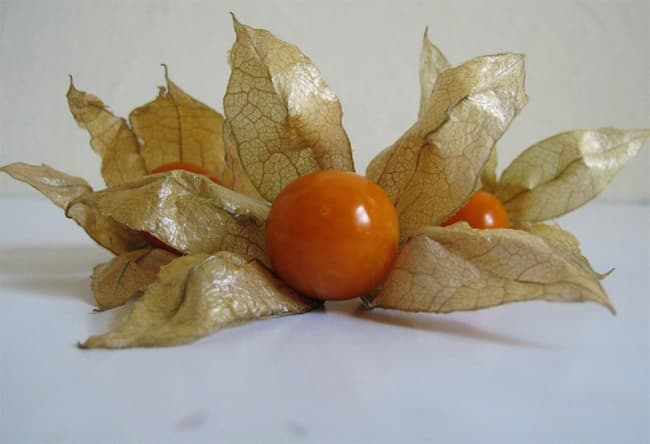
Growing conditions.
The plant is thermophilic, in the middle lane it is grown only through seedlings. At the optimum temperature of +20+22°C shoots appear in 7-8 days. Growth at +15+20°С. Plant out outdoors when the danger of frost has passed. Placed on fairly fertile, loose, drained soils.
* Physalis is a relative of the tomato.
Physalis is an annual bushy herbaceous plant up to 1.5 m tall. The fruits are round, yellow and 1-2 cm in diameter.
The plant is light-loving, cold-resistant, tolerates frosts, and is not afraid of strong winds. However, at low temperatures, seed germination is greatly delayed. Two types of edible physalis were introduced into the culture - Mexican and strawberry.
Mexican physalis plant is usually 60-80 cm in height, strawberry - is 30-40 cm. More often we grow Mexican physalis. The plant is annual and produces up to 200 or more fruits.
Strawberry physalis is sometimes called raisin. The plant is creeping, and self-pollinating, the stem is densely pubescent, and the fruits are yellow or bright orange. The variety is early and can be propagated by seeds, but it is less productive than the Mexican. Mexico physalis is more commonly used as a vegetable (raw and processed). Strawberry physalis is used as a berry plant (jam is boiled from the fruits or they are dried for compotes).
Physalis fruits contain many elements necessary for the body: 8-9% of dry matter in it: 3-4% sugars, 0.2-0.3% pectin, many vitamins, especially PP, and high iron content.
Physalis is curative in diseases of the kidneys. When using it for these purposes, the fruits must be poured with boiling water to remove the sticky substance from the surface.
Physalis fruits are eaten raw or canned. Vegetable caviar and jam are prepared from them. Unripe physalis fruits can be stored all winter.
Decorative garden physalis (often called "Chinese lanterns") is used to make autumn-winter bouquets.
Ornamental physalis is a perennial plant that propagates by rhizomes. It either does not form fruits, or they are inedible, enclosed in bright orange cases, which gives the plant a special decorative effect.
Preparing seeds for sowing.
Seeds are disinfected before sowing. You can treat them with formalin (solution concentration 1:10) for 6-10 minutes. Then the seeds are covered with a cloth soaked in the same solution and left for two hours, then they are washed. You can treat the seeds with a strong (purple) solution of potassium permanganate for 15-20 minutes, then they are washed with clean water. To obtain friendly seedlings, it is recommended to germinate the seeds. To do this, immediately after disinfection, they are laid on a wet cloth. Germination lasts 5-7 days at a temperature not lower than +20°C. Seeds can be sown when 10-15% of them have hatched.
Growing seedlings.
Seedlings of physalis of the Mexican variety type begin to be grown in early April, and strawberry type - at the end of March. The nutrient mixture for pots is prepared from soddy soil and humus (1: 1) with the addition of mineral fertilizers (15-20 g of urea, 20-25 g of superphosphate, 15-20 g of potassium salt per bucket of a mixture of earth and humus). Seeds germinate in about a week at an air temperature of +20 +30 °C (if the temperature is below +12 °C, the seeds may not germinate for a long time). The recommended plant density when growing seedlings is 7x9 cm. If the crops turned out to be thickened, then the extra plants can be planted in a greenhouse or pots. When growing seedlings, it is necessary to monitor the temperature and humidity (at a temperature of +25 +30 °C and high humidity, the plants stretch, lie down and can get sick with a “black leg”). Strong seedlings are obtained in a well-ventilated room at a temperature of +15 +20 °C. When growing seedlings, the soil should be regularly loosened, weeded and watered as needed. With the slow development of seedlings or their strong stretching, fertilizing with an aqueous solution of bird droppings should be done. At an outdoor temperature of +10 °C and above during the day, seedlings should be taken out to the balcony, gradually increasing the time it stays there from 30 minutes to several hours. In the phase of 1-2 true leaves, the plants dive into greenhouses or pots.
Site preparation and planting physalis in the ground.
Physalis loves loose, fertile, well-aerated, non-acidic soil. Fresh manure is not recommended for physalis. Plants respond well to the introduction of compost, humus and ash (2-3 cups per 1 sq. M). A place for planting plants must be prepared in advance. In holes, up to 15 cm deep, put a handful of humus, and a tablespoon of ash, mix well with the ground and pour abundantly. Plants are buried to the first true leaf. After planting, the bed should be mulched with humus, keeping the leaves clean. Usually, physalis is not tied up, because its stem is strong and thick enough.
Attention! Physalis in low places suffers from late blight. It is not recommended to arrange beds with physalis next to potatoes, tomatoes, peppers, eggplants, as they have common pests and common diseases. Physalis can be grown on almost all soils, except for strongly acidic ones, on which it develops poorly and is susceptible to disease. Soils should not be heavily filled with manure, because then the above-ground mass grows in the physalis, and the formation and ripening of fruits are delayed. On poor lands, physalis gives a smaller crop, but the fruits ripen earlier and are more sugary. If necessary, the soil is limed (2.5-3 kg per 10 sq. M). Physalis seedlings are planted in the ground in the phase of 3-4 true leaves in the second half of May (the timing of planting varies significantly depending on the weather conditions). Strong, well-hardened physalis seedlings take root quite quickly. It is better to plant seedlings from greenhouses in cloudy weather and late in the evening. Before sampling, it is watered abundantly, so that when excavating, the roots are less damaged and the plant is removed with a clod of earth. As a rule, 30-day-old seedlings with buds are planted in the ground. Planting time is 7-10 days earlier than the tomato (i.e. at the end of May - the first decade of June). The scheme of plant placement on beds is 50x50 cm (for Mexican) and 30x30 cm (for strawberry physalis). Plants do not stepson and do not tie up.
Care, watering and fertilizing.
Planting care consists of weeding, loosening, watering and fertilizing. During the growing season, the aisles are loosened 3-4 times. On poorly fertilized and poor soils, top dressing is carried out. In the future (from the end of June), the plants are fed at intervals of 2-3 weeks with a solution of bird droppings (1:15) or mullein (1:10). The first top dressing is carried out during the period of mass flowering, the second - during fruit formation, the third - after another 2-3 weeks. Use solutions of mineral fertilizers (10 g of ammonium nitrate, 10-20 g of superphosphate, 10-15 g of potassium salt, dissolved in 10 litres of water). The consumption rate of the solution is 10 litres per 1 sq. m. To feed physalis, you can also use slurry (1:10), bird droppings (1:15-20) at the rate of 0.5 litres per bush. To increase the yield in mid-July, it is recommended to pinch the tops of the stems. Plants, as a rule, do not stepson. The more branched they are, the higher the yield. To enhance the branching, pinch the tops of the shoots (most often this occurs in mid-July). Physalis is resistant to diseases and pests. However, it is necessary to monitor his condition constantly.
Harvest and storage.
Physalis fruits ripen 50-60 days after planting seedlings or 80-100 days after germination or sowing seeds in the ground. The lower fruits ripen first. Their cuttings brighten and dry out, the colour of the fruit becomes yellow (for Mexican physalis) or bright orange (for strawberry type). Ripe fruits fall off, but in dry weather, they can lie healthy on the ground for up to two weeks. Large unripe fruits ripen well during storage. The crop is usually harvested at intervals of 7-10 days. It is better not to collect fruits in wet weather due to wet covers. If this still had to be done (due to prolonged rains), then the fruits must be dried and freed from the wrappers.
Attention! Do not damage the fruits and make sure that they do not fall under frost. Physalis fruits are stored in lattice boxes in a dry room.
Getting your own seeds.
IF In crops all plants have varietal characteristics, then larger fruits are selected for seeds. If the plants in the crops turn out to be heterogeneous, then it is necessary to select two plants with varietal characteristics and carry out artificial pollination. To this end, the buds on both plants are isolated with cotton wool until they open, and after pollination, the pollinated flower is isolated.
Attention! An important requirement in the seed production of Mexican physalis is the cultivation of only one variety on the site. Strawberry and Peruvian physalis do not cross with each other, as well as with Mexican and ornamental physalis, so they can be grown on the same site. Ripened fruits, which usually fall off, are harvested for seeds, and larger, healthier ones are selected. The fruits harvested for seeds are ripened for two weeks indoors at +20 +25 °С.
* How to grow vegetable physalis?
Mexican (vegetable) physalis is an unpretentious, branched, tall (120-150 cm) plant, the most cold-resistant of all nightshade crops.
Shoots appear at a temperature of +10+12°C. The fruits are quite large (60-70 g), enclosed in small covers.
The fruits are covered with a sticky substance, so before use they are removed from the covers and washed with hot water.
Physalis easily reproduces by self-seeding. As soon as the soil warms up to a temperature of +12°C, shoots appear from the fruits that fell to the ground in the fall in the spring.
Physalis is grown in the same way as tomatoes, but it can be sown for seedlings a month later than tomatoes, since it begins to bear fruit 80-100 days after the emergence of shoots, depending on the variety. It is planted in open ground after the spring frosts have passed.
For seedlings, physalis should be sown 40-50 days before transplanting the seedlings into the ground or greenhouse. Early-ripening varieties are also grown without seedlings.
The watering and fertilizing regime is the same as for tomatoes, but physalis is not side-sonned or shaped.