


Your shopping cart is empty!
Mountain Fritillary
Fritillaria montana
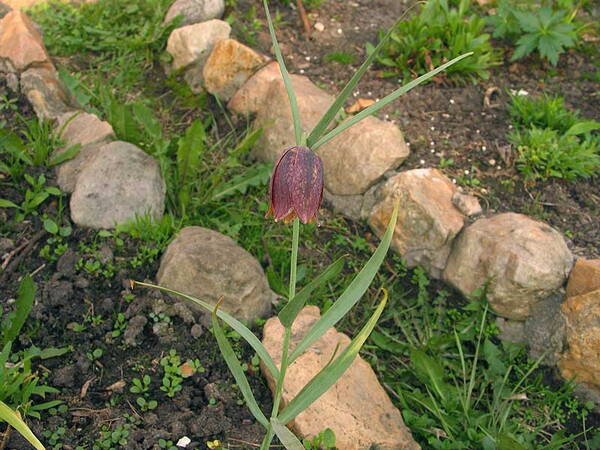
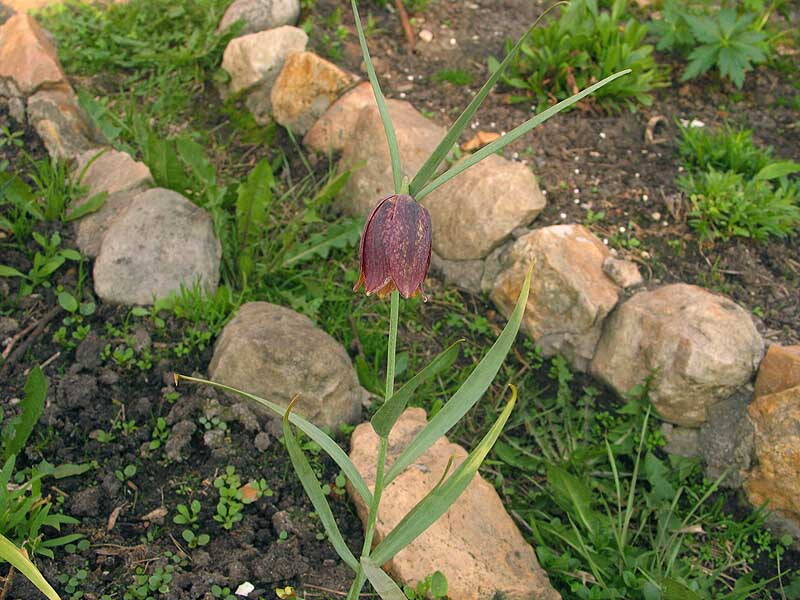
Mountain Fritillary - Fritillaria montana.
In the wild, the species is distributed in the south of France, Italy and the former Yugoslavia, as well as in northern Greece.
Despite the fact that it began to be cultivated as early as 1832, it still remains little known.
The bulb is medium-sized. The plant is up to 80 cm tall. The leaves are linear, alternate on the stem and 3 in a whorl at the base of the peduncle.
Flowers 1-2, they are quite large, dark brown, with indistinct speckles. Fruit is a smooth, oblong-oval capsule.
It is stable in culture. It loves light. It grows and develops well in any loose soil.
It reproduces both by seeds and by daughter bulbs. In Estonia it awakens a little earlier than other species of fritillaries. It blooms in the first week of May.
It is of interest for introduction and selection. It is often found in collections of botanical gardens and among amateur flower growers.
It differs from the closely related Fritillaria tenella in its aroma, size, and linear light leaves.
Reproduction: by seeds and vegetatively. This sequence is not accidental. The fact is that the seed method is universal and suitable for all species, you only need at least two flowering plants of the same species. After pollination (using insects or artificially), a seed capsule is formed, which takes a vertical position as it ripens. The stem lengthens and becomes stronger. Seeds can be collected after the walls of the capsule have dried out. Sometimes, in very rainy years, it is advisable to break off the capsule earlier, when its walls begin to lighten, and ripen it in a dry, ventilated place.
The seeds of most hazel grouse are resistant to fungal diseases. It is recommended to sow them immediately after collection in a plot with well-prepared, organically rich soil, since the seedlings will grow here for several years and they need to be provided with nutrition for all these years. Inorganic fertilizers are applied in the form of annual feeding at key moments of plant development: at the beginning of growth, during the formation of the bulb. Seeds are sown on raised ridges for better drainage in furrows 6-10 cm wide, with row spacing of approximately the same size. The depth of planting is 1 cm. To ensure that the bottom of the furrow is even, use a rectangular rigid plate with even edges, which is drawn along the guide board. Immediately after sowing, the surface of the ridge is mulched with peat in a layer of 2 cm.
The shoots appear in the spring of the following year and are a single leaf several centimeters high. Germination varies greatly depending on the species and even within the same species in different years. This is mainly due to the weather conditions in which the seeds ripened. Seedlings are usually more resistant to soil freezing in winter than adult plants and generally to many unfavorable factors. Perhaps the main problem in our climate zone is protecting fritillary seedlings, natives of areas with dry summers, from soil moisture in the summer. Already two-year-old plants should be dug up after the end of the growing season and stored in a dry place in the summer. This is quite meticulous work, because the bulbs are still very small and some of them, as a rule, are lost.
Use: Fritillaries are good cut flowers, but their main purpose is to decorate the garden. Fritillaries of the same species are planted in groups that imitate natural plant clusters. A mixed group looks completely unnatural. Large species are also great when planted alone, especially since they bloom much earlier than other ornamental crops. Low species look better in rock gardens, where they seem to be closer to the viewer.
Growing fritillaries, especially small species, in pots is worth noting. Usually, several plants are planted in one container. When planting, it is very important to ensure good drainage. During the growth period, the temperature should be low (corresponding to spring). At this time, the plants should be in a ventilated greenhouse or outside. On a glazed unheated balcony or loggia, fritillaries in pots can be kept all year round. They are replanted once every 2 years.
Partners: good in rocky areas and in mixborders in combination with peonies, daffodils, tulips.
In the wild, the species is distributed in the south of France, Italy and the former Yugoslavia, as well as in northern Greece.
Despite the fact that it began to be cultivated as early as 1832, it still remains little known.
The bulb is medium-sized. The plant is up to 80 cm tall. The leaves are linear, alternate on the stem and 3 in a whorl at the base of the peduncle.
Flowers 1-2, they are quite large, dark brown, with indistinct speckles. Fruit is a smooth, oblong-oval capsule.
It is stable in culture. It loves light. It grows and develops well in any loose soil.
It reproduces both by seeds and by daughter bulbs. In Estonia it awakens a little earlier than other species of fritillaries. It blooms in the first week of May.
It is of interest for introduction and selection. It is often found in collections of botanical gardens and among amateur flower growers.
It differs from the closely related Fritillaria tenella in its aroma, size, and linear light leaves.
Reproduction: by seeds and vegetatively. This sequence is not accidental. The fact is that the seed method is universal and suitable for all species, you only need at least two flowering plants of the same species. After pollination (using insects or artificially), a seed capsule is formed, which takes a vertical position as it ripens. The stem lengthens and becomes stronger. Seeds can be collected after the walls of the capsule have dried out. Sometimes, in very rainy years, it is advisable to break off the capsule earlier, when its walls begin to lighten, and ripen it in a dry, ventilated place.
The seeds of most hazel grouse are resistant to fungal diseases. It is recommended to sow them immediately after collection in a plot with well-prepared, organically rich soil, since the seedlings will grow here for several years and they need to be provided with nutrition for all these years. Inorganic fertilizers are applied in the form of annual feeding at key moments of plant development: at the beginning of growth, during the formation of the bulb. Seeds are sown on raised ridges for better drainage in furrows 6-10 cm wide, with row spacing of approximately the same size. The depth of planting is 1 cm. To ensure that the bottom of the furrow is even, use a rectangular rigid plate with even edges, which is drawn along the guide board. Immediately after sowing, the surface of the ridge is mulched with peat in a layer of 2 cm.
The shoots appear in the spring of the following year and are a single leaf several centimeters high. Germination varies greatly depending on the species and even within the same species in different years. This is mainly due to the weather conditions in which the seeds ripened. Seedlings are usually more resistant to soil freezing in winter than adult plants and generally to many unfavorable factors. Perhaps the main problem in our climate zone is protecting fritillary seedlings, natives of areas with dry summers, from soil moisture in the summer. Already two-year-old plants should be dug up after the end of the growing season and stored in a dry place in the summer. This is quite meticulous work, because the bulbs are still very small and some of them, as a rule, are lost.
Use: Fritillaries are good cut flowers, but their main purpose is to decorate the garden. Fritillaries of the same species are planted in groups that imitate natural plant clusters. A mixed group looks completely unnatural. Large species are also great when planted alone, especially since they bloom much earlier than other ornamental crops. Low species look better in rock gardens, where they seem to be closer to the viewer.
Growing fritillaries, especially small species, in pots is worth noting. Usually, several plants are planted in one container. When planting, it is very important to ensure good drainage. During the growth period, the temperature should be low (corresponding to spring). At this time, the plants should be in a ventilated greenhouse or outside. On a glazed unheated balcony or loggia, fritillaries in pots can be kept all year round. They are replanted once every 2 years.
Partners: good in rocky areas and in mixborders in combination with peonies, daffodils, tulips.
Bot. syn.: Fritillaria caussolesis, Fritillaria degeniana J.Wagner, Fritillaria gawleri Jaub., Fritillaria intermedia Terracino, Fritillaria nigra hort.non Mill., Fritillaria orientalis hort., Fritillaria orsiniana Parl., Fritillaria pollinensis Terracino, Fritillaria racemosa Ker Gawl.