


Your shopping cart is empty!
Beetroot "Alexis"
Beta vulgaris var. conditiva Alef.
1.67€
Ex Tax: 1.35€
Ex Tax: 1.35€
Table Beetroot "Alexis".
Juicy and very tasty!
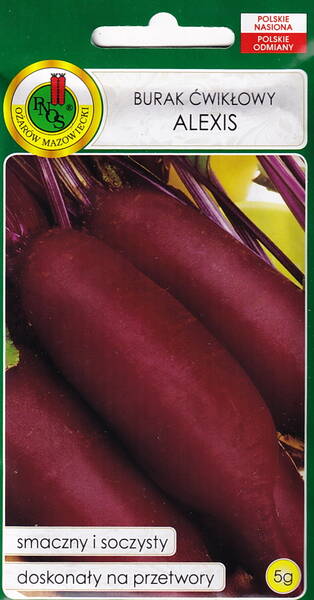
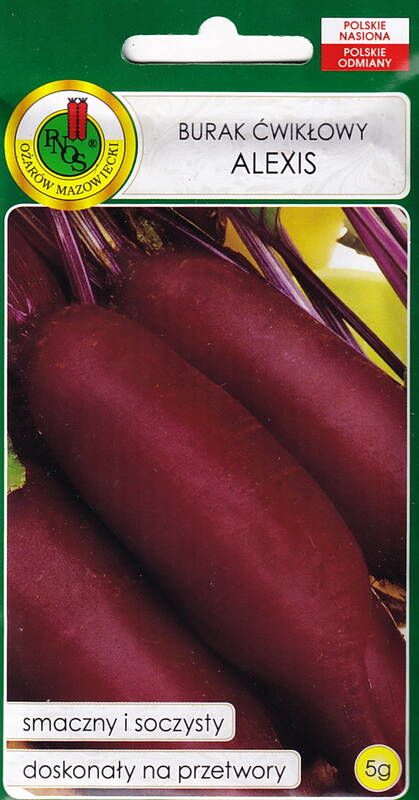
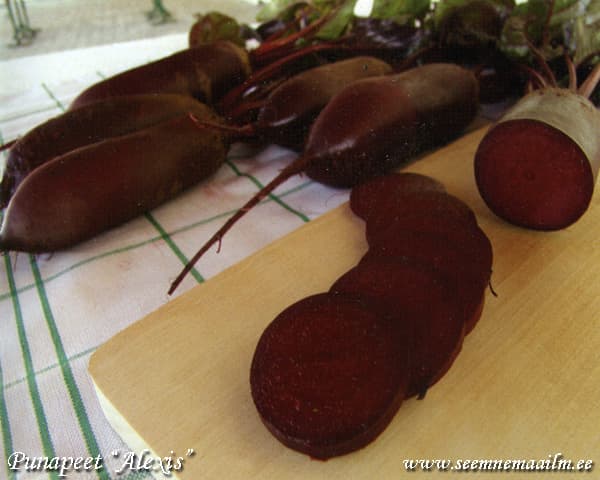
A mid-ripening (130 days), sparsely leafed variety with cylindrical roots 21-26 cm long.
The flesh of the root is dark purple, evenly coloured, without rings.
Cultivation.
Beetroot grows best on rich, fertile soils with a neutral reaction. On heavy soils, it should be grown on ridges. The best predecessors are early potatoes, cucumber, onions, pumpkin, zucchini.
In autumn, humus is applied to the plot for beetroot, the soil is limed if necessary, and in spring a complex mineral fertilizer is applied. Seeds are sown in late April - early May to a depth of 2-4 cm in rows with a spacing of 25-30 cm and a distance between seeds of 8-10 cm. Thinning is not required.
Further care consists of loosening, regular feeding, and watering. In Estonia, beetroot seeds can be sown before winter in late October - early November.
Juicy and very tasty!
A mid-ripening (130 days), sparsely leafed variety with cylindrical roots 21-26 cm long.
The flesh of the root is dark purple, evenly coloured, without rings.
Cultivation.
Beetroot grows best on rich, fertile soils with a neutral reaction. On heavy soils, it should be grown on ridges. The best predecessors are early potatoes, cucumber, onions, pumpkin, zucchini.
In autumn, humus is applied to the plot for beetroot, the soil is limed if necessary, and in spring a complex mineral fertilizer is applied. Seeds are sown in late April - early May to a depth of 2-4 cm in rows with a spacing of 25-30 cm and a distance between seeds of 8-10 cm. Thinning is not required.
Further care consists of loosening, regular feeding, and watering. In Estonia, beetroot seeds can be sown before winter in late October - early November.
* Table beetroot seeds are enclosed in single-seeded capsules, which fuse together in groups of 2-5, more often 3, into so-called clusters. With sufficient moisture, seeds germinate over a wide temperature range (+5+28°C).
Table beetroot belongs to cold-resistant plants, however, it is more demanding of heat than carrots. Beetroot easily tolerates short-term autumn frosts down to minus 3°C. Further temperature decrease negatively affects plants, apical buds are damaged. Temperature conditions of cultivation have a great influence on both the growth and development of plants. Under the influence of unfavourable temperatures, the biennial development cycle is often disrupted, which manifests itself in the appearance of plants with flowering stems (bolting) in the first year of life. It is the prolonged exposure of the plant to low temperatures that promotes flowering in the first year. Therefore, with early and especially pre-winter sowing and a protracted cold spring, bolting manifests itself more strongly than with late sowing and a warm spring.
Beetroot is most demanding of moisture during the period of seed germination and intensive growth of leaves and roots.
Beetroot grows on almost all types of soil, except for heavy loamy soils prone to crusting. Unlike carrots, beetroot withstands a higher concentration of salts, but is very sensitive to soil acidity – pH<5 is detrimental.
Crop rotation.
Although beetroot is cultivated in monoculture, direct proximity to other Chenopodiaceae, as well as other crops susceptible to scab, should be avoided. This is especially important for areas infected with nematodes. In the presence of stem nematodes, predecessors such as potatoes, onions, strawberries should be avoided, and in the presence of root-knot nematodes - carrots too.
Table beetroot crops should be placed away from other types of beetroot to avoid infection with the jaundice virus (vector - leaf aphid). Under conditions of a short growing season (12-24 weeks), wide combinations with other crops characterized by short cultivation periods are possible.
Growing.
Sowing scheme: 30-40 x 5-6 cm; (50-20) x 5-6 cm. Table beetroot is sown in a single-row wide-row method with row spacing of 30–40 cm, the distance between seeds in the row is 5–6 cm.
Storage.
Storage of roots with a well-formed epidermis does not present special problems. Beetroot can be stored in piles, storage facilities (in bulk or in boxes), refrigeration chambers at a temperature above 0°C and high humidity. Roots with leaves are stored for 2 weeks, without leaves - up to 6 months. Under favourable conditions, roots can be stored until May.
Fertilizer.
To obtain 6-8 kg per m² (60-80 t/ha) of beetroot, it is necessary to apply fertilizers per 10 m²: ammonium nitrate 600 g, superphosphate 750 g, potassium salt 630 g (N 200, P2O5 100-150, K2O 200-250 kg of active substance per 1 ha). 2/3 of phosphorus and potash fertilizers are applied in autumn, nitrogen and the rest of phosphorus-potash fertilizers are applied in the form of top dressing. Beetroot responds very positively to the use of microelements, and especially boron and manganese. On peat bogs, the use of copper is effective. When fresh organic fertilizers are applied under beetroot, the quality of the roots deteriorates. If there are few nutrients in the soil and organic fertilizers were not applied under the predecessor, it is advisable to apply 20-30 t/ha of well-rotted manure under early beetroot.
* HOW TO REDUCE SOIL ACIDITY?
Soil acidity can be lowered by applying neutralizing materials — lime or dolomite flour, ground chalk, wood ash.
The application rates depend on acidity, soil mechanical composition, and the cultivated crop. The application rate of liming materials also depends on the fineness of grinding: large particles with a diameter of more than 4 mm have a weak neutralizing effect.
When deepening the arable soil layer, lime doses are increased in proportion to the thickness of the deepened layer.
It is better to apply lime simultaneously with manure - this contributes to faster decomposition of organic matter. On peat and sandy soils, it is better to apply dolomite flour or wood ash, which additionally enrich the soil with microelements.
Lime is applied one or two years before planting the garden when digging the soil. One-time liming has a positive effect on the soil for five to eight years (the duration of lime action on loamy soils is longer than on sandy ones).
On sandy soils, liming should be repeated every three to five years, on loamy ones — every five to seven years.
To maintain a certain pH value, 100 g/m² of CaCO3 needs to be applied to the soil annually.
The soil can be limed at any time of the year. The best effect is achieved when the soil is limed simultaneously with autumn or spring digging of the site. In this case, lime is introduced into the furrow during the digging process or scattered over the soil surface, after which the site is dug up.