


Your shopping cart is empty!
Boor (10,0%)
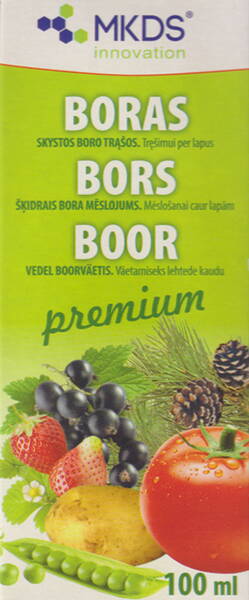
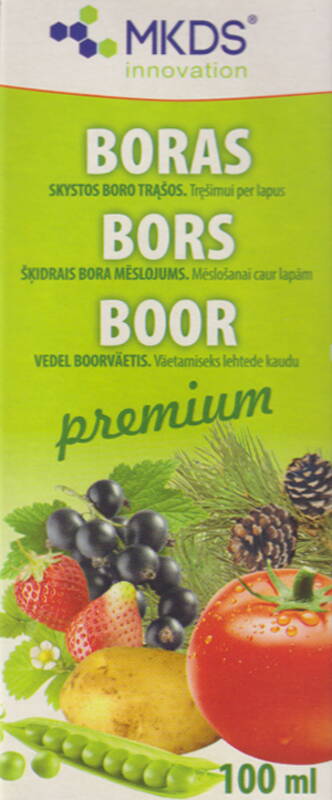
Boron (B) 10.0% (Na2B8O13 x 4H2O) .
Boron is a powerful and very important trace element that:
* triggers the synthesis of lignin and pectins, thus participating in the reconstruction of plant cells;
* gives plants strength;
* enhances the movement of substances in plants and photosynthesis, facilitates the metabolism of carbohydrates and proteins, stimulates chlorophyll formation;
* increases the abundance of flowers, improves crop quality, promotes root growth, increases drought resistance;
* ensures high sugar content in fruits and starch in potato tubers.
* Boric acid is a necessary helper in the garden when:
- fruits of zucchini or courgettes are rotting,
- tomatoes in the greenhouse are suffering from heat stress,
- fruit set is poor in peppers and eggplants,
- there are few ovaries on cucumbers.
Application and consumption rate.
Boron is a powerful and very important trace element that:
* triggers the synthesis of lignin and pectins, thus participating in the reconstruction of plant cells;
* gives plants strength;
* enhances the movement of substances in plants and photosynthesis, facilitates the metabolism of carbohydrates and proteins, stimulates chlorophyll formation;
* increases the abundance of flowers, improves crop quality, promotes root growth, increases drought resistance;
* ensures high sugar content in fruits and starch in potato tubers.
* Boric acid is a necessary helper in the garden when:
- fruits of zucchini or courgettes are rotting,
- tomatoes in the greenhouse are suffering from heat stress,
- fruit set is poor in peppers and eggplants,
- there are few ovaries on cucumbers.
Application and consumption rate.
|
Plants |
Per 100 m² / 4 L water |
Foliar spraying |
|
Conifers |
30 ml |
Early spring |
|
Fruit bushes and trees |
10 ml |
Before flowering (buds unopened); |
|
Garden Strawberry |
10 ml |
Before flowering |
|
Potato |
10 ml |
1-2 times when tops are 20 cm high |
|
Tomato |
10 ml |
2 times if necessary |
|
Cabbage, carrot, celery, beet |
10 ml |
2 times if necessary |
|
Beans, peas |
10 - 20 ml |
1-2 times before flowering |
|
Vegetables |
20 ml |
After formation of the 8th-10th leaf |
|
Other plants |
10 ml |
As needed |
* Attention: strictly observe the dosage.
* For foliar spraying, the concentration of the solution must not exceed 0.8%.
* Observe the recommended rate per unit area.
Do not spray under direct sunlight.
Can be mixed with plant protection products (we recommend checking mixing and compatibility in advance).
When preparing the solution, fill 2/3 of the tank volume with water – pour each product separately.
* In complex feeding, boron is used as the last component!
The amount of boron applied does not depend on soil pH. Storage temperature from +5°C to +35°C.
Avoid strong temperature fluctuations. Do not inhale vapors. Keep out of reach of children.
Boric acid is a nutrient for vegetable and fruit crops to prevent and treat diseases caused by a lack of boron (heart rot in beets, hollowness of root crops, brown and red rot in cauliflower, cork tissue and scab on root crops, etc.).
Particularly sensitive to a lack of boron are such crops as potatoes (scab disease), sugar beets, fodder root crops, apple trees and pears when grown on acidic, waterlogged, sandy, sandy, and heavily limed soddy-podzolic soils.
The use of boron microfertilizers promotes an increase in the ovaries of fruit and berry crops during flowering, stimulates the formation of new growth points, increases the content of sugar and vitamins in grown crops, increases their resistance to adverse conditions and diseases, both during growth and during storage of the crop.
Boric acid treatment of fruit and berry crops gives an increase in yield by an average of 20-25% and is highly effective in growing tomatoes, cucumbers, and cabbage.
Boron improves the supply of oxygen to the roots. With its deficiency, weak flowering is observed, the growth point dies, and root growth stops.
The absence of boron inhibits the entry of calcium into the plant.
Boron is not part of enzymes, but is localized in the substrate and is involved in the movement of sugars through membranes due to the formation of a carbohydrate-borate complex.
Characteristic signs of boron deficiency are the death of growth points, shoots and roots, disturbances in the formation and development of reproductive organs, destruction of vascular tissue, etc.