


Your shopping cart is empty!
Carrot "Judita" F1
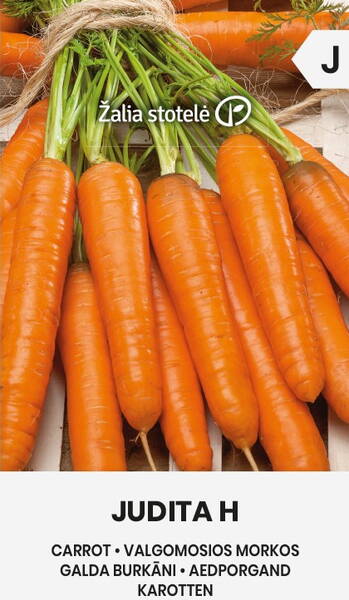
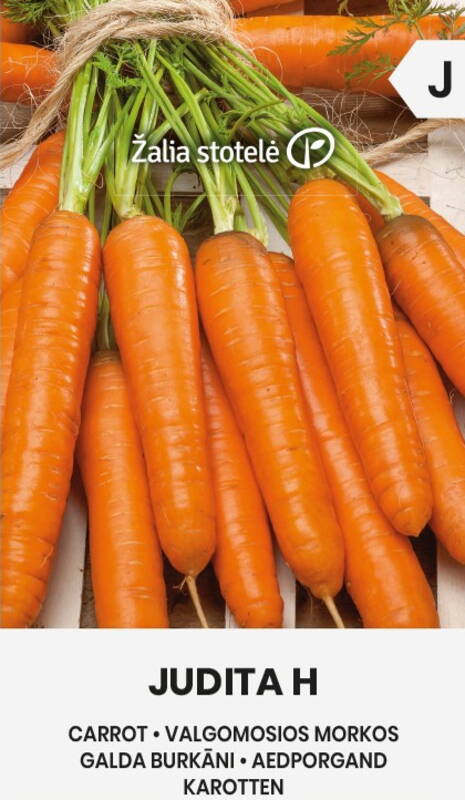
Carrot "Judita" F1.
Juicy flesh with excellent taste qualities.
For this reason, this variety is excellent for juices, salads, and other thermal processing or freezing.
Mid-late, high-yielding, Alternaria-resistant hybrid of the "Berlicumer" type. Vegetation period 110–130 days. Roots are dense, smooth, bright orange, 18–22 cm long, do not crack.
Intended for fresh consumption and short-term storage.
Forms lush and healthy foliage, which can be used in cooking, added to soups, salads, or dried for tea.
1.0 g = 800-1000 seeds.
Juicy flesh with excellent taste qualities.
For this reason, this variety is excellent for juices, salads, and other thermal processing or freezing.
Mid-late, high-yielding, Alternaria-resistant hybrid of the "Berlicumer" type. Vegetation period 110–130 days. Roots are dense, smooth, bright orange, 18–22 cm long, do not crack.
Intended for fresh consumption and short-term storage.
Forms lush and healthy foliage, which can be used in cooking, added to soups, salads, or dried for tea.
1.0 g = 800-1000 seeds.
* How to grow carrots.
First of all, I would like to note that carrots are extremely light-loving plants. The brighter the place, the easier it is to grow them and the longer they can "sit".
Carrots can be planted before winter from September 15 to 30 (but it is better not to do this, because seeds often freeze out, and no special germination speed is observed compared to early spring sowing).
In spring, carrot sowing can begin from April 15, but it is most expedient to sow in warmed-up soil, approximately after May 5. The end of sowing is May 31. Harvesting for storage is carried out in September.
The main criterion for harvesting is the very moment when fresh leaves begin to appear on the carrots, and tiny hairs on the roots.
This indicates that the carrots must already be harvested. Such carrots must be dried well, otherwise they will grow.
If you collected carrots before the appearance of the above signs, then you can be calm: they will not grow further.
When harvesting carrots for storage, it is better not to cut the tops, but to break them off by hand, making twisting movements, followed by breaking, which also prevents their subsequent growth.
Soil preparation.
Carrots, like all other root crops, love loose and well-drained soil. To prepare it, per 1 square meter apply 1 bucket of manure humus, 1 bucket of peat or sod land, 1 bucket of sand, 1 bucket of rotted sawdust (this is optional, as it can be replaced with peat), 1 litre of garden lime (dolomite flour), 1/2 litre of ash, 1 tablespoon of superphosphate, 1 tablespoon of nitroammophoska and 1 teaspoon of potash fertilizers. All this is carefully dug up and formed into beds 45-50 centimetres wide.
Sowing seeds.
Sowing of seeds is carried out in 3 longitudinal rows 1/2 centimetre deep, drawn in such a way that one of them passes in the middle of the bed, and the other 2 at a distance of 5 cm from the edge. Seeds are scattered with a pinch at a rate of 1 gram per 3 running meters. Then the seeds are covered with the same soil.
The beds are watered and lightly sprinkled with well-rotted peat or sod land.
Since carrot seeds germinate very poorly, we highly recommend covering the beds with covering material (agrofibre) until germination.
If it is not available, you can use film (however, on hot days this cannot be done due to possible overheating).
Care of crops.
The first thinning is carried out at the stage of formation of seedlings (2-3 leaves). The most developed plants are left at a distance of about 1 cm from each other. Along with this, weeding is also carried out. Thinned rows are slightly hilled up using a hand cultivator, then the beds are watered.
The second thinning is carried out at the stage of ovary formation. Just like the first time, the best plants are left, but now the distance between them is made 2-3 cm. Plants are no longer hilled up, but the row spacings are loosened.
Watering is carried out as needed (it should be especially intensive in July).
For the entire growing period, it is advisable to carry out 2 feedings with organic fertilizers: the first - in the period between thinnings and the second - in mid-July. For this, you can use manure slurry (liquid manure), diluted in a ratio of 1 to 15-20 with a consumption of 10 litres per 1 square meter of the bed or humate, diluting it according to the instructions.
Manure slurry is prepared as follows: several buckets of fresh manure are placed in a container (for example, a barrel) and poured with water in a ratio of 1:1, covered so that it does not get flooded with rain and does not "stink", and kept for 3-4 days, stirring occasionally (1-2 times a day). Only the dissolved liquid part is used for feeding (the remaining thick part can be re-filled with water in the same ratio).