


Your shopping cart is empty!
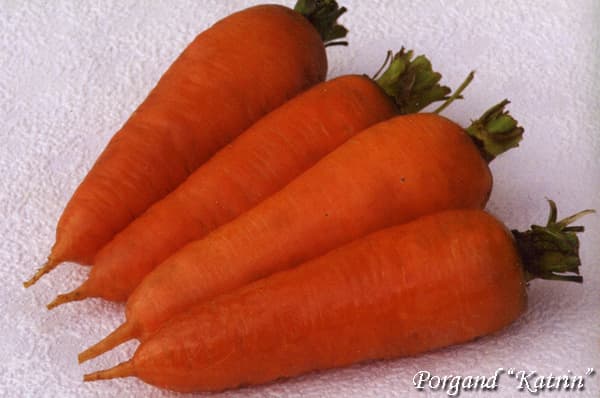
Carrot "Katrin"

Eco seeds

Carrot "Katrin".
Exceptional taste qualities!
A mid-early variety with a short root (11-13 cm) of the "Chantenay" type.
Roots have a smooth surface, the upper part of the root does not turn green.
95–105 days from germination to harvest.
Designed for fresh consumption, canning, and short-term storage.
Exceptional taste qualities!
A mid-early variety with a short root (11-13 cm) of the "Chantenay" type.
Roots have a smooth surface, the upper part of the root does not turn green.
95–105 days from germination to harvest.
Designed for fresh consumption, canning, and short-term storage.
* Carrots have long been used to treat oily, acne-prone, and aging facial skin.
For dry facial skin, grate two carrots, mix with egg yolk, add a few drops of lemon juice and vegetable oil, apply a thin layer of the mask to the face for 20 minutes, and then rinse with warm water.
For oily and porous facial skin, a mask is made from chopped carrots.
A mixture of carrot and green pepper juices, taken in a 2:1 ratio, cleanses the facial skin well from pigment spots. And if there is no green pepper at hand, a mask of finely grated carrots applied to the face for 30 minutes will help make pigment spots and freckles on dark skin less noticeable. Then it is washed off alternately with cold and hot water.
For sunburns, masks should be made from finely grated carrots mixed with one beaten egg white. The resulting mass is applied to the burned skin for 20-25 minutes 1-2 times a day.
For dry skin, carrot masks are used. To do this, grated carrots are applied to the face and neck, where they remain until dry. For better fixation of such a mask, grated carrots are thoroughly mixed with egg yolk or fresh sour cream until creamy. Masks are done 2-3 times a week. The course of treatment is 20 procedures. Before applying the mask, the face and neck are cleaned with swabs moistened with carrot juice.
To accelerate hair growth, strengthen it, and give it a natural shine, a mixture of carrot and lemon juices is rubbed into the scalp. To prepare it, take the juice of one small lemon for 1 cup of carrot juice.
To improve hair growth and restore its natural colour, a mixture of juices consisting of 3 parts carrots, 1 part lettuce, 2 parts green vegetable pepper, and 1 part alfalfa herb is also effective.
With increased hair greasiness, the scalp is lubricated with a mixture of lemon and carrot juice 1-2 hours before washing the head and covered with a terry towel. After washing the head, it is rinsed with room temperature water, to which 1 tablespoon of lemon juice or vinegar is added per 1.5-2 litres of water.
Well, probably everyone knows how to prepare carrot juice without complex equipment: you need to grate the peeled carrot on a fine grater, then squeeze the juice from it through a double layer of cheesecloth. Carrot juice can be stored in the open air for no more than 30 minutes.
* When choosing carrots, pay attention to small fruits of bright orange colour. Carrots weighing about 150 g are the most "vitaminized". The larger the root crop, the more intensely it absorbs nitrates. The orange colour is directly proportional to the benefit – the brighter the carrot, the more carotene it contains, which means Vitamin A.
Buy firm carrots, without spots or cracks, which mean that the carrot has a spoiled centre. The juiciest carrots are thick, not long, and dark orange. They are pickled, put in salads and vegetable stews, eaten raw, and juice is made from them.
But light orange roots with a long tail and a "slender body" are ideal for carrot cutlets and casseroles. There is less juice in them, which means that the cutlets will not lose their shape.
It is known that carrots are one of the most "vitamin-rich" vegetables. However, during cooking, some of the beneficial substances are inevitably lost: to minimize vitamin loss, do not cook it in an open pot. The lid will not only help preserve the taste and aroma of vegetables but also make the dish healthier.
It is also worth remembering that by peeling carrots, you deprive yourself of a large amount of vitamins contained in the skin (instead of cutting off the skin with a knife, scrub the carrot with a vegetable brush).
Carrots store well in a plastic bag. But to extend their "life", it is better to wash the roots, dip them in a pink solution of potassium permanganate, dry them, put them in a glass jar, and cover with a lid. If you are used to storing carrots in a wooden box on the balcony, sprinkle them with dry onion skins. Onion has bactericidal properties, so the skins will prevent the carrots from rotting and spoiling. Well, if you haven't accumulated enough skins, simply dip the carrot in onion decoction, dry it, and put it in the box.
Title: Description: