


Your shopping cart is empty!
Carrot "Amsterdam 2" (50 g)
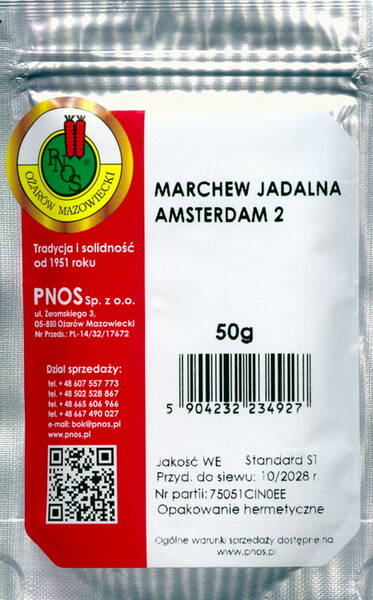
Prof Pack
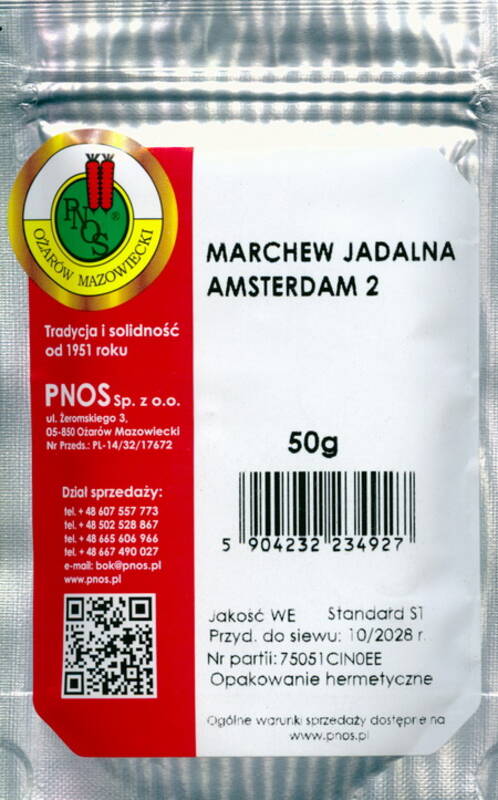
Carrot "Amsterdam 2" — Daucus carota L.
Early variety: ripens within 80 days from germination. Not for storage.
Sowing: late April - early May in well-moistened, loose, fertile soil with a deep arable layer to a depth of 1.5-2.0 cm according to a 5x20 cm scheme.
Care: two-time thinning, loosening row spacings, infrequent watering, top dressing with mineral complex fertilizers, treatment with insecticides against carrot fly.
Do not apply fresh organic fertilizers!
* Carrot is a widely cultivated vegetable. It is valued primarily for its high content of provitamin A, vitamins B1, B2, PP, and a large amount of minerals. Like all vegetables, carrots are more useful to us fresh. This crop requires well-fertilized light soil with a sufficient amount of lime, with a deep arable layer.
Carrots do not tolerate direct fertilization with fresh manure; this causes branching and cracking of root crops. Similar signs also appear with excessive nitrogen application. Carrots are very cold-resistant, so they are sown early in spring or before winter. The seeding rate is 0.3-0.5 g/m2. Seeding depth is 1-2 cm. Row spacing is 20-25 cm.
Carrot seeds germinate slowly (on the 15-20th day), so it is useful to sow them together with an indicator crop (mustard, lettuce). This will allow you to start loosening the soil and removing weeds even before the carrots appear, since the formation of a crust on the surface of crops and weeds are harmful to its seedlings.
Seedlings are thinned out as early as possible, leaving one plant at a distance of 4-5 cm, and late varieties — 7-10 cm from each other.
Immediately after thinning, ammonium nitrate (15 g/m2) and boron-containing fertilizers are applied to the soil. Fertilizers should not be applied later.
In dry weather, crops must be watered. During the period of intensive growth of root crops, watering is limited so that root crops do not crack from excess moisture.
* Carrots are divided into early varieties (Parisian-type), mid, and late.
In early types, the root crop is generally shorter and has a blunt tip. These carrots contain a large amount of sugars and taste more pleasant.
Mid and late varieties have longer root crops, and their yield is significantly higher.
Early variety: ripens within 80 days from germination. Not for storage.
Sowing: late April - early May in well-moistened, loose, fertile soil with a deep arable layer to a depth of 1.5-2.0 cm according to a 5x20 cm scheme.
Care: two-time thinning, loosening row spacings, infrequent watering, top dressing with mineral complex fertilizers, treatment with insecticides against carrot fly.
Do not apply fresh organic fertilizers!
* Carrot is a widely cultivated vegetable. It is valued primarily for its high content of provitamin A, vitamins B1, B2, PP, and a large amount of minerals. Like all vegetables, carrots are more useful to us fresh. This crop requires well-fertilized light soil with a sufficient amount of lime, with a deep arable layer.
Carrots do not tolerate direct fertilization with fresh manure; this causes branching and cracking of root crops. Similar signs also appear with excessive nitrogen application. Carrots are very cold-resistant, so they are sown early in spring or before winter. The seeding rate is 0.3-0.5 g/m2. Seeding depth is 1-2 cm. Row spacing is 20-25 cm.
Carrot seeds germinate slowly (on the 15-20th day), so it is useful to sow them together with an indicator crop (mustard, lettuce). This will allow you to start loosening the soil and removing weeds even before the carrots appear, since the formation of a crust on the surface of crops and weeds are harmful to its seedlings.
Seedlings are thinned out as early as possible, leaving one plant at a distance of 4-5 cm, and late varieties — 7-10 cm from each other.
Immediately after thinning, ammonium nitrate (15 g/m2) and boron-containing fertilizers are applied to the soil. Fertilizers should not be applied later.
In dry weather, crops must be watered. During the period of intensive growth of root crops, watering is limited so that root crops do not crack from excess moisture.
* Carrots are divided into early varieties (Parisian-type), mid, and late.
In early types, the root crop is generally shorter and has a blunt tip. These carrots contain a large amount of sugars and taste more pleasant.
Mid and late varieties have longer root crops, and their yield is significantly higher.