


Your shopping cart is empty!
Gumbo "Red Burgundy" (Ocra, Gombo, Okra, Lady fingers)
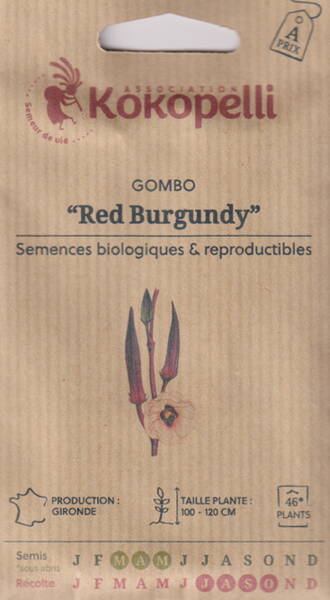
Eco seeds
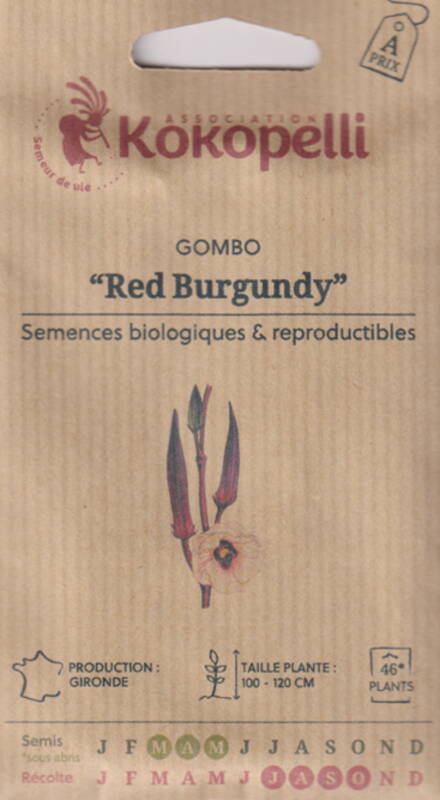
Okra "Red Burgundy" - Abelmoschus esculentus = Hibiscus esculentus.
OKRA - also known as: Edible Hibiscus, Gumbo, or Ladies' Fingers.
A unique, delicate taste and an exotic appearance!
A very interesting and highly nutritious annual herbaceous vegetable crop. The plant resembles a vigorous shrub: the thick stem, covered with stiff hairs, branches out right at the base. The leaves of okra are large, dark green, seven-lobed, and also covered with stiff down.
It grows quickly: it begins to bear fruit just 55-65 days after seedling emergence and continuously produces a harvest until the very first autumn frosts.
The plants are vigorous and have a highly decorative appearance. In summer, solitary large cream-colored flowers with a bright purple-red spot in the middle bloom from the leaf axils. In temperate climates, the bushes grow to 120-150 cm, and in southern regions – up to 2 meters.
The fruit - is an elongated, finger-like pod of a pomegranate-burgundy color, up to 30 cm long, covered with a light fuzz. The pods vaguely resemble peppers in shape.
Culinary value and benefits:
A low-calorie diet product.
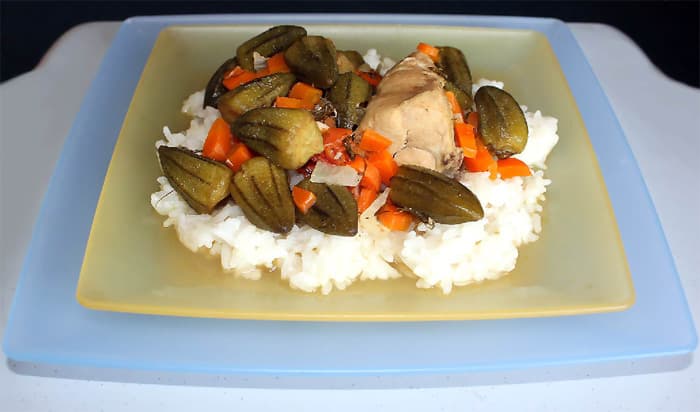
Only young, unripe, and soft 3-6 day-old pods weighing 10-30 g are consumed. The taste of the pods is unusual: it is delicate, savory, and somewhat reminiscent of asparagus or eggplant. They can be eaten raw in salads, boiled, fried, stewed, dried, pickled, and canned for future use. Okra is used to make amazing soups, sauces, and side dishes; it pairs perfectly with meat, poultry, and fish. Young leaves are also edible and used in salads.
Due to the high content of vitamins (A, C, B group) and enveloping mucilaginous substances, okra dishes are extremely useful for the prevention and treatment of stomach ulcers, gastritis, and other gastrointestinal diseases. Okra is excellent at helping to restore the body's exhausted strength after heavy physical labor or a long illness.
Okra seeds are also a gastronomically curious product. Unripe seeds, collected before the frosts, are used to make an analogue of «green peas». And fully ripe seeds make an excellent coffee substitute: they are roasted in a dry pan until a coffee aroma appears and then ground. The resulting coffee-chocolate beverage contains no caffeine, so it can be drunk at night, and is beneficial for children and the elderly. The seeds are also pressed for oil, which is rich in unsaturated fats and has a delicate aroma.
1.0 g = 15-18 seeds.
Cultivation agrotechnics.
In Northern Europe and countries with a similar climate, it is safer to grow okra through seedlings.
The crop is easy to care for, but it has a taproot and tolerates transplanting extremely poorly, so the seeds are sown directly into individual peat pots. Seeds germinate slowly – from 2 to 3 weeks. The optimal temperature for growing seedlings is +18...+21°C.
Seedlings are planted in the open ground only when the threat of spring frosts has completely passed, the soil has warmed up well, and the night temperature does not drop below +12...+15°C (for temperate zones, this is approximately after June 10). Planting scheme: the distance between plants in a row is 30-40 cm, and between rows is 70 cm.
Direct sowing of dry seeds into the ground (2 pcs. per hole to a depth of 2.5-3 cm) is also possible after stable warm weather sets in. Later, the weaker sprout in the hole is simply cut off with scissors.
Okra loves open sunny places and light, fertile soil. It does not tolerate waterlogged areas with high groundwater levels.
Care consists of infrequent but deep watering (the soil should be moistened to a depth of 30-40 cm), weeding, and top dressing with humus or small doses of complex fertilizer. The plant requires the mandatory removal of side shoots (suckers), as the harvest on them is minimal, but they thicken the bush greatly.
Harvesting: this is the most important stage. The pods must be cut or carefully broken off regularly, every 3-4 days, when they reach a size of 4-6 cm. With the slightest delay in harvesting, the fruits become tough, fibrous, and completely inedible. The yield is high: with good care, 30-40 pods can be harvested from one bush per season.
OKRA - also known as: Edible Hibiscus, Gumbo, or Ladies' Fingers.
A unique, delicate taste and an exotic appearance!
A very interesting and highly nutritious annual herbaceous vegetable crop. The plant resembles a vigorous shrub: the thick stem, covered with stiff hairs, branches out right at the base. The leaves of okra are large, dark green, seven-lobed, and also covered with stiff down.
It grows quickly: it begins to bear fruit just 55-65 days after seedling emergence and continuously produces a harvest until the very first autumn frosts.
The plants are vigorous and have a highly decorative appearance. In summer, solitary large cream-colored flowers with a bright purple-red spot in the middle bloom from the leaf axils. In temperate climates, the bushes grow to 120-150 cm, and in southern regions – up to 2 meters.
The fruit - is an elongated, finger-like pod of a pomegranate-burgundy color, up to 30 cm long, covered with a light fuzz. The pods vaguely resemble peppers in shape.
Culinary value and benefits:
A low-calorie diet product.
Only young, unripe, and soft 3-6 day-old pods weighing 10-30 g are consumed. The taste of the pods is unusual: it is delicate, savory, and somewhat reminiscent of asparagus or eggplant. They can be eaten raw in salads, boiled, fried, stewed, dried, pickled, and canned for future use. Okra is used to make amazing soups, sauces, and side dishes; it pairs perfectly with meat, poultry, and fish. Young leaves are also edible and used in salads.
Due to the high content of vitamins (A, C, B group) and enveloping mucilaginous substances, okra dishes are extremely useful for the prevention and treatment of stomach ulcers, gastritis, and other gastrointestinal diseases. Okra is excellent at helping to restore the body's exhausted strength after heavy physical labor or a long illness.
Okra seeds are also a gastronomically curious product. Unripe seeds, collected before the frosts, are used to make an analogue of «green peas». And fully ripe seeds make an excellent coffee substitute: they are roasted in a dry pan until a coffee aroma appears and then ground. The resulting coffee-chocolate beverage contains no caffeine, so it can be drunk at night, and is beneficial for children and the elderly. The seeds are also pressed for oil, which is rich in unsaturated fats and has a delicate aroma.
1.0 g = 15-18 seeds.
Cultivation agrotechnics.
In Northern Europe and countries with a similar climate, it is safer to grow okra through seedlings.
The crop is easy to care for, but it has a taproot and tolerates transplanting extremely poorly, so the seeds are sown directly into individual peat pots. Seeds germinate slowly – from 2 to 3 weeks. The optimal temperature for growing seedlings is +18...+21°C.
Seedlings are planted in the open ground only when the threat of spring frosts has completely passed, the soil has warmed up well, and the night temperature does not drop below +12...+15°C (for temperate zones, this is approximately after June 10). Planting scheme: the distance between plants in a row is 30-40 cm, and between rows is 70 cm.
Direct sowing of dry seeds into the ground (2 pcs. per hole to a depth of 2.5-3 cm) is also possible after stable warm weather sets in. Later, the weaker sprout in the hole is simply cut off with scissors.
Okra loves open sunny places and light, fertile soil. It does not tolerate waterlogged areas with high groundwater levels.
Care consists of infrequent but deep watering (the soil should be moistened to a depth of 30-40 cm), weeding, and top dressing with humus or small doses of complex fertilizer. The plant requires the mandatory removal of side shoots (suckers), as the harvest on them is minimal, but they thicken the bush greatly.
Harvesting: this is the most important stage. The pods must be cut or carefully broken off regularly, every 3-4 days, when they reach a size of 4-6 cm. With the slightest delay in harvesting, the fruits become tough, fibrous, and completely inedible. The yield is high: with good care, 30-40 pods can be harvested from one bush per season.
* Attention: The plant is self-pollinating; however, in a humid climate, cross-pollination with other varieties is possible. Keep this in mind if you plan to save your own seeds for sowing next year.
Bot. syn.: Hibiscus esculentus.
* An annual herbaceous plant of the genus Hibiscus in the Malvaceae (mallow) family, a highly valued vegetable crop.
Tropical Africa is traditionally considered the homeland of okra, and it has even survived in a wild state in the Antilles. Today, it is widely distributed in several countries of Southern Europe, the Americas, Africa, and Asia.
An interesting historical fact: at the beginning of the last century, the famous writer Anton Chekhov successfully grew okra on his estate in the Moscow region.
This crop is extremely heat- and light-loving, which is why it is more often grown outdoors in southern regions. It prefers light, well-drained soils rich in organic matter. The plant is drought-resistant, but to obtain an abundant harvest of tender pods, it requires sufficient and regular watering (while absolutely not tolerating waterlogging). For seed germination, the soil temperature must be at least +15°C, and for normal active growth, not lower than +20°C. Okra cannot tolerate frosts under any circumstances.
Okra plants can reach up to 200 centimeters (tall forms), while dwarf forms have a stem height of only 30-40 cm.
The stem is thick, highly branched, and densely covered with stiff hairs. The leaves are also pubescent, very large, 5-7 lobed (rarely entire), light and dark green, situated on long petioles. The flowers are large, solitary, bisexual, and self-pollinating, with a 5-lobed corolla. The petals are incredibly beautiful: yellow, cream, or orange, with an expressive large red or purple center.
The fruit of okra is a multi-faceted, elongated seed pod of a finger-like shape, 6-30 cm long. The seeds are round, bare or with a slight brown fuzz, dark green or gray. Only the unripe (three-to-six-day-old) ovaries are consumed as soon as they reach 4-6 cm in length. They are cut with sharp scissors every 2-3 days, strictly avoiding overripening. Overripe fruits become tough, tasteless, and lose all their dietary properties. It is not recommended to store harvested tender fruits for long (no more than two days at room temperature, and a maximum of 3-4 days in the refrigerator).
Okra fruits contain a lot of beneficial proteins, carotene, ascorbic acid (up to 45 mg%), as well as enveloping mucilaginous substances (which are incredibly valuable in the prevention and treatment of stomach ulcers and gastritis).
The fruits are consumed fresh, boiled, stewed, and canned, and are successfully used to prepare exquisite salads, soups, side dishes, and other meals (before consumption, the stalk is carefully removed, and the fruits are thoroughly washed). Unripe seeds are used as a substitute for green peas, and fully ripe, roasted seeds are used to make an excellent caffeine-free coffee substitute.
By the way: okra is the closest relative of the ornamental hibiscus - the «Chinese rose».
You can even grow okra in winter on a bright southern windowsill!
To easily determine if a pod is overripe: snap its tip. If it breaks with a characteristic crisp snap, it's the perfect time to pick and cook it (but if it bends softly, it means the pod has become fibrous and is hopelessly overripe).
However, overripe okra pods can also find a wonderful use: the dried ribbed fruits look incredibly interesting in installations for winter bouquets (it's no wonder "advanced" florists love using them when arranging dry compositions...)