

Your shopping cart is empty!
Grass-Leafed Flag (Plum Iris)
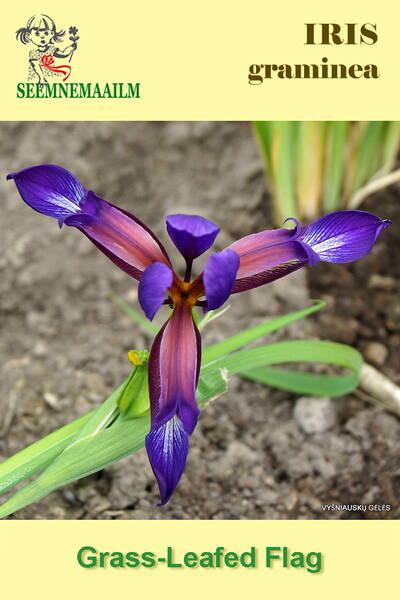
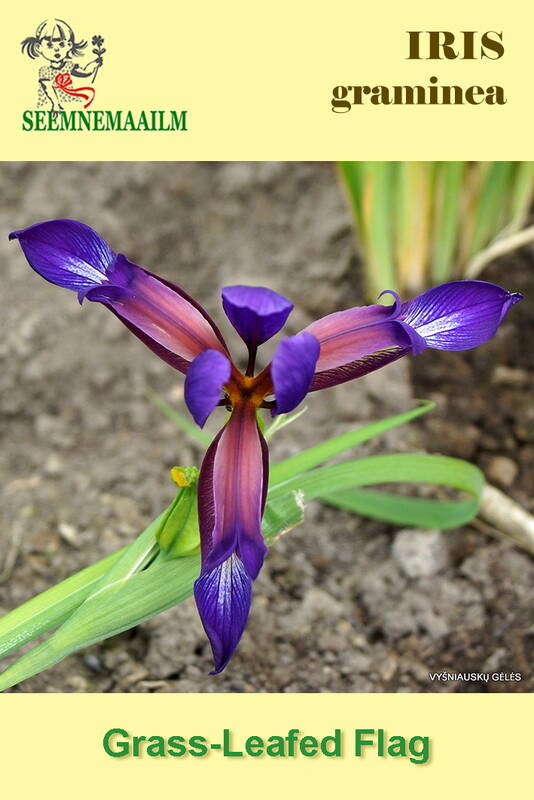
Grass-leaved Flag (Plum Iris) - Iris graminea.
A fragrant perennial from the Iris family (Iridaceae).
Origin: from South-Western Europe to the Caucasus (meadows, open woodlands).
Height of flowering plant: 40 cm. Leaves up to 50-60 cm long, grass-like, dark green.
Flower stalk 20-25 cm tall, significantly shorter than the leaves, ending with 1-2 large purple-crimson flowers. The flowers seem to "peek out" from behind the leaves.
Natural flowering period: May - June. Retains its decorative appeal after flowering. Quite drought-tolerant.
Hardiness zones: Z5 - Z9.
Foliage: herbaceous, linear, longer than the inflorescences, with prominent veins, green.
Soil requirements: average.
Use: for rock gardens.
Distinction: The Royal Horticultural Society's Award of Garden Merit (A.G.M.).
Seed sowing: preliminary stratification is required.
Seed stratification is a method of pre-sowing seed treatment to accelerate germination. It is used mainly for hard-to-germinate seeds of woody (fruit, forest, ornamental) species and some medicinal plants. The seeds are layered with a moist substrate (sand, sawdust, peat chips, moss), and then kept at a low temperature (+1+5 °C, for example in the bottom tray of a refrigerator) with free air access. For 1 part seeds, take 3-4 parts substrate. Stratification lasts from one to several months.
A fragrant perennial from the Iris family (Iridaceae).
Origin: from South-Western Europe to the Caucasus (meadows, open woodlands).
Height of flowering plant: 40 cm. Leaves up to 50-60 cm long, grass-like, dark green.
Flower stalk 20-25 cm tall, significantly shorter than the leaves, ending with 1-2 large purple-crimson flowers. The flowers seem to "peek out" from behind the leaves.
Natural flowering period: May - June. Retains its decorative appeal after flowering. Quite drought-tolerant.
Hardiness zones: Z5 - Z9.
Foliage: herbaceous, linear, longer than the inflorescences, with prominent veins, green.
Soil requirements: average.
Use: for rock gardens.
Distinction: The Royal Horticultural Society's Award of Garden Merit (A.G.M.).
Seed sowing: preliminary stratification is required.
Seed stratification is a method of pre-sowing seed treatment to accelerate germination. It is used mainly for hard-to-germinate seeds of woody (fruit, forest, ornamental) species and some medicinal plants. The seeds are layered with a moist substrate (sand, sawdust, peat chips, moss), and then kept at a low temperature (+1+5 °C, for example in the bottom tray of a refrigerator) with free air access. For 1 part seeds, take 3-4 parts substrate. Stratification lasts from one to several months.