


Your shopping cart is empty!
Hot pepper "Bhut Jolokia"
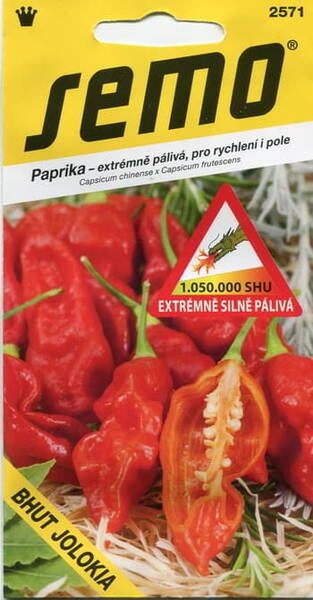

Hot Pepper "Bhut Jolokia" (1 050 000 SHU).
A super-hot pepper that rivals the legendary "Habanero" in spiciness!
A perennial shrub – an excellent plant for container or pot culture.
The plant is 0.8-1.2 m tall, branched with elongated lanceolate leaves.
Fruits – 10-12 cm long, up to 1-1.5 cm wide, on a long stalk, slightly curved pods, often with folds and wrinkles.
The walls of the fruit are thin. In technical ripeness, the fruit is green, and in biological ripeness, it is red.
A super-hot pepper that rivals the legendary "Habanero" in spiciness!
A perennial shrub – an excellent plant for container or pot culture.
The plant is 0.8-1.2 m tall, branched with elongated lanceolate leaves.
Fruits – 10-12 cm long, up to 1-1.5 cm wide, on a long stalk, slightly curved pods, often with folds and wrinkles.
The walls of the fruit are thin. In technical ripeness, the fruit is green, and in biological ripeness, it is red.
* Scoville Scale.
Wilbur Lincoln Scoville (1865-1942).
A famous American pharmacist, Doctor of Science at Columbia University in 1929, who created the "Scoville Scale". He worked at the pharmaceutical company "Parke Davis" in Detroit. It was here in 1912 that he conducted tests to determine the pungency of various pepper varieties. Today the enterprise belongs to one of the largest corporations in the world – "Pfizer", but at that time it was a very large and oldest drug manufacturer in the USA.
In 1920, Wilbur Scoville proposed the organoleptic test (Scoville Organoleptic Test), in which the pungency of a pepper sample is evaluated in special units – Scoville Heat Units (SHU).
This test was originally aimed at measuring the level of capsaicin - precisely the element that is directly "responsible" for the burning taste of red pepper.
In black pepper, another component is responsible for pungency - piperine.
In general, pure capsaicin (8-methyl-n-vanillyl-6-nonenamide) is a colorless crystalline powder that is soluble in alcohol and insoluble in cold water. It can be used in medicine (various warming ointments, tinctures, patches), as well as in the production of weapons for self-defense (pepper sprays, pistols). One kilogram of pure capsaicin costs about 5000 Euros.
In its pure form, it can be very dangerous for humans, since even 1.0 mg placed on a person's hand causes pain like from hot iron, after which the skin immediately becomes covered with blisters...
Experiments on animals have shown that the lethal dose when consuming capsaicin is 100 mg/kg (for mice). However, in a human weighing 60 kg, death can occur only by quickly eating almost 2 kg of hot pepper... (which is practically impossible).
In order to determine the capsaicin content organoleptically, Scoville first dissolved a precisely measured amount of a specific pepper sample in alcohol, after which he divided the prepared solution into 5 portions and called 5 experimenters. For each of them, certain portions of sweetened water were gradually added to the issued portion of the alcohol solution and given to the tasters to try. (Water was added until 3 out of 5 experimenters stopped feeling the spicy taste, then the test was considered finished).
Then the results were calculated: if, in order for the burning taste to disappear, it was required to add 1000 parts of water to one part of the alcohol solution sample, then such a pepper variety was assigned an activity of 1000 SHU.
Subsequently, the Scoville Scale was standardized taking into account the presence of pure capsaicin, determined by more precise methods (currently - chromatographic): 6.6% pure capsaicin corresponds to 1 million SHU, and 100% - 16 million SHU.
Scoville and his followers empirically obtained pungency values for the main pepper varieties and as a result, the modern "Scoville table" by "pungency" rating looks like this:
15 000 000 - 16 000 000 Pure Capsaicin
9 100 000 - 15 000 000 Capsaicinoids: dihydrocapsaicin, nordihydrocapsaicin, etc.
2 000 000 - 5 300 000 Pepper Sprays (USA)
1 200 000 - 1 460 000 Trinidad Scorpion Butch T
855 000 - 1 041 427 Bhut Jolokia, Naga Jolokia
876 000 - 970 000 Dorset Naga, Tezpur
350 000 - 577 000 Red Savina Habanero
100 000 - 350 000 Habanero Chile, Madame Janette
100 000 - 350 000 South American chinenses, African birdseye
100 000 - 200 000 Jamaican Hot Pepper
50 000 - 10 000 Birds Eye, Thai Pepper, Malagueta Pepper, Chiltepin Pepper, Tepin, Chinese kwangsi
30 000 - 50 000 Capsicum Frutescens, Aji pepper, Tabasco pepper, Piquin, Pakistan dundicut
10 000 - 25 000 Serrano pepper, de Arbol, Crushed Red Pepper, High Grade Coral Red Pepper
7 000 - 8 000 Tabasco Sauce (Habanero)
5 000 - 10 000 Wax Pepper, Early Jalapeño
2 500 - 8 000 Jalapeno Pepper
2 500 - 5 000 Tabasco Sauce (Tabasco pepper), Louisiana hot sauce, Pasilla, Mirasol, Chipotle
1 500 - 2 500 Rocotillo Pepper, Sandia, Cascabel, Yellow Wax Hot
1 000 - 1 500 Draky, Anaheim, Poblano Pepper, Mild Jalepeno
600 - 800 Tabasco Sauce (Green Pepper)
500 - 1000 Ancho, Cherry, New Mexico
100 - 500 Pimiento, Pepperoncini, Pickled pepperoncini, Hungarian pepper
0 Sweet paprika (Bell pepper).
* Capsaicin is an alkaloid contained in various species of Capsicum peppers (for example, vegetable pepper fruits contain about 0.03%). Pure capsaicin, or 8-methyl-n-vanillyl-6-nonenamide, is a whitish powder that is soluble in alcohol and insoluble in cold water (which is why drinking water will not help relieve the burning sensation from pepper, since an alcohol-containing liquid is needed: vodka, tequila, or beer).
* Capsaicin is quite unique compared to other spicy substances: this powerful irritant, unlike, for example, mustard oil (zingerone and allyl isothiocyanate), black pepper (piperine), and ginger (gingerol), causes habituation after taking regular low concentration doses, which allows consuming "shockingly peppery" dishes in the future: this effect is caused by the selective degeneration of certain primary sensory neurons and the person simply stops feeling the spiciness...