


Your shopping cart is empty!
Lacy phacelia "Natra" (1000 g)
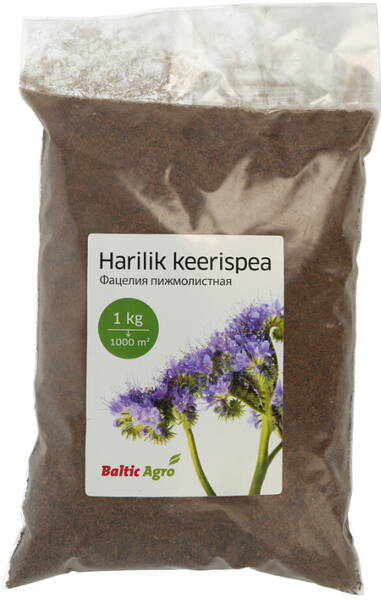
Prof Pack
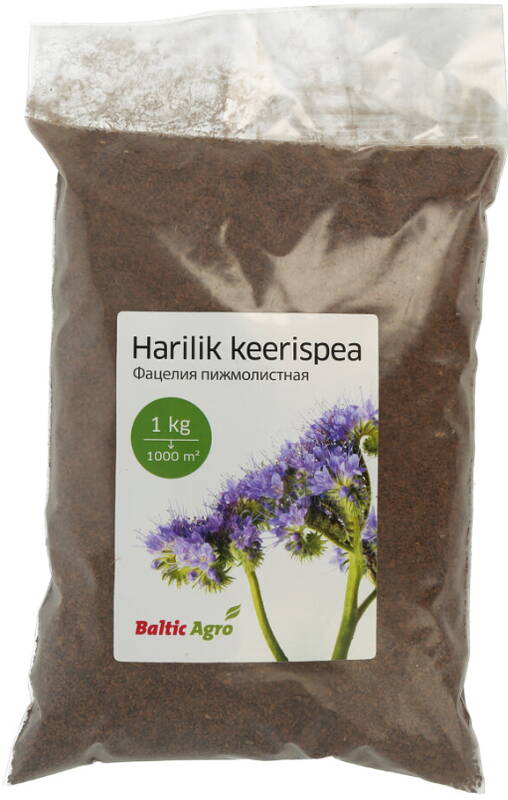
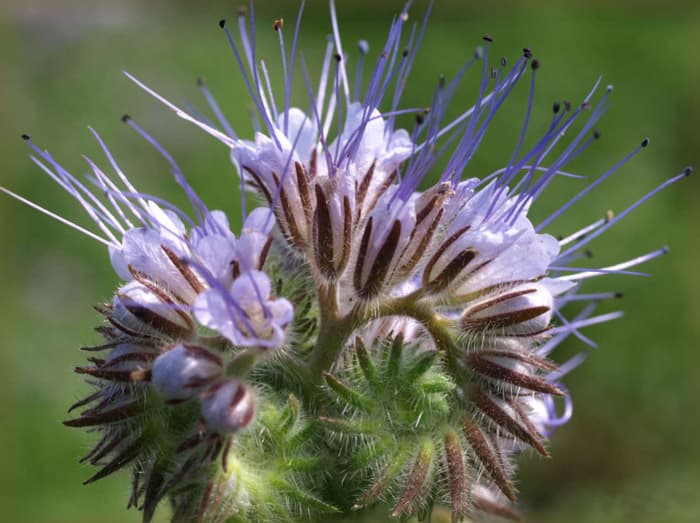
Lacy Phacelia "Natra" - Phacelia tanacetifolia.
1.0 kg = 1000 m2.
An annual plant. Grows to a height of about 60 cm.
An excellent catch crop, ornamental, and honey-bearing plant. Phacelia has no common diseases with the most widespread agricultural crops, and therefore it fits well into crop rotation. As a catch crop, it is grown to increase soil fertility; in addition, it creates strong competition for weeds. The plant has the ability to convert phosphorus, which is indigestible to other plants, into an accessible form. If the seeds are sown after the ripening and harvesting of early main crops, the phacelia will still have time to bloom. However, for the purpose of growing it as a honey plant, the seeds should be sown in the spring. Honey productivity is 150–300 kg/ha. Phacelia honey is valued on a par with linden honey. Phacelia is also grown as an ornamental plant.
Application guide.
Sowing rate is 100–120 g/100 m², when grown for green mass — 150 g/100 m². Sowing is carried out starting from April. Sowing depth is 1–2 cm.
1.0 kg = 1000 m2.
An annual plant. Grows to a height of about 60 cm.
An excellent catch crop, ornamental, and honey-bearing plant. Phacelia has no common diseases with the most widespread agricultural crops, and therefore it fits well into crop rotation. As a catch crop, it is grown to increase soil fertility; in addition, it creates strong competition for weeds. The plant has the ability to convert phosphorus, which is indigestible to other plants, into an accessible form. If the seeds are sown after the ripening and harvesting of early main crops, the phacelia will still have time to bloom. However, for the purpose of growing it as a honey plant, the seeds should be sown in the spring. Honey productivity is 150–300 kg/ha. Phacelia honey is valued on a par with linden honey. Phacelia is also grown as an ornamental plant.
Application guide.
Sowing rate is 100–120 g/100 m², when grown for green mass — 150 g/100 m². Sowing is carried out starting from April. Sowing depth is 1–2 cm.
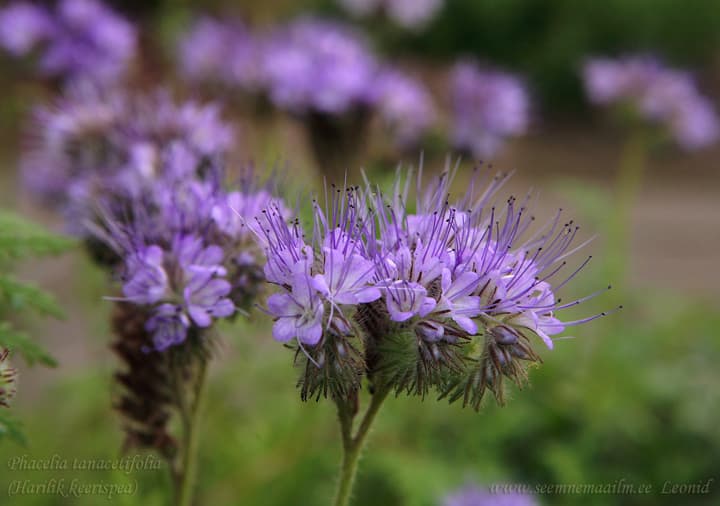
A valuable annual honey, fodder, green manure, and ornamental plant. Belongs to the Hydrophyllaceae family.
Forms a branched stem 30-70 cm high, covered with hairs. Leaves are alternate, sometimes with a bluish tint. In the middle of summer, small blue or pale blue flowers up to 2 cm in diameter are formed. With spring sowing, flowering begins in 35 - 40 days and lasts up to 1.5 months. Phacelia is considered an excellent honey plant.
Each flower lives for 2 days, secreting up to 4 - 5 mg of nectar, which makes high-quality honey. In addition, phacelia is used as a "green manure". It is sown in sunny areas with poor soils. Then the land is plowed, burying the plants entirely, and thus enriching the soil with organic matter. As an ornamental plant, it is used as a background, looks great as a free-standing clump, and goes well with any other flowering plants. The optimal soil temperature for seed germination is +18...+20°C.
The seeding rate is 9-12 kg/ha (1.0 g/m2).
There are 700 seeds in 1 g (after sowing, it is recommended to roll the soil). You can sow phacelia in April or later - at the beginning of each month (from late July to October). In this way, you can get a continuous conveyor of honey-bearing phacelia.
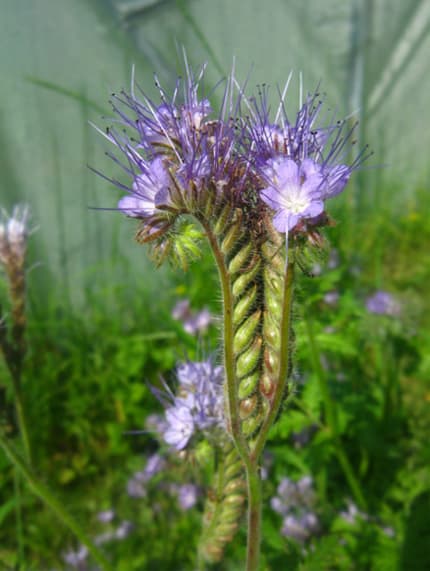
Phacelia can also be used as fodder for livestock, sown in a mixture with cereals and leguminous plants.
Name: derived from the Greek word "phakelos" — a bundle, and is explained by the arrangement of flowers in the inflorescence.
Originally, this plant was cultivated as an agricultural crop. Its flowers are rich in nectar, which produces high-quality honey.
In addition, phacelia was used as a "green manure". It was sown on poor soils illuminated by direct sunlight, since exactly such conditions are suitable for it. Then the land was plowed, burying the plants entirely, and thus enriching the soil with organic matter.
Now this phacelia is grown mainly as an ornamental plant. Its shoots grow to a height of 50-100 cm and in the middle of summer form small flowers up to 2 cm in diameter. Their petals have an indefinite modest bluish-gray color.
Phacelia goes well with any other flowering plants.
* Sowing... fertilizers.
Killing two birds with one stone: we increase soil fertility and destroy weeds. Green manure crops, or, as they are also called, green fertilizers, are grown on the site to improve the soil structure and increase the content of nutrients in it. In addition, green manures are an ecologically clean source of organic matter; they contribute to the accumulation of humus in the soil. In terms of efficiency, these crops are equivalent to manure and are inferior to it only in the content of phosphorus and potassium. If you are just starting to develop a plot or grow mainly annual plants in the garden, then to combat weeds you can use green manures together with classic weeding. They grow very quickly and will compete with weeds. Some green manure crops assimilate mineral nutrition elements from the soil that are hard to reach for many vegetable and fruit plants. Later, during the decomposition of green manures, these elements are "released" and used by cultivated plants.
Plants from the legume family (lupine, peas, vetch, field pea, serradella, clover, sweet clover), from the cabbage family (mustard, rapeseed, oilseed radish) and other fast-growing plants (buckwheat) are suitable for green manure. Leguminous crops assimilate and accumulate nitrogen due to the symbiotic activity of nodule nitrogen-fixing bacteria. Most cruciferous plants have phytosanitary properties: they suppress the development and reproduction of weeds, expel pests such as nematodes and wireworms.
Planting cultivated plants immediately after plowing green manures is undesirable, since active biochemical processes occur in the soil during the decomposition of the vegetative mass, which suppress seed germination and plant growth. Therefore, you will have to wait 2–4 weeks and only then start planting. Dig or plow the earth, loosen it, breaking all the clods, and level it with a rake.
Scatter the seeds of green manure crops manually or using a seeder and slightly level the ground with a rake. So that the green manure does not allow weeds to grow, it is sown not in rows, but broadcast and then embedded with a rake. Approximately 2–4 weeks before planting the main crop, dig the green manures into the soil. If this is difficult to do, you can first cut the green manures by hand and chop them. The above-ground part of green manures is plowed in on light soils to a depth of 15–18 cm, on heavy soils (clay) – by 12-15 cm. Moreover, the younger the plants, the faster their vegetative mass decomposes. In fruit orchards, it is better to use green manures from legumes (lupine) or an oat-pea mixture. Seeds are sown in early spring in near-trunk circles. The green mass of plants is plowed into the soil in the summer before budding begins. After that, you can immediately re-sow green manure crops. With early spring sowing, as soon as the snow melts, early-maturing cold-resistant plants are selected – mustard, oilseed radish, oats. If time permits (for example, with late summer and autumn plantings in the row spacings of the garden), it is best to bring the sowing of green manures to the flowering stage.
When using green manure, take into account this feature as well – do not plant plants from the same family as the green manure crop (for example, cabbage cannot be grown after oilseed radish). This is due to the accumulation in the soil of pathogens or pests characteristic of plants of this family.
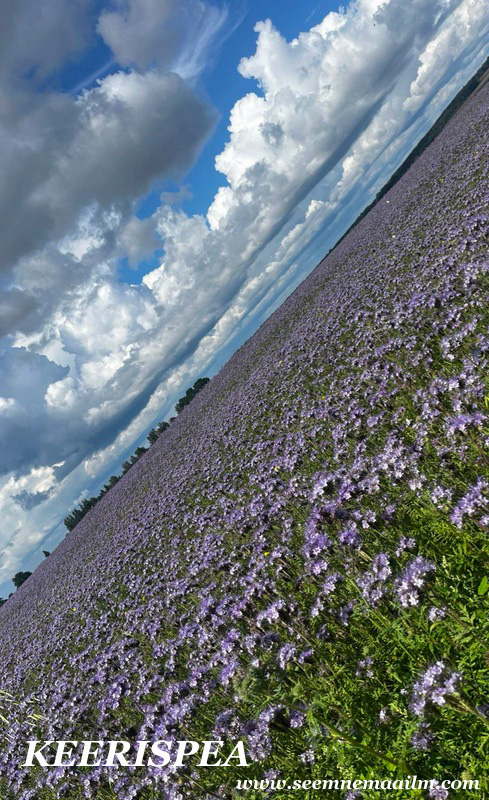
Lacy Phacelia. Phacelia tanacetifolia.