


Your shopping cart is empty!
Lawndaisy "Сhrysanthemum mix" (Common daisy, English daisy, Bruisewort)
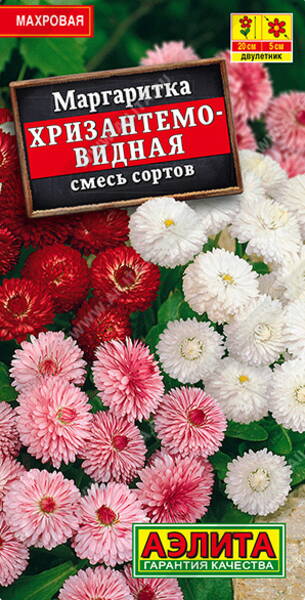
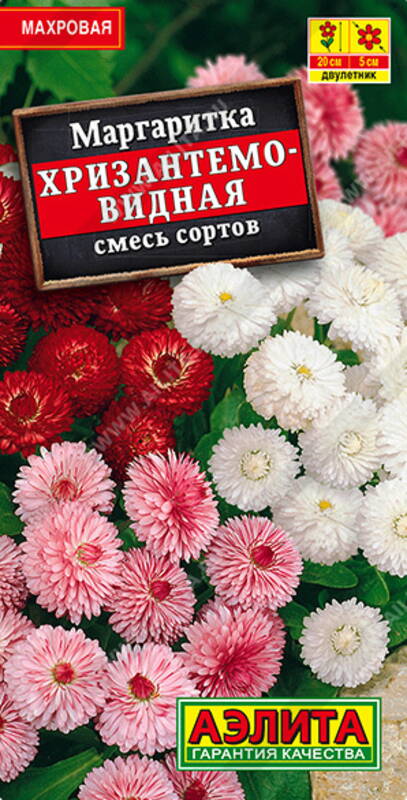
Daisy "Chrysanthemum-flowered" (color mixture) - Bellis perennis.
Double and colorful flowers!
A luxurious mixture of daisies featuring charming, fully double inflorescences 4-5 cm in diameter. The plant forms a compact basal rosette of leaves with sturdy flower stalks 15-20 cm high. Perennial and winter-hardy by nature, in ornamental gardening it is most often successfully used as a biennial. This mix is perfect for container landscaping, creating bright spring borders in the garden, and will magnificently decorate alpine rockeries and low-growing garden flower beds.
Seeds are sown for seedlings in special nursery beds. Uniform emergence occurs in 7-10 days, after which they are carefully thinned out. The grown seedlings should be planted in their permanent location no later than August. The plants are completely unpretentious, cold-resistant, and can grow perfectly even in light shade.
This elegant, highly winter-hardy plant from the Asteraceae family reaches a height of only 15-20 cm.
It blooms abundantly in April-July, and with good care and timely watering, blooming continues right through to autumn (with a short break during the hottest period of the season).
The flower heads, 4-5 cm in diameter, delight the eye with bright white, pink, and red colors. The leaves are gathered in a beautiful, dense rosette.
Daisies grow well in almost any soil. It is a light-loving plant, but it perfectly withstands light shading from trees.
Seeds are sown in late June - early July in the open ground to a depth of no more than 0.5 cm. 1.0 g contains about 7000 small seeds.
The daisy is absolutely perfect for growing in formal flower beds, rock gardens, and borders, as well as in outdoor pots, balcony boxes, and as a magnificent ground cover plant.
Agrotechnics.
It prefers open sunny locations but can grow successfully in partial shade. It grows in any cultivated, well-drained soil without water stagnation. Propagated by sowing seeds in late June – early July in prepared nursery beds. The seeds are only lightly covered with fine soil. At an optimal soil temperature of +18°C, seedlings emerge in 7-14 days. Seedlings are pricked out at the stage of the 1st-2nd pair of true leaves with a 10x10 cm spacing.
In August, the hardened seedlings are planted in their permanent location, maintaining a distance of 20-30 cm between plants.
Double and colorful flowers!
A luxurious mixture of daisies featuring charming, fully double inflorescences 4-5 cm in diameter. The plant forms a compact basal rosette of leaves with sturdy flower stalks 15-20 cm high. Perennial and winter-hardy by nature, in ornamental gardening it is most often successfully used as a biennial. This mix is perfect for container landscaping, creating bright spring borders in the garden, and will magnificently decorate alpine rockeries and low-growing garden flower beds.
Seeds are sown for seedlings in special nursery beds. Uniform emergence occurs in 7-10 days, after which they are carefully thinned out. The grown seedlings should be planted in their permanent location no later than August. The plants are completely unpretentious, cold-resistant, and can grow perfectly even in light shade.
This elegant, highly winter-hardy plant from the Asteraceae family reaches a height of only 15-20 cm.
It blooms abundantly in April-July, and with good care and timely watering, blooming continues right through to autumn (with a short break during the hottest period of the season).
The flower heads, 4-5 cm in diameter, delight the eye with bright white, pink, and red colors. The leaves are gathered in a beautiful, dense rosette.
Daisies grow well in almost any soil. It is a light-loving plant, but it perfectly withstands light shading from trees.
Seeds are sown in late June - early July in the open ground to a depth of no more than 0.5 cm. 1.0 g contains about 7000 small seeds.
The daisy is absolutely perfect for growing in formal flower beds, rock gardens, and borders, as well as in outdoor pots, balcony boxes, and as a magnificent ground cover plant.
Agrotechnics.
It prefers open sunny locations but can grow successfully in partial shade. It grows in any cultivated, well-drained soil without water stagnation. Propagated by sowing seeds in late June – early July in prepared nursery beds. The seeds are only lightly covered with fine soil. At an optimal soil temperature of +18°C, seedlings emerge in 7-14 days. Seedlings are pricked out at the stage of the 1st-2nd pair of true leaves with a 10x10 cm spacing.
In August, the hardened seedlings are planted in their permanent location, maintaining a distance of 20-30 cm between plants.