


Your shopping cart is empty!
Musque pumpkin "Butternut Liscia" (100 g)
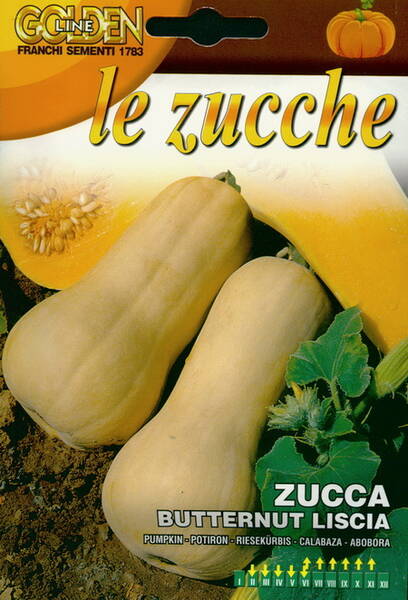
Prof Pack
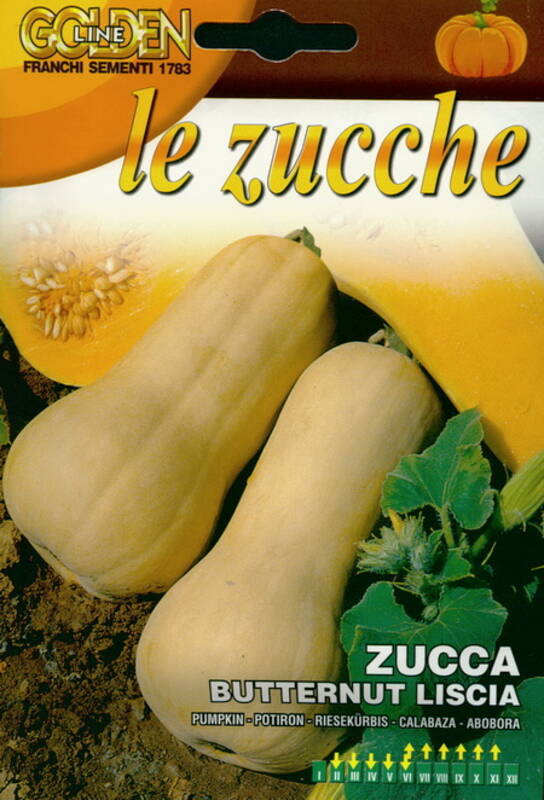
Butternut squash "Butternut Liscia".
Extra-early ripening, delicious and long-storing! Does not cross-pollinate with other pumpkin crops!
Forms a pear-shaped fruit measuring 25x10 cm with an amazing nutty flavor.
The variety is distinguished by a predominance of pulp with a minimal seed chamber.
Extra-early ripening, delicious and long-storing! Does not cross-pollinate with other pumpkin crops!
Forms a pear-shaped fruit measuring 25x10 cm with an amazing nutty flavor.
The variety is distinguished by a predominance of pulp with a minimal seed chamber.
* Waltham Butternut Squash is considered the American champion among squashes for its taste qualities.
Butternut squash named "Waltham" was bred in 1960 at the Massachusetts Agricultural Experiment Station by crossing cultivated butternut squashes with wild African "girlfriends". It turns out that butternut is an extra-early ripening species (85-95 days pass from germination to fruit harvesting), is widely known and grown in Australia, Africa, Europe, Asia, America, and is a source of food for all five continents.
One of the best butternut squashes in the world, with an excellent nutty flavor, sweet, with dense, buttery orange flesh and the ability to be stored all winter on the floor in the hallway. Butternuts appeared in Europe relatively recently and even in the UK are still considered a novelty, which cannot be said about Argentina, from where the fruits of these squashes are exported all over the world. Butternut squash plants grow powerful and with long vines. The number of fruits weighing from 500 g to 1 kg can be quite large – up to 30 small squashes from one plant. However, it is necessary to pick the fruits in a timely manner, since when the seeds ripen in them, the growth of the rest is delayed.
Unripe greenish squashes will later ripen while lying on the floor and acquire a characteristic beige color. You cannot pick one-day-old fruits in milky ripeness for ripening, because they will not be able to ripen.
Of course, it is necessary to grow these squashes in our conditions through seedlings. Seeds are planted in containers in the first decade of May. For the seeds to germinate until emergence, it is necessary to provide heat, keep the pots in a greenhouse with solar heating, or under a lamp or next to a heating radiator (in cold soil, seeds rot from the inside). It is completely unnecessary to soak the seeds. Seedlings are planted in the ground when the threat of frost has finally passed. Some farmers confuse butternut squash with zucchini due to its small size, but on the cut it does not look like zucchini at all.
Butternut is a squash with a thick straight "neck" and a "bulb" at the end, and inside this "bulb" there is a small cavity with seeds. The entire remaining "body" of the fruit is filled with tender orange flesh. By the way, thanks to its orange color, butternut squash is a rich source of antioxidants.
It is easy to guess that there is an unimaginable multitude of recipes for preparing dishes from this squash for vegetable, meat, cereal, pasta dishes, soups, purees, sauces. It is widely used for stuffing. Puddings, cakes, pastries, candied fruits are made from the tender fruits. Finally, it is fried and simply boiled.
The undoubted advantage of growing this variety is that it does not cross-pollinate with the widely distributed large-fruited and hard-barked pumpkins, including zucchini and pattypan squash. Therefore, when obtaining your own seeds from butternut, beware of cross-pollination only with muscat varieties (of which we do not have so many in Estonia, by the way).