


Your shopping cart is empty!
Catnip "Gatto"
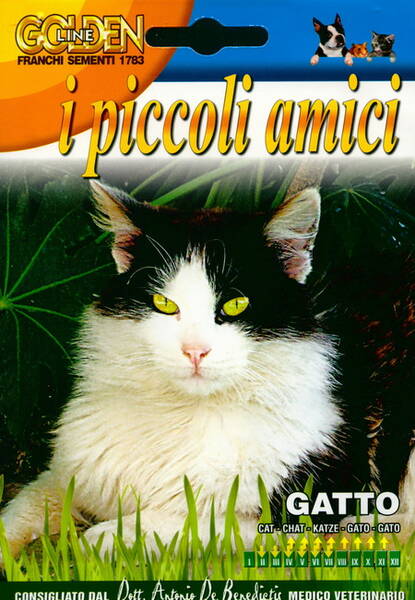

Catnip (Lemon Catnip) — Nepeta cataria = Cataria vulgaris Moench.
Minty lemon on your windowsill! Soothes nerves and delights cats.
This amazing perennial combines the benefits of a medicinal herb with the aroma of an exquisite spice. An upright bush 40-100 cm high with velvety leaves exudes a strong, refreshing lemon-mint aroma with light notes of geranium.
Why grow it?
1. Culinary secret: Fresh and dried leaves are the perfect seasoning for salads, sauces, and marinades. Add a sprig to tea, and you get a fragrant drink that relieves stress and improves sleep.
2. Green pharmacy: Catnip infusions help with migraines, anemia, coughs, and stomach problems. It is a gentle natural sedative.
3. Honey plant and garden friend: Its whitish-blue flowers attract bees and butterflies, bringing life to your garden.
4. Low maintenance: Winter-hardy, requires no covering, and grows in one place for 5-6 years.
Agrotechnics.
Location: Catnip loves the sun and light, loose soil. Important: it does not tolerate stagnant water or heavy clay soils.
Sowing:
* Seedlings: Sow in March-April. Germination occurs in a week, but initially, they grow slowly (forming roots). Prick out at the stage of 2 true leaves. Plant outdoors in May-June.
* Direct sowing: Early spring (when the soil at a depth of 10 cm warms up to +12°C) or before winter (October-November). Seeding depth 0.5-1 cm. For even sowing, mix seeds with sand (1:5).
Care: Weeding and occasional watering. The plant blooms in the first year of life (June-August).
Tip for city dwellers: No garden? Catnip grows beautifully in a pot on a windowsill or balcony, filling your home with the scent of freshness!
Minty lemon on your windowsill! Soothes nerves and delights cats.
This amazing perennial combines the benefits of a medicinal herb with the aroma of an exquisite spice. An upright bush 40-100 cm high with velvety leaves exudes a strong, refreshing lemon-mint aroma with light notes of geranium.
Why grow it?
1. Culinary secret: Fresh and dried leaves are the perfect seasoning for salads, sauces, and marinades. Add a sprig to tea, and you get a fragrant drink that relieves stress and improves sleep.
2. Green pharmacy: Catnip infusions help with migraines, anemia, coughs, and stomach problems. It is a gentle natural sedative.
3. Honey plant and garden friend: Its whitish-blue flowers attract bees and butterflies, bringing life to your garden.
4. Low maintenance: Winter-hardy, requires no covering, and grows in one place for 5-6 years.
Agrotechnics.
Location: Catnip loves the sun and light, loose soil. Important: it does not tolerate stagnant water or heavy clay soils.
Sowing:
* Seedlings: Sow in March-April. Germination occurs in a week, but initially, they grow slowly (forming roots). Prick out at the stage of 2 true leaves. Plant outdoors in May-June.
* Direct sowing: Early spring (when the soil at a depth of 10 cm warms up to +12°C) or before winter (October-November). Seeding depth 0.5-1 cm. For even sowing, mix seeds with sand (1:5).
Care: Weeding and occasional watering. The plant blooms in the first year of life (June-August).
Tip for city dwellers: No garden? Catnip grows beautifully in a pot on a windowsill or balcony, filling your home with the scent of freshness!
Family: Lamiaceae.
Distribution: All regions except the Arctic.
Habitat: Wastelands, forest clearings, slopes, weedy places, along roadsides. Culinary use: Leaves and stem tips as a spice and tea substitute.
Harvest time: The entire growing season.
More than 250 species of catnip inhabit the Northern Hemisphere, reaching their greatest diversity in Europe, Asia, and North Africa. These are strongly scented perennial herbaceous plants with a classic "nettle-like" appearance — upright stems, green or grey-green leaves, and white, blue, or pink flowers gathered in whorls.
Many catnips (and especially Nepeta cataria) contain an essential oil whose strong, distinctive lemon scent attracts cats. This is reflected in its name in many languages.
Botanical Description:
Catnip is a fairly large perennial plant with a woody branching root. The stem reaches a height of 40-100 cm; it is strong, upright, and fuzzy. The leaves are triangular-ovate with a heart-shaped base, pointed, coarsely toothed, and also pubescent. The flowers are in dense compound cymes collected at the ends of the stem and branches in the form of a raceme; the corolla is dirty white with purple or violet speckles on the lower lip. The plant blooms in June-July.
The "Cat" Effect:
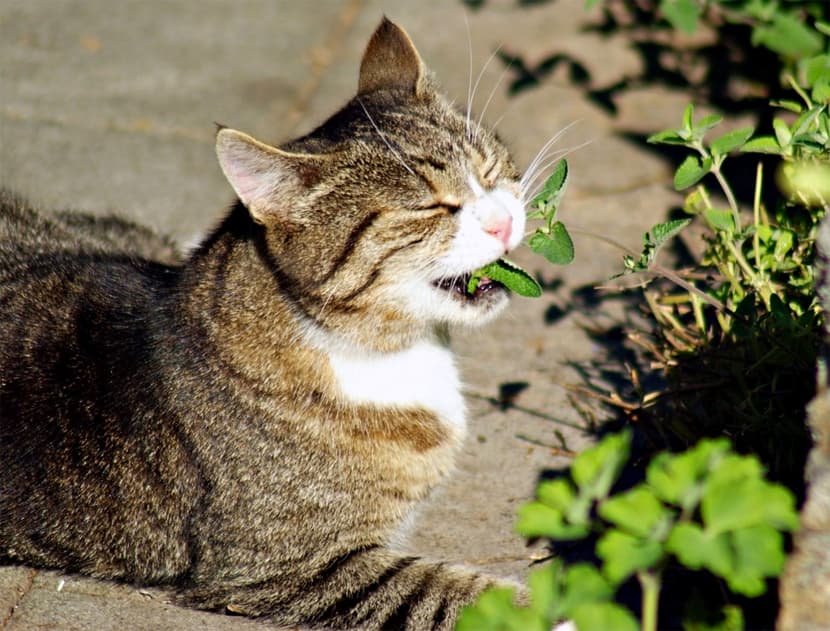
Cats go crazy for catnip just like they do for valerian, falling into unbridled euphoria. The reaction manifests as follows: the animal starts to frenzy, licks and bites the plant, shakes its head, twitches convulsively, purrs loudly, and rolls on the ground. After about 10 minutes, the cat returns to normal.
Historical Fact:
In the 1960s, when there was an active fight against hemp in the USA and other countries, catnip was sometimes used as a mild hallucinogen substitute for marijuana or as a filter filler when smoking it, with somewhat similar effects. Since catnip herb burns out quickly when smoked, it was mixed with tobacco. More intense visual and auditory hallucinations were reportedly achieved by spraying tobacco with an alcohol extract of catnip. With the partial or full legalization of marijuana in many places, catnip faded into the background and ceased to be used for this purpose, as its effect is significantly weaker.
Culinary Uses:
In Europe and Eastern countries, the plant is used as a spice. Essential oil with a strong lemon scent is used in the production of confectionery, in the perfume industry, and in soap making.
Catnip is collected and grown as a spicy plant ("catmint") with the aroma of geranium, rose, and lemon: fresh leaves are put in salads, dry leaves and inflorescences — in meat and fish dishes, added to sauces, tea, and vinegar for flavoring.
You can use catnip for canning — it is perfect for zucchini, tomatoes, and squash, as well as for pumpkin or apple puree, and jam made from chokeberry (aronia) or shadberry (amelanchier). In principle, most recipes cited for germander (Teucrium) are also suitable for catnip.
* Apple Jam-Sauce with Catnip.
Wash the catnip leaves and place them in boiling water. Cover with a lid and let boil for 5 minutes, then turn off the heat and let it steep. Meanwhile, wash and cut the apples into small pieces (do not peel the apples and do not remove the core!).
Strain the catnip broth, squeeze the leaves out, and discard them. Pour the broth over the apples, bring to a boil, and cook, stirring, for 20 minutes (until pureed). Rub the hot puree through a sieve, add sugar, and a little water if necessary. Bring to a boil again, pour into hot sterilized jars, and seal. Don't be confused: the puree will have a slightly greenish tint.
This puree can be used as jam or as a sauce for pork and duck. In the latter case, you can slightly reduce the amount of sugar and add grated fresh ginger or horseradish.
The sauce can be prepared more simply. To do this, boil the apples in water directly with the catnip placed in a cloth bag, which is then removed. The scent will be stronger with this approach.
Apples - 2 kg, fresh catnip leaves - 70 g, water - 1 L, sugar - 1.2 kg.
* Tea with Fireweed (Ivan-chai) and Catnip.
Pour a glass of boiling water over 1 tablespoon of a mixture of catnip and Fireweed (Ivan-chai) and let it steep for 5-10 minutes.
Fireweed (Ivan-chai) - 1 part, catnip - 1 part.