


Your shopping cart is empty!
Sweet pepper "Lungy" F1
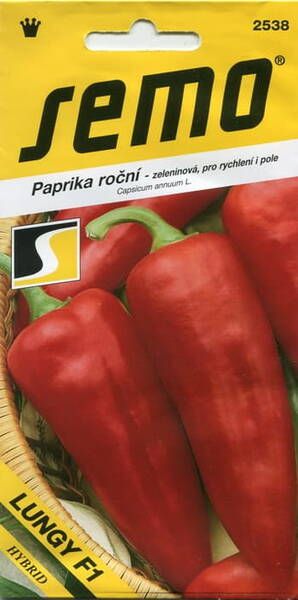

Sweet pepper "Lungy" F1.
An extra-early sweet pepper hybrid with good resistance to diseases and stressful growing conditions.
Fruits are broad, conical; green at technical maturity and dark red at full maturity.
Suitable for harvest at both technical and biological maturity stages.
Recommended for open field, plastic tunnels and glass greenhouses.
Excellent for the fresh market and processing thanks to thick walls and uniform shape.
An extra-early sweet pepper hybrid with good resistance to diseases and stressful growing conditions.
Fruits are broad, conical; green at technical maturity and dark red at full maturity.
Suitable for harvest at both technical and biological maturity stages.
Recommended for open field, plastic tunnels and glass greenhouses.
Excellent for the fresh market and processing thanks to thick walls and uniform shape.
* Sweet pepper is one of the most in-demand vegetable crops. How can you get a maximum yield in an unheated film greenhouse?
RAISING SEEDLINGS.
When growing sweet pepper in unheated film greenhouses, sow seeds for seedlings in mid-March and transplant into the greenhouse in late May.
Sowing.
It is recommended to sow into plastic trays or “nutrient cubes”. This keeps the root ball intact during transplanting, reduces plant stress, and saves seed.
Sow seeds 1 cm deep. Cover with plastic film to prevent the topsoil from drying out. Remove the cover when the first seedlings appear.
Optimal conditions.
For fast, even germination and emergence in 5–7 days, keep the temperature at +25…+30°C. (At +13…+15°C, seedlings appear only 18–25 days after sowing, sometimes later.) For the first 3–4 days after emergence, lower the temperature to +18°C; then maintain about +25°C. Substrate moisture during seedling production should be 75–80% of field capacity.
Potting-on.
In plastic trays (3×3×3 or 4×4×4 cm), seedlings grow 15–20 days until the first true leaf, then they are transplanted into larger pots (10×10×10 cm). After leaves close, space plants out to 20–25 plants/m² until planting out.
Raising with pricking out.
For pricked-out seedlings, sow in rows in trays with 3–4 cm between rows. After 20–25 days, at 1–2 true leaves, prick out into 8×10 or 10×10 cm pots.
Fertilizing.
Pepper responds well to feeding. Feed seedlings 2–3 times at 10–12 day intervals. The first feed is at the 2 true-leaf stage (when pricking out, not earlier than 10–15 days after pricking). The fertilizer solution concentration must not exceed 0.5%.
Hardening.
To improve establishment, harden seedlings 2–3 weeks before planting: reduce watering and lower temperatures to +20…+22°C by day and +16…+18°C at night.
PLANTING IN GREENHOUSES.
Plant seedlings at 50–60 days old. By then plants are 30–35 cm tall with 15–18 leaves and open flowers. Water well before planting.
Recommended spacing: (80+40)×30–35 cm, (80+60)×30–35 cm or (100+60)×30–35 cm. Aim for an even distribution of 3–4 plants per m².
PLANT CARE.
Temperature.
After planting, adjust temperature based on light levels and plant age.
Before fruiting, on bright sunny days, maintain 24…28°C. At 30…35°C, plants are stressed, dry matter accumulation decreases, and buds may drop (this also happens when temperatures fall to 15°C or lower). In cloudy weather, reduce to 20…22°C by day and 17…19°C at night.
During fruiting: 24…30°C on sunny days, 20…22°C on cloudy days, and 18…20°C at night.
Optimal soil temperature is 20°C. Higher soil temperatures can promote excessive leaf growth while delaying a strong root system and reducing fruit set. Young plants are especially sensitive to soil temperature.
Soil and air humidity.
Soil moisture is crucial. With good water supply, plants tolerate heat better, yield increases, and fruit quality improves (vitamin C, sugars, etc.). Pepper has a relatively weak root system and is sensitive to high salt concentration, so water frequently but not excessively (otherwise blossom-end rot may occur). Water best in the morning, at the root, not by overhead watering. Optimal soil moisture: 75% before fruiting and 80% during fruiting. Irregular watering during fruiting may cause fruit cracking.
Relative humidity in the greenhouse should not exceed 65–77%. At higher humidity, pollen becomes less viable and flowers and ovaries may drop.
Fertilizing.
Feed every 2 weeks; the first feeding is 15 days after seedlings have rooted. Organic feeds have a very positive effect. Use mullein diluted 1:10 with superphosphate added (20–30 g per 10 L). Apply up to 5 L of solution per 1 m².
Training.
Train plants as they grow. The main stem develops first; after 10–12 leaves (depending on hybrid and light), 2–4 first-order side shoots form. Leave the two strongest shoots to form the plant “framework” and pinch the rest. Tie the main shoots to the trellis with twine.
As shoots branch into “forks”, in each fork keep the strongest shoot as the main one; pinch the weaker opposite shoot above the first leaf. Repeat this for subsequent forks.
Remove the first flower (the “crown bud”); otherwise growth may slow and yield can decrease.
During flowering, gently shake plants daily for better pollination; bumblebees can also be used.
HARVEST.
Harvest as fruits mature (1–2 times per week). Fruits can be picked at technical maturity (green) or full maturity (red, yellow, orange).
Sweet pepper is rich in vitamins and is considered a multivitamin food. By vitamin C content it surpasses most cultivated vegetables and fruits, except blackcurrant and rosehip (up to 400 mg%). Fruits are also rich in P-active compounds, carotene and B vitamins. To meet daily needs for vitamin C and P-active compounds, 20–50 g of pepper fruit is enough.
TABBOULEH SALAD (recipe from Lebanon).
Bulgur 1 cup
Sweet pepper 1 pc (large)
Cucumber 1 pc
Tomatoes 2 pcs (medium)
Fresh herbs (dill, parsley, cilantro, etc.) to taste
Olive oil 2 tbsp
Lemon juice 1/2 tsp
Salt and ground black pepper to taste.
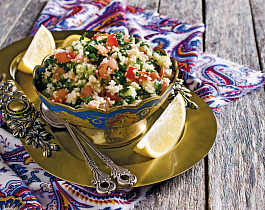
1. Rinse the bulgur thoroughly, changing the water several times until it runs clear.
2. Cook bulgur in water (1 part bulgur to 2 parts water). After boiling, salt to taste and simmer for about 20 minutes. Add olive oil, mix well and let cool.
3. Wash vegetables and dice them. Drain excess juice.
4. Wash, dry and chop the herbs.
5. Combine everything in a bowl. Season with olive oil, lemon juice, salt and ground black pepper to taste.