


Your shopping cart is empty!
Petunia "Gioconda Dark Pink" F1
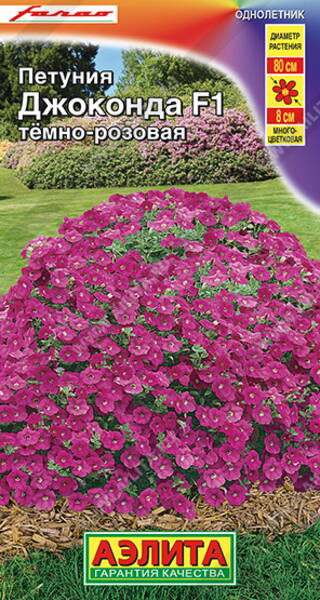
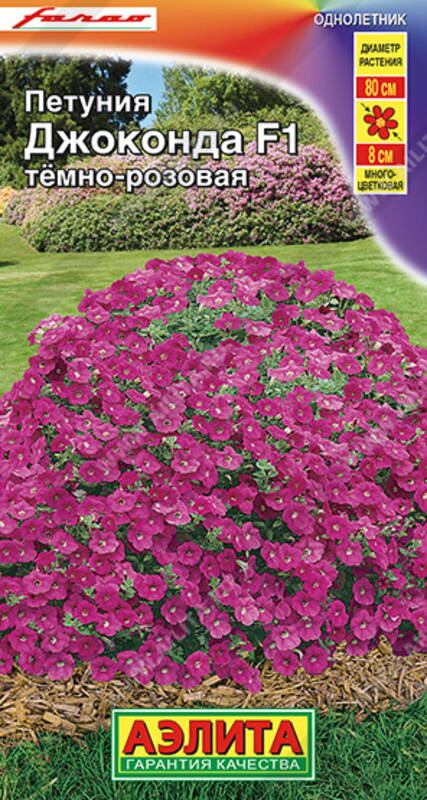
Petunia "Gioconda Dark Pink" F1 - Petunia multiflora.
A breakthrough in breeding: a petunia that can bloom all year round!
Multiflora trailing cascade petunia.
A petunia of Italian breeding by the "Farao" company with unsurpassed characteristics. Thanks to the male sterility gene, it produces a staggering number of flowers and blooms continuously from spring to late autumn.
Flowers with a spectacular "star" pattern are not damaged by rain and wind. The Gioconda series petunia is a serious competitor to surfinias, which can only be propagated vegetatively. It will decorate flower beds, borders, hanging baskets, and garden vases.
Height 20 cm. Flower diameter 6-8 cm. Length of the plant 80-100 cm.
Gioconda is the world's first petunia that produces a staggering number of flowers due to male sterility (does not produce seeds), which creates competition for petunias and surfinias that reproduce by cuttings. Plants with incredibly powerful branching shoots (covering the soil up to 1 meter in diameter, at a height of 20 cm), are covered with a huge number of flowers. When grown in pots, the shoots cascade over the edges.
Gioconda petunia is able to adapt to a wide range of temperatures – from +8 to +40°C. When the temperature drops, the plants do not die, but only slow down growth and flowering.
By maintaining optimal growing conditions (11-hour daylight and temperature +20...+22°C), you can keep the plants blooming all year round, which provides new opportunities in decorative landscaping.
Ideal for greenhouse seedling production: plants are uniform, very strong, and, most importantly, flowering begins at an early stage. Ideal for growing in pots, hanging baskets, and in the open ground.
Sowing: seeds in pelleted form!
In order to facilitate the sowing and cultivation of small-seeded crops, a system was developed to coat each seed with a special compound. When moisture hits the pellet – the shell crumbles. Sow in February-March for seedlings. The pellets are placed on the surface of slightly compacted and moistened soil without embedding them, moistened from a sprayer, covered with glass and kept at a temperature of +20...+24°C, preventing the pellet shell and compost from drying out until the seedlings germinate, and periodically removing condensation drops from the glass surface. Seedlings appear only in the light (excluding direct sunlight) on the 10-15th day. After the appearance of the first true leaf, the crops are ventilated. In the future, the glass is removed, gradually reducing the temperature to +14...+16°C. Seedlings do not tolerate high temperatures and waterlogging well. Hardened seedlings are planted in the ground after the end of spring frosts at a distance of 15-20 cm.
Care: grows best in well-lit areas with light, fertile soil. Responds gratefully to watering and regular feeding.
Flowering: from June until frost.
A breakthrough in breeding: a petunia that can bloom all year round!
Multiflora trailing cascade petunia.
A petunia of Italian breeding by the "Farao" company with unsurpassed characteristics. Thanks to the male sterility gene, it produces a staggering number of flowers and blooms continuously from spring to late autumn.
Flowers with a spectacular "star" pattern are not damaged by rain and wind. The Gioconda series petunia is a serious competitor to surfinias, which can only be propagated vegetatively. It will decorate flower beds, borders, hanging baskets, and garden vases.
Height 20 cm. Flower diameter 6-8 cm. Length of the plant 80-100 cm.
Gioconda is the world's first petunia that produces a staggering number of flowers due to male sterility (does not produce seeds), which creates competition for petunias and surfinias that reproduce by cuttings. Plants with incredibly powerful branching shoots (covering the soil up to 1 meter in diameter, at a height of 20 cm), are covered with a huge number of flowers. When grown in pots, the shoots cascade over the edges.
Gioconda petunia is able to adapt to a wide range of temperatures – from +8 to +40°C. When the temperature drops, the plants do not die, but only slow down growth and flowering.
By maintaining optimal growing conditions (11-hour daylight and temperature +20...+22°C), you can keep the plants blooming all year round, which provides new opportunities in decorative landscaping.
Ideal for greenhouse seedling production: plants are uniform, very strong, and, most importantly, flowering begins at an early stage. Ideal for growing in pots, hanging baskets, and in the open ground.
Sowing: seeds in pelleted form!
In order to facilitate the sowing and cultivation of small-seeded crops, a system was developed to coat each seed with a special compound. When moisture hits the pellet – the shell crumbles. Sow in February-March for seedlings. The pellets are placed on the surface of slightly compacted and moistened soil without embedding them, moistened from a sprayer, covered with glass and kept at a temperature of +20...+24°C, preventing the pellet shell and compost from drying out until the seedlings germinate, and periodically removing condensation drops from the glass surface. Seedlings appear only in the light (excluding direct sunlight) on the 10-15th day. After the appearance of the first true leaf, the crops are ventilated. In the future, the glass is removed, gradually reducing the temperature to +14...+16°C. Seedlings do not tolerate high temperatures and waterlogging well. Hardened seedlings are planted in the ground after the end of spring frosts at a distance of 15-20 cm.
Care: grows best in well-lit areas with light, fertile soil. Responds gratefully to watering and regular feeding.
Flowering: from June until frost.
* Petunias have long been known as annual border plants, but in fact, they are best grown in pots where they are less splashed with dirty water.
Most of the varieties sold are hybrids between Petunia axillaris and Petunia integrifolia. Both species are short-lived perennials, and therefore it is better to renew them every year by growing from seeds. Many petunias entering the market today are grown from cuttings. They bloom early, just at the time when customers choose plants for planting in containers. The Cascade group combines petunias for balcony boxes, with trailing stems that cascade over the edges of containers like waterfalls. Some petunias grown from cuttings bear their own names, used as generic names: Surfinia and Fortunia are the most famous among them.
Commercial flower growers have registered them as trademarks. Strictly speaking, you do not even have the right to take cuttings from these plants (!).
There are 12 varieties of the Surfinia group, ranging from white to pink and purple, often with dark veins on the petals. They are rain-resistant and moderately wind-resistant, do not require much sun (although they do not mind good lighting), and need a lot of water and regular feeding. Unfortunately, like other petunias grown from cuttings, these varieties are very susceptible to viruses. An infected plant can transmit the infection to another plant through contacts of leaves, stems, or roots, through infected soil, and at the time of taking cuttings. An infected knife can cause a rapid spread of the disease.
Viral diseases are most common in the following subgroups: Hot Pink, Pastel Pink, Violet Blue, and White.
When buying plants, make sure their leaves are undamaged and uniformly green.
Affected plants have light green spots on their leaves, which eventually become wrinkled and shapeless. The flowers no longer open, and the entire plant can soon die off. If this disease is controlled, petunias grown from cuttings will undoubtedly remain popular. If not, then plants grown from seeds will probably take their place because they are less susceptible to viruses.
Petunias sown in early spring do not bloom until summer. To bring them to the market as early as possible, commercial growers often sow them in autumn and winter, in which case the plants need a lot of light and heat.
It is better for amateur gardeners to sow them indoors between the end of January and the end of March. Sow the seeds in a poor mixture of sand and peat. Cover with glass and keep at a soil temperature of about +20°C. Remove the glass after germination to avoid overheating the seedlings. Grow them in a cooler and brighter place, but not in bright sun. Do not take the seedlings outdoors until the frosts are over. Place them in a wind-protected place, in the sun or partial shade, and make sure that the soil does not dry out and does not become waterlogged. Petunias grown from seeds do not need feeding and will bloom throughout the season more and more abundantly.