


Your shopping cart is empty!
Petunia multiflora "Amore Mio Red" F1
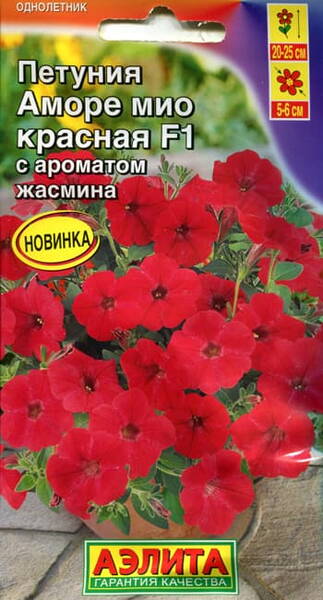
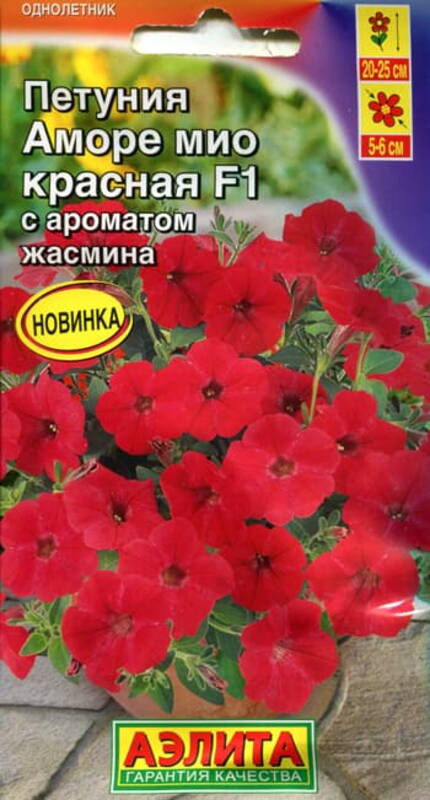
Petunia Multiflora "Amore Mio Red" F1 - Petunia multiflora.
A unique petunia with a light jasmine fragrance.
Blooms continuously and super abundantly from spring to late autumn. The bushes are compact, 20-25 cm high and 40-50 cm wide. No shaping or pinching required. Flowers are 5-6 cm in diameter. Due to the male sterility gene, seeds are not set.
The hybrid is resistant to adverse weather conditions - rain, heat, cold, and highly resistant to gray mold.
Agrotechnics.
Seeds in granules! Sowing is superficial, without embedding (seeds germinate in the light!), under glass or film to maintain constant humidity until full germination. The granules must dissolve when sowing!
Sowing seeds for seedlings is carried out in February-March. The seeds are slightly pressed into the soil, not sprinkled with earth. The planting container is covered with glass and placed in a lighted place. At a soil temperature of +18+20°C, seedlings appear on the 14-20th day. Seedlings are pricked in the phase of 2 true leaves. Seedlings are planted in open ground after the end of spring frosts.
Location: light-loving and heat-loving. It grows well in open sunny places. Large-flowered petunias are more heat-loving than small-flowered ones, and stop blooming in damp, cold weather.
Soil: prefers loamy or sandy loamy soils, but can grow on any sufficiently fertile soil.
Care: drought-resistant, but requires watering in the prolonged absence of moisture. Tolerates strong soil moisture, but suffers from stagnant water. Large-flowered forms are more demanding on heat, moisture and nutrition conditions than small-flowered ones.
Top dressing is the main condition for abundant and prolonged flowering of petunias, therefore, plants are fed regularly, starting a week after planting and until August with an interval of 7-10 days. Abundant flowering of petunias is provided by complete complex fertilizers, especially with a predominance of potassium. Regular feeding continues until the end of flowering.
A unique petunia with a light jasmine fragrance.
Blooms continuously and super abundantly from spring to late autumn. The bushes are compact, 20-25 cm high and 40-50 cm wide. No shaping or pinching required. Flowers are 5-6 cm in diameter. Due to the male sterility gene, seeds are not set.
The hybrid is resistant to adverse weather conditions - rain, heat, cold, and highly resistant to gray mold.
Agrotechnics.
Seeds in granules! Sowing is superficial, without embedding (seeds germinate in the light!), under glass or film to maintain constant humidity until full germination. The granules must dissolve when sowing!
Sowing seeds for seedlings is carried out in February-March. The seeds are slightly pressed into the soil, not sprinkled with earth. The planting container is covered with glass and placed in a lighted place. At a soil temperature of +18+20°C, seedlings appear on the 14-20th day. Seedlings are pricked in the phase of 2 true leaves. Seedlings are planted in open ground after the end of spring frosts.
Location: light-loving and heat-loving. It grows well in open sunny places. Large-flowered petunias are more heat-loving than small-flowered ones, and stop blooming in damp, cold weather.
Soil: prefers loamy or sandy loamy soils, but can grow on any sufficiently fertile soil.
Care: drought-resistant, but requires watering in the prolonged absence of moisture. Tolerates strong soil moisture, but suffers from stagnant water. Large-flowered forms are more demanding on heat, moisture and nutrition conditions than small-flowered ones.
Top dressing is the main condition for abundant and prolonged flowering of petunias, therefore, plants are fed regularly, starting a week after planting and until August with an interval of 7-10 days. Abundant flowering of petunias is provided by complete complex fertilizers, especially with a predominance of potassium. Regular feeding continues until the end of flowering.