


Your shopping cart is empty!
Evergreen Boxwood
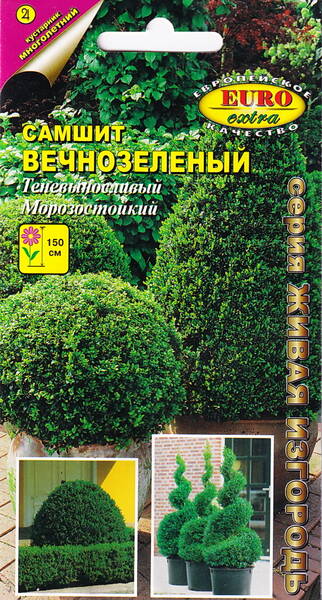
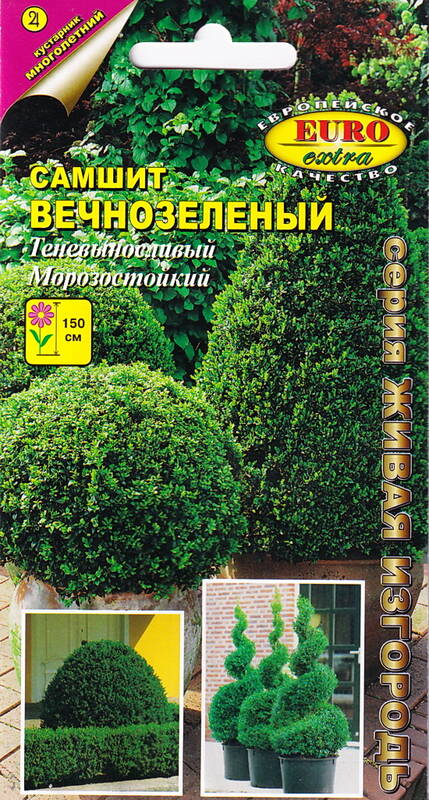
Evergreen Boxwood (Common Box) - Buxus sempervirens.
Name: Derived from the ancient Greek word "pyxos" — meaning dense.
Widely distributed in the Mediterranean region, extending into the Caucasus, where it grows wild in the undergrowth of mixed and deciduous forests, tolerating even dense shade perfectly.
The shrub is highly resistant to pests and diseases. Please be cautious: all parts of the plant, especially the leaves, are POISONOUS!
In regions with a mild temperate climate, evergreen boxwood can grow to 2 meters or more, showing off its gorgeous bright green attire all year round. However, in harsher conditions, the size of this shrub is strictly determined by the height of the protective snow cover. Boxwood is reasonably resistant to winter cold, but like any evergreen crop, it suffers greatly and sometimes dies from drying winter winds and scorching spring sun, which can completely destroy the plant in just a few clear days. This is the main reason for failure when novice gardeners try to grow this shrub. Young, poorly rooted plantings require special attention.
Location: Boxwood feels great in shady and semi-shady places, but it also grows beautifully in bright summer sun, provided the plants are shaded during the winter-spring period.
Soil: It is surprisingly undemanding regarding soil but develops best in well-fertilized, loose soils, where it shows vigorous growth. On poor soils, it produces short but very densely foliated shoots, which are ideal for topiary clipping. It prefers calcareous (limestone) soils.
Care: The most difficult period in cultivating this shrub is a long, lingering winter with alternating severe frosts and thaws, as well as the transition from cloudy days to bright, sunny ones. Evergreen plants are most vulnerable during this period because their root system is still dormant (in frozen ground), while the above-ground part wakes up with the first bright sun. As a result, the leaves and woody shoots actively evaporate moisture but do not receive it from the roots, causing them to dry out. Plants located in shady places or under reliable snow cover practically do not suffer.
In autumn, right before the frosts set in (usually in early November), a very heavy water-recharging irrigation is carried out, saturating the plants with life-giving moisture for the long winter period. It is advisable to mulch the soil under the bushes with peat or rotted pine needles. Dry autumn leaves are absolutely unsuitable for this, as in mild, wet winters they cause dangerous rotting of the plants, rapid development of fungal diseases, and leaf drop. After that, with the onset of a steady cooling to -10°C, protective shading begins. Small spherical forms are completely covered with wooden or plastic boxes with mandatory ventilation holes. Iron buckets should not be used: they cool down drastically in winter and heat up like a frying pan in the spring sun, which can literally "roast" the plant. Standard trees (trained with a single trunk) must be tied to sturdy supports to protect them from breaking under the weight of wet snow, and fully wrapped with spruce branches or thick non-woven fabric. Well-lignified trunks can be whitewashed like fruit trees, in which case trunk covering is not needed. Borders and low hedges are covered with 2-3 layers of non-woven fabric or burlap, securing them carefully. To prevent branches from breaking apart, the bushes sometimes need to be gently tied with twine. With the onset of warm spring weather, the covers are removed; otherwise, the plants will rot. It is advisable to loosen or completely remove the remaining snow from the bushes so the sun can warm the soil faster — then the awakened roots will start supplying moisture to the green leaves earlier. Covers are removed exclusively in cloudy weather, leaving a few spruce branches or a single light layer of non-woven fabric on the plants for adaptation. After another 7-10 days, the plants are completely freed from the cover.
Pruning: In regions with a mild climate, boxwood spheres and other shaped bushes are clipped for the first time as early as April. In harsher conditions, it is wiser to wait until early May. Since boxwood grows very slowly, you should always limit yourself to a light correction of the crown, trimming only the new growth. Cutting back to old, hard wood should only be done in extreme cases if the plant has completely lost its shape. Boxwood can also be grown as an elegant standard tree. To do this, select young plants that naturally have a strong central shoot, cut off all lower lateral shoots flush with the trunk to the desired level, and slightly shorten the remaining ones at the top. This forces the top to branch well, and over time (though it will take years of patience), you will have a cute green sphere on a slender stem.
Propagation: Mostly vegetatively — by summer and autumn cuttings. Between 80 and 100% of cuttings root successfully. The timing for summer cuttings is determined by the physiological state of the young shoots: they must be slightly lignified at the very base, which usually happens in the last ten days of June to mid-July. Autumn cuttings are taken in late August to early September. The optimal length of cuttings is 5-10 cm (about 2-3 internodes). Leave the top two leaves on the cutting and carefully remove the lower ones. Make the cuts immediately below the first internode and above the last one. Then plant the cuttings in a loose substrate of a 1:1 mixture of peat and garden soil and cover them with glass jars or plastic film to create a greenhouse effect. With regular watering every other day or daily (in a wet summer, you can rely on natural rainfall), the cuttings root in about 3 weeks. Then the young plants are transplanted to a nursery bed to grow on, using a 10x10 cm spacing. By autumn, they form neat, branching bushes suitable for transplanting to a permanent location. Sometimes, especially if cutting is done very late, root formation slows down. In this case, some plants can be potted and placed on a cool windowsill indoors, where they safely spend the winter. Cuttings left in the ground are reliably covered for the winter with spruce branches and other insulating materials. In spring, they quickly start growing.
Usage: Highly recommended for creating borders, group compositions, and single plantings (specimens) on lawns. Since ancient times, boxwood has been rightfully considered a classic, unsurpassed plant for topiary art.
Name: Derived from the ancient Greek word "pyxos" — meaning dense.
Widely distributed in the Mediterranean region, extending into the Caucasus, where it grows wild in the undergrowth of mixed and deciduous forests, tolerating even dense shade perfectly.
The shrub is highly resistant to pests and diseases. Please be cautious: all parts of the plant, especially the leaves, are POISONOUS!
In regions with a mild temperate climate, evergreen boxwood can grow to 2 meters or more, showing off its gorgeous bright green attire all year round. However, in harsher conditions, the size of this shrub is strictly determined by the height of the protective snow cover. Boxwood is reasonably resistant to winter cold, but like any evergreen crop, it suffers greatly and sometimes dies from drying winter winds and scorching spring sun, which can completely destroy the plant in just a few clear days. This is the main reason for failure when novice gardeners try to grow this shrub. Young, poorly rooted plantings require special attention.
Location: Boxwood feels great in shady and semi-shady places, but it also grows beautifully in bright summer sun, provided the plants are shaded during the winter-spring period.
Soil: It is surprisingly undemanding regarding soil but develops best in well-fertilized, loose soils, where it shows vigorous growth. On poor soils, it produces short but very densely foliated shoots, which are ideal for topiary clipping. It prefers calcareous (limestone) soils.
Care: The most difficult period in cultivating this shrub is a long, lingering winter with alternating severe frosts and thaws, as well as the transition from cloudy days to bright, sunny ones. Evergreen plants are most vulnerable during this period because their root system is still dormant (in frozen ground), while the above-ground part wakes up with the first bright sun. As a result, the leaves and woody shoots actively evaporate moisture but do not receive it from the roots, causing them to dry out. Plants located in shady places or under reliable snow cover practically do not suffer.
In autumn, right before the frosts set in (usually in early November), a very heavy water-recharging irrigation is carried out, saturating the plants with life-giving moisture for the long winter period. It is advisable to mulch the soil under the bushes with peat or rotted pine needles. Dry autumn leaves are absolutely unsuitable for this, as in mild, wet winters they cause dangerous rotting of the plants, rapid development of fungal diseases, and leaf drop. After that, with the onset of a steady cooling to -10°C, protective shading begins. Small spherical forms are completely covered with wooden or plastic boxes with mandatory ventilation holes. Iron buckets should not be used: they cool down drastically in winter and heat up like a frying pan in the spring sun, which can literally "roast" the plant. Standard trees (trained with a single trunk) must be tied to sturdy supports to protect them from breaking under the weight of wet snow, and fully wrapped with spruce branches or thick non-woven fabric. Well-lignified trunks can be whitewashed like fruit trees, in which case trunk covering is not needed. Borders and low hedges are covered with 2-3 layers of non-woven fabric or burlap, securing them carefully. To prevent branches from breaking apart, the bushes sometimes need to be gently tied with twine. With the onset of warm spring weather, the covers are removed; otherwise, the plants will rot. It is advisable to loosen or completely remove the remaining snow from the bushes so the sun can warm the soil faster — then the awakened roots will start supplying moisture to the green leaves earlier. Covers are removed exclusively in cloudy weather, leaving a few spruce branches or a single light layer of non-woven fabric on the plants for adaptation. After another 7-10 days, the plants are completely freed from the cover.
Pruning: In regions with a mild climate, boxwood spheres and other shaped bushes are clipped for the first time as early as April. In harsher conditions, it is wiser to wait until early May. Since boxwood grows very slowly, you should always limit yourself to a light correction of the crown, trimming only the new growth. Cutting back to old, hard wood should only be done in extreme cases if the plant has completely lost its shape. Boxwood can also be grown as an elegant standard tree. To do this, select young plants that naturally have a strong central shoot, cut off all lower lateral shoots flush with the trunk to the desired level, and slightly shorten the remaining ones at the top. This forces the top to branch well, and over time (though it will take years of patience), you will have a cute green sphere on a slender stem.
Propagation: Mostly vegetatively — by summer and autumn cuttings. Between 80 and 100% of cuttings root successfully. The timing for summer cuttings is determined by the physiological state of the young shoots: they must be slightly lignified at the very base, which usually happens in the last ten days of June to mid-July. Autumn cuttings are taken in late August to early September. The optimal length of cuttings is 5-10 cm (about 2-3 internodes). Leave the top two leaves on the cutting and carefully remove the lower ones. Make the cuts immediately below the first internode and above the last one. Then plant the cuttings in a loose substrate of a 1:1 mixture of peat and garden soil and cover them with glass jars or plastic film to create a greenhouse effect. With regular watering every other day or daily (in a wet summer, you can rely on natural rainfall), the cuttings root in about 3 weeks. Then the young plants are transplanted to a nursery bed to grow on, using a 10x10 cm spacing. By autumn, they form neat, branching bushes suitable for transplanting to a permanent location. Sometimes, especially if cutting is done very late, root formation slows down. In this case, some plants can be potted and placed on a cool windowsill indoors, where they safely spend the winter. Cuttings left in the ground are reliably covered for the winter with spruce branches and other insulating materials. In spring, they quickly start growing.
Usage: Highly recommended for creating borders, group compositions, and single plantings (specimens) on lawns. Since ancient times, boxwood has been rightfully considered a classic, unsurpassed plant for topiary art.