


Your shopping cart is empty!
Pumpkin "Atlantic Giant" (100 g)
Prof Pack
New
Cucurbita maxima Duch. ex. Lam.
40.23€
Ex Tax: 32.45€
Ex Tax: 32.45€
Giant pumpkin "Atlantic Giant" - Cucurbita maxima Duchesnea.
Medium-late variety (110-130 days). Gains weight up to 50 kg. Stores well.
Optimal predecessors for pumpkin - perennial grasses, virgin soil, fallow land, annual grasses, cabbage, potatoes, tomatoes, onions.
To avoid diseases, it is better to return the pumpkin to its original place after 3–4 years. Pumpkin does not require direct liming of soils, responds well to organic fertilizers (doses of manure or compost 60–80 kg/10 m2), as well as to fertilizing with nitrogen-potassium fertilizers during flowering and early fruiting (potassium nitrate 100 g/10 m2) with watering. With a lack of nutrition, pumpkin ovaries fall off. Pumpkin responds well to spraying with sodium humate (0.02% solution).
Medium-late variety (110-130 days). Gains weight up to 50 kg. Stores well.
Optimal predecessors for pumpkin - perennial grasses, virgin soil, fallow land, annual grasses, cabbage, potatoes, tomatoes, onions.
To avoid diseases, it is better to return the pumpkin to its original place after 3–4 years. Pumpkin does not require direct liming of soils, responds well to organic fertilizers (doses of manure or compost 60–80 kg/10 m2), as well as to fertilizing with nitrogen-potassium fertilizers during flowering and early fruiting (potassium nitrate 100 g/10 m2) with watering. With a lack of nutrition, pumpkin ovaries fall off. Pumpkin responds well to spraying with sodium humate (0.02% solution).
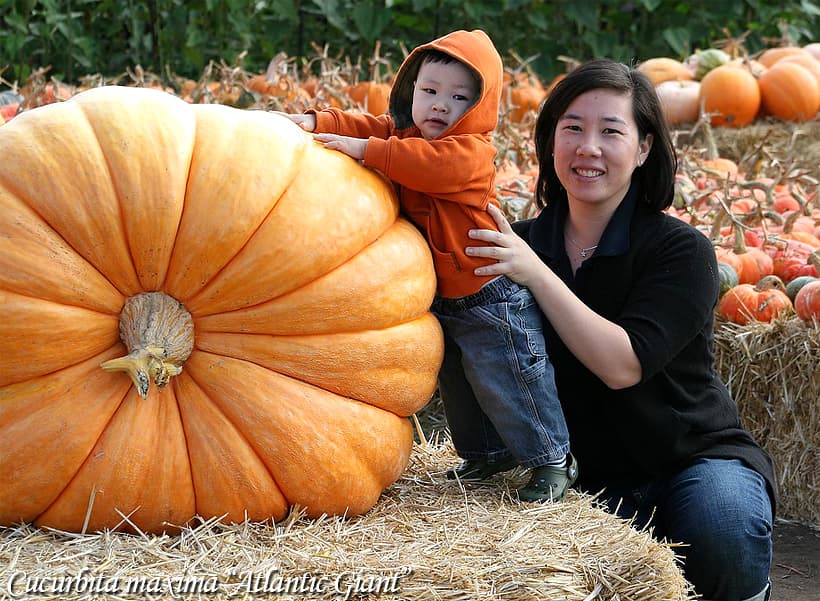
Giant pumpkin "Atlantic Giant".
* The pumpkin fruit is called a berry - and it is the largest berry on the planet. It is a juicy fruit containing many seeds inside.
Pumpkin fruits are not only eaten, but dishes, containers for storing liquids, bulk materials, musical instruments are made from them...
But, first of all, pumpkin is one of the best food plants. In terms of calorie content, it is equivalent to cauliflower. Pumpkin pulp contains up to 25% of dry matter, up to 20% of starch, up to 15% of fat. Pumpkin is rich in pectin substances. Pumpkin contains more iron than other vegetables, so it is recommended for anemia. In addition, pumpkin is a real source of vitamins: E, T, C, B1, B2, B5, carotenoids. Pumpkin also has a high content of mineral salts - potassium, calcium, magnesium, iron, copper, cobalt and others.
Pumpkin is eaten raw, it is baked, fried, steamed, stewed. Drinks, jam, candied fruits are made from pumpkin.
It has been established that pumpkin pulp helps to improve the functioning of the gastrointestinal tract, promotes bile secretion, and regulates water and salt metabolism. It is recommended raw or boiled for patients suffering from cardiovascular diseases, with edema, liver, kidney diseases, metabolic disorders, and constipation.
"Milk" made from pumpkin and hemp seeds is a good remedy for liver and bladder diseases.
Pumpkin juice is a good diuretic and choleretic agent. In small doses, pumpkin juice helps with insomnia.
Pumpkin seeds have long been used to expel tapeworms: bovine, pork and dwarf tapeworm.
Pumpkin stores well in winter even just at room temperature. At the same time, pumpkin is a source of vitamins when there are no other vegetables. A preparation from pumpkin seeds - tykveol (oil extract) is widely used in urological practice for the prevention and treatment of prostate diseases.
* When slicing vegetables, use a stainless steel knife: vitamin C is destroyed upon contact with iron!
* It is better to cut raw vegetables on a plastic or porcelain board, because a wooden one absorbs the juice... (if you have a wooden one, then take good care of it: after use, rinse with boiling water and at least once a week sprinkle with salt and wipe with a sponge. If the board becomes uneven - rub it with sandpaper).
* The larger the vegetables are cut, the fewer nutrients they lose when boiling and canning.
* Pumpkin contains about 90 percent water, a lot of jelly-forming pectin substances, sugars, silicic and phosphoric acids, potassium, calcium, magnesium, as well as vitamins B1, B2, B3, PP, E, and a lot of provitamin A - especially in fruits with bright orange flesh. In addition to being a valuable food product that is well absorbed by the body, it is used in dietetics and is widely used in medicine.
A mask made from raw grated pumpkin has a toning effect on the skin, stimulates blood circulation and improves its elasticity.
Diseases of the gastrointestinal tract.
Pumpkin has a positive effect on inflammation of the large intestine and helps normalize stool during constipation. Cardiovascular diseases. It is especially effective to introduce pumpkin into the diet for hypertension, obesity, and metabolic disorders. Almost all people with heart, kidney, and liver diseases suffer from this. An infusion of pumpkin seeds relieves pain in angina pectoris.
Diuretic effect.
Pumpkin is used for edema caused by cardiovascular diseases. In these cases, pumpkin porridge is consumed (preferably with honey), which is eaten twice a day.
Kidney and liver diseases.
Folk medicine advises using fresh juice from pumpkin pulp (100-200 g per day) or 500 g of grated pulp for kidney and liver diseases. Pumpkin juice stimulates and cleanses the kidney and bladder system.
With pyelonephritis, acute and chronic cystitis, it is recommended to eat 50 g of pumpkin porridge twice a day.
Peeled pumpkin seeds have a destructive effect on helminths. They are used against tapeworms and large roundworms. At home, an anthelmintic remedy from seeds is prepared in two ways:
* Raw seeds are peeled from the hard shell, leaving a thin greenish skin, and ground in a mortar. Then they are mixed with honey or jam (100 g per 300 g of seeds) and taken on an empty stomach, lying in bed, in small portions for an hour. After about three hours, a laxative is taken, and half an hour later (regardless of the bowel reaction) an enema is given. Eating is allowed only after a bowel movement caused by the enema. The dose of seeds for children aged 3-4 years is 75 g, 10 years - 150 g.
* Pass 500 g of seeds along with the seed coat through a meat grinder, pour a liter of water and evaporate in a water bath for two hours without bringing to a boil. The decoction is filtered through cheesecloth. The oil film formed on the surface must be removed. The entire decoction is drunk on an empty stomach within 20-30 minutes. Two hours later, a saline laxative is taken. For children over 10 years old, a decoction is prepared from 300 g of seeds; 5-7 years old - from 200 g; under 5 years old - from 100-150 g (the amount of water is proportionally reduced). Seeds used as an anthelmintic can be stored for no more than two years.