


Your shopping cart is empty!
Radish (mix of colours)
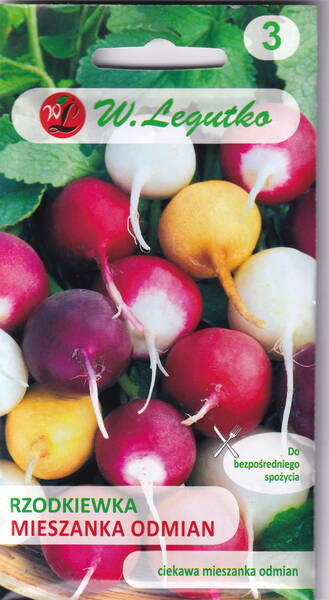
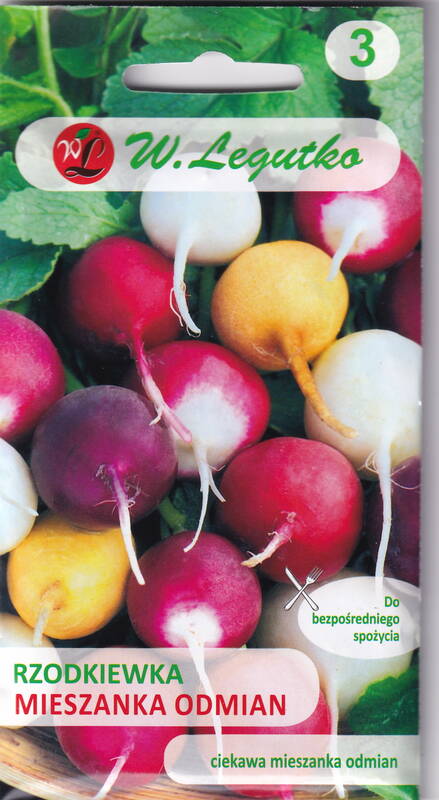
Radish (mix of colours): Zlata(25%)+Granat(25%)+Blanka(25%)+Viola(25%).
* Radish is one of the most popular fast-growing vegetables. You can harvest three crops of root vegetables from the same beds in a season.
Radishes prefer loose, moist, fertile soils with a neutral or slightly acidic reaction.
In unstructured and nutrient-poor soils, the vegetable does not form a root crop. Radishes are usually sown in the ground from April 15 to May 15 and from August 15 to September 1.
This is because heat and long daylight hours cause it to bolt, although there are varieties that can be grown throughout the entire garden season (as soon as the ground thaws and until it freezes again) - for example, the "Duro" variety.
When growing this crop, remember that large, fresh seeds are chosen for sowing. To get a high yield, they must be sown evenly, not deeply embedded in the soil. Thickened crops do not form root vegetables.
Radishes are cold-resistant but do not tolerate dry and hot weather well: root vegetables become flabby and bitter.
Radishes love loose, well-draining, and fertilizer-rich soil. For the first sowing, it is prepared in the fall and covered with a film, and in the spring, even before the snow melts, it is cleared and, as soon as the ground thaws by about 20 cm, it is loosened and sowing is carried out. 1 bucket of manure humus, 1 bucket of rotted sawdust (if not, 1 bucket of sod land and 1/2 bucket of river sand), 1/2 liter of wood ash, 1/4 liter of garden lime (dolomite flour), 1 tablespoon of superphosphate, 1 tablespoon of nitrophoska, 1 tablespoon of urea (carbamide), and 1 teaspoon of potash fertilizers (potassium chloride or potassium sulfate) are added to the soil per 1 square meter. All this is evenly scattered over the dug area and dug again, then leveled with a rake and a bed is formed.
The bed should not be very high or sloping so that water does not drain from it and does not stagnate, creating puddles. Sowing is carried out in transverse grooves 1 cm deep made with a rod. The distance between the grooves is 5 cm, and between the seeds 2-3 cm, then the grooves are covered with the same earth, watered with warm water, and covered with covering material (lutrasil, climatex, agril, and the like).
Usually, the bed covered with covering material does not need to be watered until seedlings appear. After the seeds have sprouted, watering is carried out every 1-2 days, and less often in cold weather. When the ovary reaches the size of a large pea, watering must be done daily at the rate of 1-2 buckets per square meter. The more intense the watering, the juicier the radish and the less bitterness. The covering material can not be removed for the entire growing period of the radish, however, to slow down growth at the fruiting stage, it is better to open it.
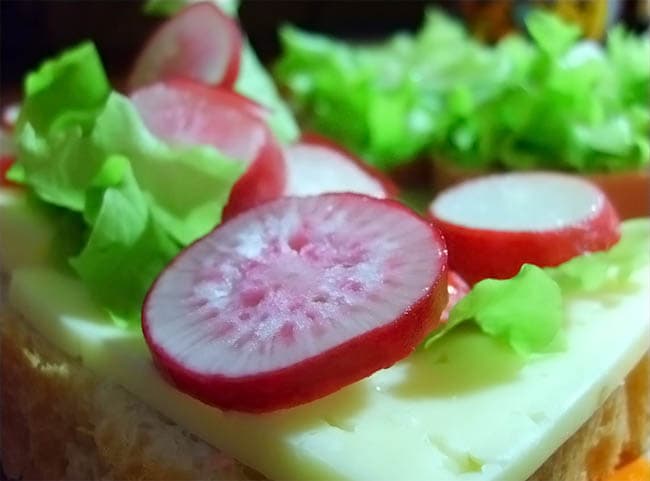
Raphanus sativus L.
Eng.: Radish. Bot.: Raphanus sativus L.