


Your shopping cart is empty!
Radish "Karminowa" (seeds on tape with fertilizer)
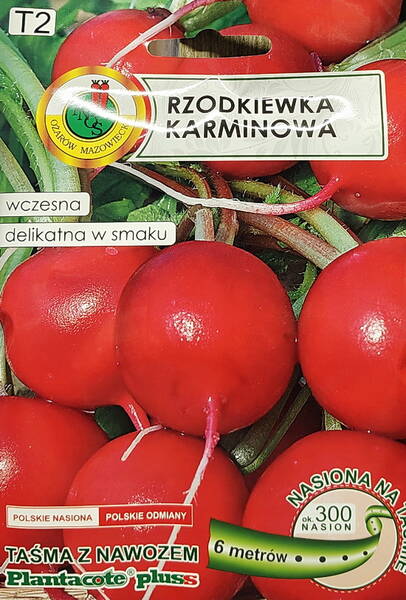
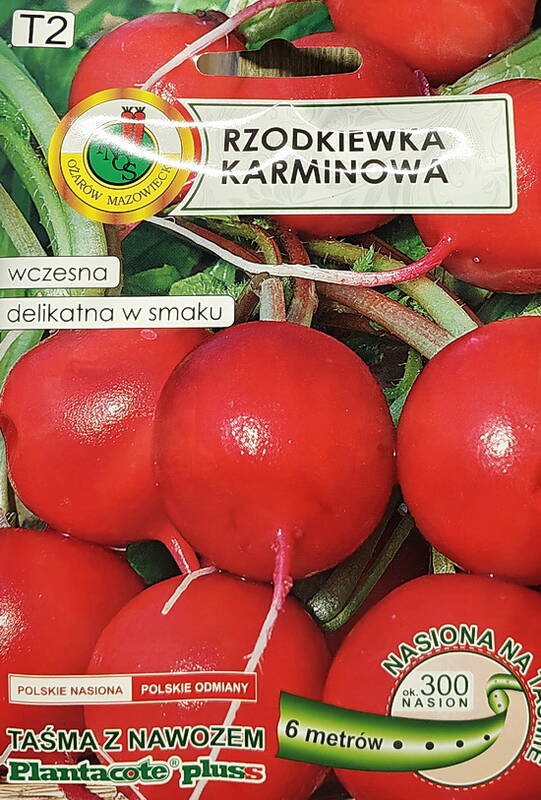
Radish "Karminowa" (seeds on tape with fertilizer) - Raphanus sativus var. sativus L.
Large-fruited variety: 3.5-4.5 cm in diameter.
Root crops are round, flesh is white, juicy, with a slight pleasant pungency.
Distinctive qualities of the variety: resistance to bolting, low level of stalk formation, suitability of root crops for late harvesting, excellent transportability.
This variety stores perfectly, maintaining its marketable appearance.
Attention: do NOT soak the tape before sowing! Lay dry tape into moist soil.
6 m (300 seeds).
Large-fruited variety: 3.5-4.5 cm in diameter.
Root crops are round, flesh is white, juicy, with a slight pleasant pungency.
Distinctive qualities of the variety: resistance to bolting, low level of stalk formation, suitability of root crops for late harvesting, excellent transportability.
This variety stores perfectly, maintaining its marketable appearance.
Attention: do NOT soak the tape before sowing! Lay dry tape into moist soil.
6 m (300 seeds).
* RADISH IN A SPRING GREENHOUSE.
Radish is the closest relative of the black radish.
But while the black radish has been known to people since ancient times, the garden radish began to be cultivated in Europe only from the 16th century.
(There are European and Asian subgroups of radish varieties. Traditional European varieties are very early ripening, but usually store poorly and are relatively small. However, modern varieties like Karminowa combine earliness with good storage).
It is the first of the root crops to appear on our table in early spring during the period of vitamin deficiency and is the basis of most spring salads.
Moreover, three crops of radishes can be easily harvested per season.
Radish contains quite a lot of vitamin C (up to 30 mg%), and in an easily accessible form. Radish tops also contain a lot of vitamin C, but for some reason, gardeners know little about this (try adding young leaves to salads!).
Radish is rich in essential oils that positively affect all digestion processes, suppressing various harmful microorganisms.
Radish juice is very rich in potassium salts, which is very useful in the treatment of kidney and cardiovascular diseases.
Radish can also be used as an anti-inflammatory agent when there are no other options (radish juice mixed with onion juice and pepper is also useful for colds). And a mixture of radish juice with carrot juice restores the tone of the mucous membrane in the body.
Radish is quite cold-resistant: its seeds begin to germinate at a temperature of +3+4°C, seedlings tolerate frosts down to -2-3°C.
However, prolonged exposure to low temperatures slows down development and can cause plant bolting. Therefore, super-early sowing is desirable in greenhouses with additional covering of plants with film.
In the greenhouse, before germination, the temperature must be maintained at +16+18 degrees. When seedlings appear, so that the plants do not stretch ("get leggy"), the temperature must be lowered to +10°C and maintained until the first true leaf appears. Then the temperature must be raised to +15+18°C.
Radish is demanding of good lighting: with dense planting, plants will shade each other, quickly bolt, and will not yield a crop (that's why seeds on tape are a perfect solution).
But good root crops can only be obtained with a short daylight day (no more than 10-11 hours), otherwise, the plants form flower stalks.
That is why experienced gardeners strive to sow radishes as early as possible in spring. For the same reason, from the second half of May to the end of July, when the daylight hours reach a maximum, most radish varieties fail. To avoid this, in the height of summer, radish beds should be covered with black film from 8 am to 6 pm.
Radish is also demanding of soil moisture (within 60-70%). With its lack and high air temperature, root crops become coarse and flabby.
To prevent this, the soil around the plants should be mulched with peat. But excess water in the soil can lead to growth retardation, yellowing of leaves, and insufficient fruit colouring.
Radish is demanding of soil fertility and the presence of nutrients in it in an easily digestible form.
Clay soils are unsuitable for growing radishes, but it is not demanding of soil acidity: it grows well on any soil (from neutral to acidic), so soil liming is carried out only on very acidic soils.