


Your shopping cart is empty!
Smoking tobacco "Perique"

Eco seeds

Smoking tobacco "Perique" - Nicotiana tabacum L.
This heritage variety reaches 2 m in height. It produces shiny, sticky leaves 50 cm long with a powerful aroma and a medium nicotine content.
Ripening speed: mid-season.
Color: Green.
Plant height: 150 to 200 cm.
Leaf size: 40 to 50 cm.
Year of registration: 1700.
This heritage variety reaches 2 m in height. It produces shiny, sticky leaves 50 cm long with a powerful aroma and a medium nicotine content.
Ripening speed: mid-season.
Color: Green.
Plant height: 150 to 200 cm.
Leaf size: 40 to 50 cm.
Year of registration: 1700.
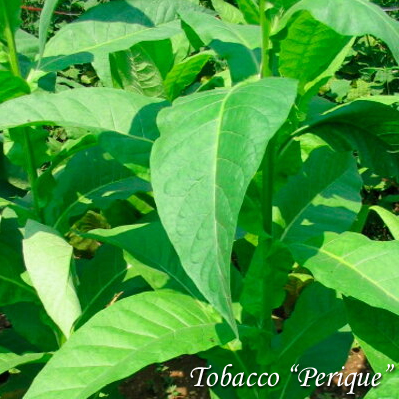
Variety history: This ancient variety originates from the dawn of tobacco culture in St. James Parish. In the late 1700s, a man named Pierre Chenet offered it to his fellow Acadians. In addition to teaching them how to successfully grow tobacco, he revealed the secret of its preparation using a pressure fermentation process, as well as a method of rolling it into tight rolls called «carottes». In honor of his efforts and dedication, this tobacco variety, as well as the method of its preparation, were named «Perique».
Agrotechnics.
Sowing for seedlings is carried out in late March — early April. Before sowing, the container is filled with slightly moist soil (three parts sandy loam turf soil and one part well-rotted and sifted humus), the surface is compacted and leveled. The seeds are evenly distributed over the surface, slightly pressed into the substrate, moistened from a spray bottle, and covered with a film. The crops are placed in a bright, warm place, watered through a tray, and ventilated every day (lifting the film for 30 minutes).
Young plants are planted in open ground in mid-to-late May at a distance of 50-70 cm.
From mid-July, the harvesting and curing of tobacco begins. Tobacco is fermented before use.
"The older, the better."
The improvement of tobacco over time is not a psychological effect, idle speculation, or superstition. Over time, very specific changes occur in tobacco that improve its taste tenfold.
It's no secret that all tobaccos improve over time, but not all blends improve to the same degree. For example, heavily flavored tobaccos improve imperceptibly, since the sugar in such tobaccos is introduced from the outside and is not formed naturally. In such aromatics, a noticeable astringent chemical taste may appear over time. Its source is food additives used to flavor and moisten the tobacco. These are safe, natural sweeteners, but they severely degrade the complex and rich flavor that gradually emerges in natural tobacco. Many aromatic blends consist primarily of Black Cavendish. This variety is the result of a process in which the raw tobacco (usually low-quality Virginia and Burley) is heated with steam and saturated with flavorings. Low-grade raw materials are usually used because top-quality tobacco does not improve after flavoring. Indeed, one shouldn't add sugar to good wine, pour ketchup on a tender fillet, or use air freshener in a garden.
However, this does not mean that top-tier aromatic blends do not exist.
For example, "Danish" style aromatics, which include many of Peter Stokkebye's blends, use very good quality tobacco that is only lightly sweetened. Small companies that produce their own blends – ones that don't produce millions of kilos of tobacco for sale in supermarkets – strive to use the best quality tobacco, even in their aromatics. Such tobaccos can improve over time, at least compared to aromatics made from poorer quality tobaccos with heavier flavoring.
English and Balkan blends – containing Turkish tobaccos (including Latakia) – also improve with age. But Latakia changes only slightly over time, remaining relatively constant after smoking.
The Perique variety, which undergoes an intensive pressing and fermentation process before making it into a blend, behaves quite differently. With improper aging, Perique spoils, but with proper storage and in combination with Virginia, the result is excellent. Hot-air dried (flue cured) Virginia in various forms improves most noticeably from long aging, thanks to its high sugar content. For comparison: "flue cured" Virginia, Turkish, Maryland, and Burley tobaccos contain 22.09%, 13.39%, 0.21%, and 0.21% sugar, respectively.
It is interesting to note how the high sugar content in Virginia – as opposed to Burley – manifests itself during curing. Many of the chemical processes that occur in tobacco during curing continue to occur during aging, long after the tobacco blend has been formulated and packaged. Of course, the mechanism is no longer exactly the same. During aging, the main role is played by microorganisms that break down sugar into a large number of flavor and aroma components. That is why high-sugar tobaccos are preferable for aging. In any case, post-production tobacco aging is a slow continuation of the curing process. During growth, tobacco stores a significant amount of starch in its leaves. Thus, it preserves necessary carbohydrates.
After the plant dies, carbohydrates in the form of starch turn into sugar. The sugar, in turn, breaks down, forming carbon dioxide, which escapes into the atmosphere. But the difference between Virginia and Burley tobaccos is significantly greater than just the genetic difference between the two plants. The main difference manifests itself during their curing. After harvesting, Burley leaves are taken to a barn. There, the tobacco slowly "ages" (this is what tobacco chemistry calls the process of aging and dying. It's not exactly the same thing, but quite close). Over a long time, starch turns into sugar and then into carbon dioxide. Therefore, the sugar content in Burley is relatively low.
In "flue cured" tobaccos, the initial starch content is noticeably high, and the sugar amount is correspondingly low. When smoked, starch produces an unpleasant, harsh, burnt, pungent taste. The curing process changes the starch/sugar ratio in tobacco.
In the curing barn, tobacco leaves turn yellow at a relatively low temperature – about 38 degrees Celsius. Most of the starch turns into sugar at this stage. But in the case of "flue cured" drying, instead of stretching this yellowing process over months, as usually happens with Burley, you quickly raise the temperature and the tobacco dries out. This stops fermentation. Because chemical processes are stopped, sugar does not turn into carbon dioxide.
The idea is to retain maximum sugar while keeping the respiration process – converting sugar to carbon dioxide – to a minimum, using all available starch from which sugar is formed. With proper curing, you get tobacco containing little starch and up to 25 percent sugar, which plays a major role in flavor formation. Now the tobacco can be processed, blended, and packaged. It can already be smoked, but you probably won't like its taste.
Blends made from Virginia varieties have a sharp, astringent taste and tend to smoke hot if they are not aged for some time. This is why most manufacturers age tobacco for at least six months before shipping it for sale.
At this point, we have cured and blended tobacco, aged for an acceptable time. So why are we going to continue aging it? Tobacco is very much like wine.
Both tobacco and wine are natural products of organic origin containing significant amounts of tannic and other acids. The taste of wine softens and becomes more complex over time, just like the taste of tobacco. Fermentation processes take place in both products. According to Dr. David Danehower of North Carolina State University, an acceptable aging time for flue-cured cigarette tobacco is one to five years, but "pipe and cigar tobacco requires significantly more time to mature."