


Your shopping cart is empty!
Sugar Beet "Nesvizhskaya"
Eco seeds
Beta vulgaris L. var. altissima
4.65€
Ex Tax: 3.75€
Ex Tax: 3.75€
Sugar Beet "Nesvizhskaya" - Beta vulgaris L. var. altissima.
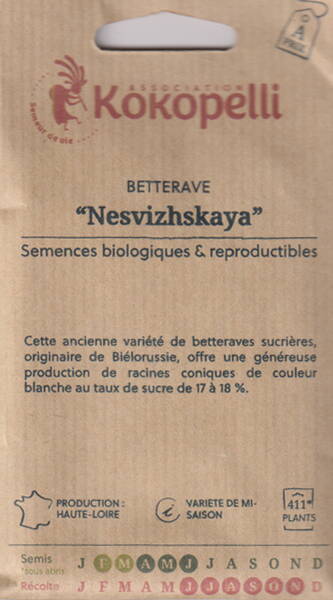
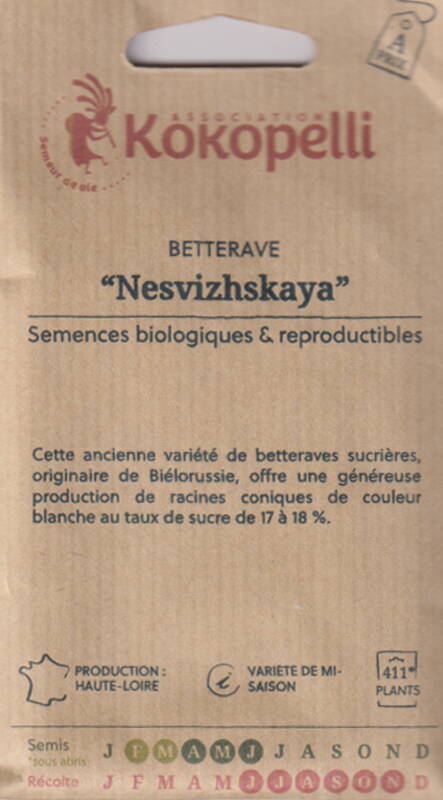
This unique heirloom sugar beet variety, originating from Belarus, produces an abundant harvest of white conical roots with a high sugar content of 17-18%.
Ripening speed: mid-season.
Root weight: 80-500 g.
Root length: 20-25 cm.
Color: white.
Leaves: wavy, typically 40-60 cm tall.
Variety history: originates from Belarus, carefully passed down from generation to generation by a seed keeper in Minsk.
1.0 g = 50-80 seeds.
This unique heirloom sugar beet variety, originating from Belarus, produces an abundant harvest of white conical roots with a high sugar content of 17-18%.
Ripening speed: mid-season.
Root weight: 80-500 g.
Root length: 20-25 cm.
Color: white.
Leaves: wavy, typically 40-60 cm tall.
Variety history: originates from Belarus, carefully passed down from generation to generation by a seed keeper in Minsk.
1.0 g = 50-80 seeds.
In its first year of life, the plant develops a powerful root system, lush foliage, and a thick, fleshy taproot with a rich reserve of sugar and other nutrients.
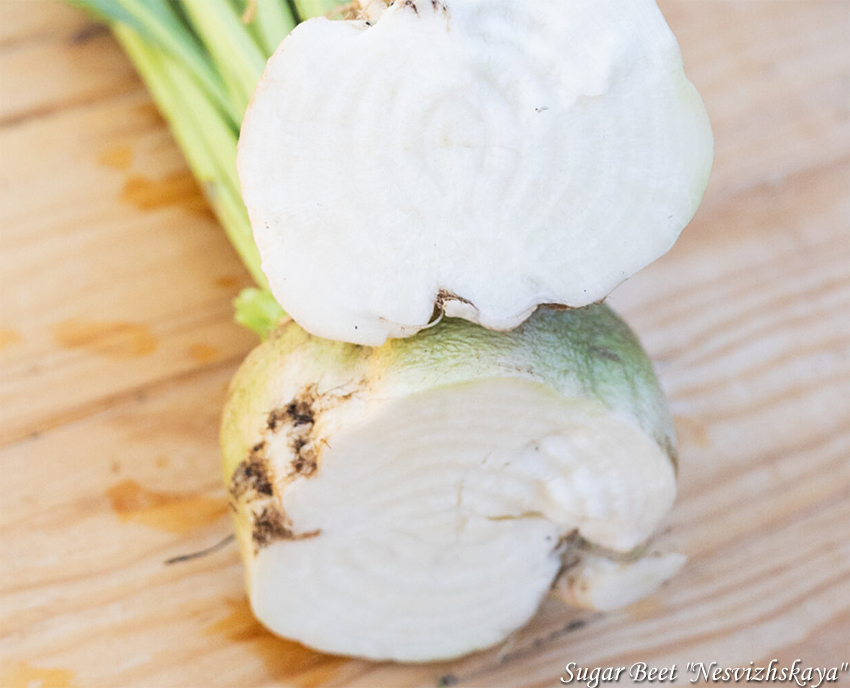
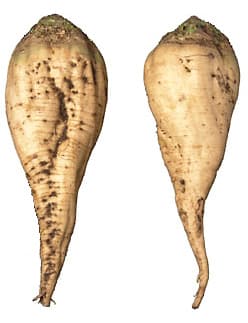
The sugar beet root has a white color and a regular taproot shape with a relatively small crown, tapering smoothly into a very long «tail» (the main axis of the root system).
During the first season, the beet forms about 60-90 leaves, of which a quarter to a half naturally die off during the renewal process.
Cotyledons and the first true leaves are critically more important for the initial growth of the beet and for increasing the final yield than the leaves formed in the second half of the growing season.
This fact must be taken into account during cultivation, especially when protecting young seedlings from the harmful effects of a hard soil crust and insect pests.
Signs of rapid root size increase and active sugar accumulation include: an increase in the number of leaves on the plant, growth in the size of the leaf blades, and a leaf lifespan averaging about 60-70 days.
Besides being an excellent vegetable, beets are incredibly rich in vitamins A, B1, B2, B6, and C. Its leaves are also a superb source of many minerals and trace elements (calcium, magnesium, copper, phosphorus, sodium, iron, etc.) and contain as much iron as the famous spinach, if not more! The root itself contains slightly fewer minerals than the greens but is packed with beneficial substances: choline, folic acid, iodine, manganese, sodium, potassium, dietary fiber, and easily digestible carbohydrates. Although its overall iron content is not the highest, the iron is of excellent quality, making beets an invaluable food for supporting healthy blood formation. It is highly recommended during periods of recovery from blood loss, in preparation for childbirth, or during general convalescence.
Sugar beet. Bot. syn.: Beta vulgaris subsp. vulgaris var. altissima, Beta saccharifera, Beta vulgaris var. saccharifera Alef., Beta vulgaris conv. saccharifera Alef.
* Rabbits, chickens, and ducks absolutely love sugar beets.
For anyone keeping livestock or poultry, it is highly desirable to grow sugar beets on their plots – the plant produces an abundance of juicy leaves of enormous size (sometimes reaching up to one meter in length!).
The leaf mass of this beet is a wonderful, vitamin-rich feed for domestic animals and birds.
And if you want to make a real homemade syrup from the roots, the recipe is simple: wash the beets thoroughly, peel them, and chop them with a knife (or grate them).
Cover the shredded beets with cold water, bring to a boil, and let steep until completely cool. Then, filter the sweet juice and evaporate the excess water in a «water bath» (bain-marie) until the original volume is reduced by 4-5 times.
The juice will gradually turn into a thick, sweet, dark-colored syrup (readiness is determined the same way as with jam – a drop on a saucer should not spread).
Pour the hot syrup into sterilized jars and store in a cool place.
Such a natural treat can be stored for quite a long time without any problems.