


Your shopping cart is empty!
Sweet pepper "Astor" F1
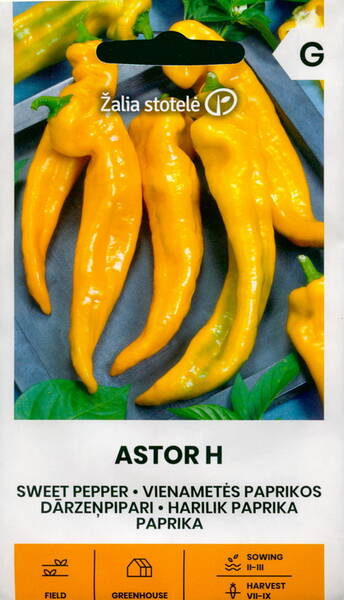
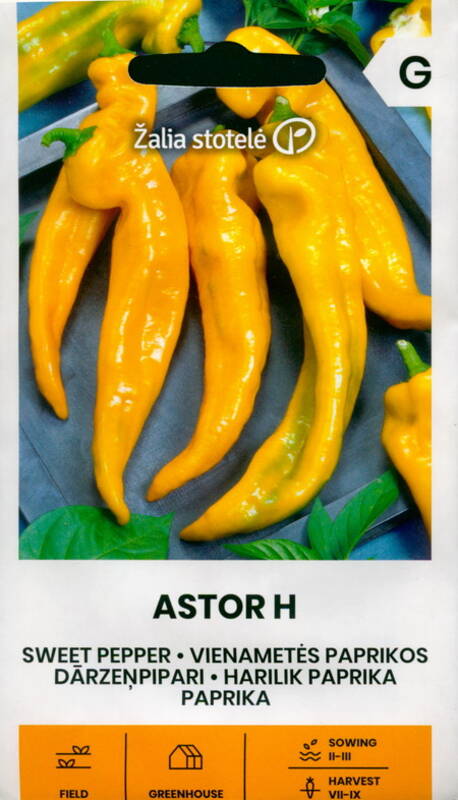
Sweet yellow pepper “Astor” F1.
Large, beautiful fruits!
An early, highly productive hybrid with bright yellow fruits.
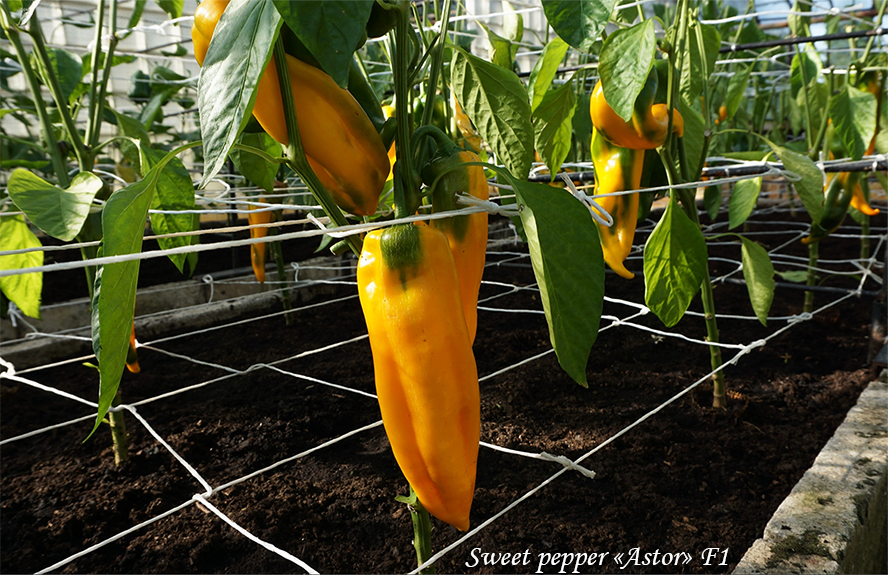
Plants are tall: about 1.0 m. Fruits are elongated (up to 25 cm), trumpet-shaped, slightly curved, with glossy skin. Average fruit weight is 200–210 g, with a wall thickness of about 5 mm.
Excellent flavor: tender, sweet, and aromatic. These sweet peppers are great fresh and suitable for all types of cooking.
Recommended for cultivation both in greenhouses and in open ground. Resistant to Tobacco mosaic virus.
Growing guidelines.
Optimal seed germination temperature is 25–28°C. Seedlings emerge in about 14 days. Transplant seedlings at 55–60 days (about 20 cm tall with around 10 well-developed leaves). Plant into a greenhouse in mid-May, and outdoors in mid-June after spring frosts have passed. Planting pattern: 70–90 × 40–50 cm.
Large, beautiful fruits!
An early, highly productive hybrid with bright yellow fruits.
Plants are tall: about 1.0 m. Fruits are elongated (up to 25 cm), trumpet-shaped, slightly curved, with glossy skin. Average fruit weight is 200–210 g, with a wall thickness of about 5 mm.
Excellent flavor: tender, sweet, and aromatic. These sweet peppers are great fresh and suitable for all types of cooking.
Recommended for cultivation both in greenhouses and in open ground. Resistant to Tobacco mosaic virus.
Growing guidelines.
Optimal seed germination temperature is 25–28°C. Seedlings emerge in about 14 days. Transplant seedlings at 55–60 days (about 20 cm tall with around 10 well-developed leaves). Plant into a greenhouse in mid-May, and outdoors in mid-June after spring frosts have passed. Planting pattern: 70–90 × 40–50 cm.
* Good preceding crops for peppers are vegetables from the Brassica family: various cabbages, radish, turnip, black radish, mustard.
A poor predecessor is tomato.
In any case, the soil must be carefully and evenly fertilized before planting peppers.
The best soil for peppers is well-warmed sandy-loam soil with a high humus content.
When choosing a spot in the garden, consider these pepper requirements:
* Pepper does not tolerate even partial shade.
* It should be in the sun from sunrise to sunset.
* It needs not only plenty of warmth, but also plenty of light.
Pepper also dislikes strong winds, especially drafts. The ideal place is the south side of a house: sheltered from wind and benefiting from reflected light.
Pepper cannot tolerate cold soil. For a truly solid harvest, raise beds by 30–50 cm (at least), or provide subsoil warming. Many gardeners overlook this—and when something fails, they blame the weather, the variety, the seeds, anything… Yet the reason can be simple: cold, overly compacted soil, especially where clay content is high.
Pepper’s moisture needs differ from tomatoes and cucumbers: it sits somewhere in between. If cucumbers love warmth and high moisture, and tomatoes prefer warmth and drier conditions, then peppers prefer very warm conditions and moderate moisture. As temperatures rise, peppers need higher humidity (similar to cucumbers). As temperatures drop, it’s better to reduce moisture closer to “tomato” levels.
During flowering, avoid overheating peppers—it causes flowers to drop and sets to wither. Optimal temperature: +24…+28°C.
During fruiting, feed peppers with fertilizers higher in nitrogen and calcium.
* To eliminate bacterial, fungal, and viral pathogens on or inside seeds, and to protect young seedlings from disease-causing microorganisms in the soil, disinfect vegetable seeds before sprouting for 15–20 minutes in a 1% potassium permanganate solution (1 g per half a glass of water), then rinse well in clean water. After treatment, seeds turn brown.
Another effective preparation method for slow-germinating seeds (celery, eggplant, pepper) is seed bubbling: treating seeds in oxygen-saturated water (seedlings from bubbled seeds appear much earlier than from dry seeds).
At home, bubbling is done as follows: fill a jar to 2/3 with water and place the tip of an aquarium air pump at the bottom. Add seeds (their mass should be four times less than the mass of water) and turn on the pump, ensuring seeds, water, and air bubbles remain in constant motion.
Bubbling duration—until sprouts appear: celery seeds 7 days, eggplant 2 days, pepper 3 days.