


Your shopping cart is empty!
Copper sulfate (1 kg)
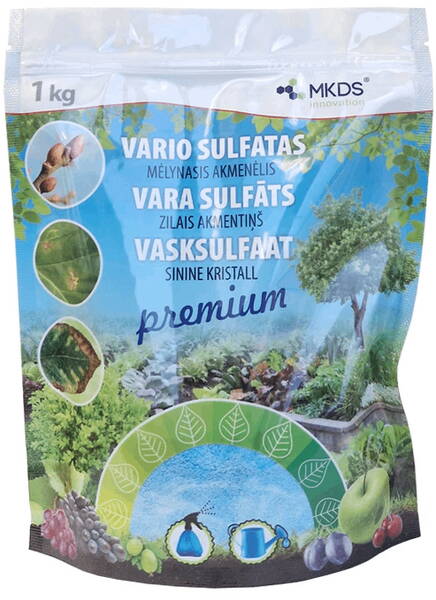
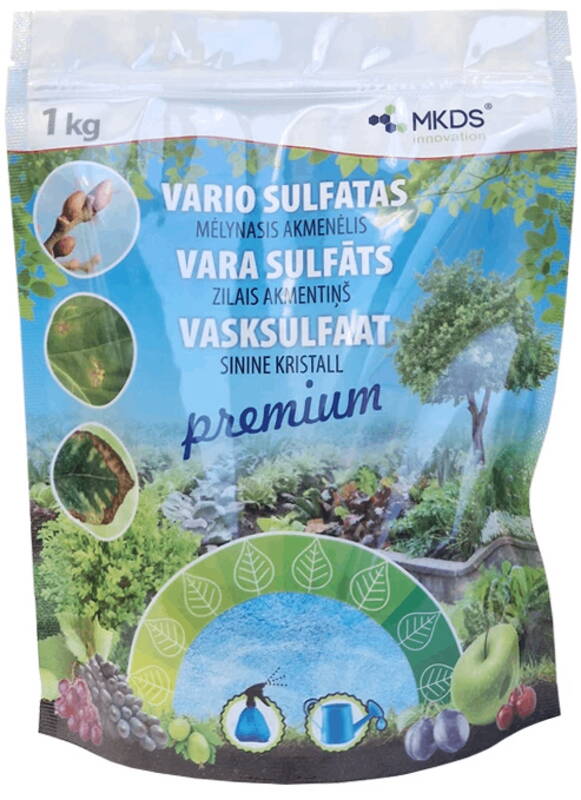
Copper Sulfate (CuSO4) – is an effective fungicide designed for spraying fruit, berry, and ornamental trees and shrubs against scab, moniliosis, anthracnose, and other diseases, as well as for disinfecting wounds on fruit crops.
Active ingredient: copper sulfate, 980 g/kg, soluble powder.
Use of Copper Sulfate:
* Crop: Apple, Pear, Quince.
Disease: scab, phyllosticta and other spotting, moniliosis, dieback.
Application rate: 100 g per 10 L of water.
Solution consumption: early spring spraying before bud break - 2-5 L per tree.
* Crop: Apricot, Peach, Plum, Sweet Cherry, Sour Cherry.
Disease: shot-hole disease (coryneum blight), cherry leaf spot and other spotting, moniliosis, peach leaf curl.
Application rate: 50-100 g per 10 L of water.
Solution consumption: early spring spraying before bud break - 2-5 L per tree.
* Crop: Gooseberry, Currant.
Disease: anthracnose, septoria leaf spot, and other spotting.
Application rate: 50-100 g per 10 L of water.
Solution consumption: early spring spraying before bud break - up to 1.5 L per bush.
Active ingredient: copper sulfate, 980 g/kg, soluble powder.
Use of Copper Sulfate:
* Crop: Apple, Pear, Quince.
Disease: scab, phyllosticta and other spotting, moniliosis, dieback.
Application rate: 100 g per 10 L of water.
Solution consumption: early spring spraying before bud break - 2-5 L per tree.
* Crop: Apricot, Peach, Plum, Sweet Cherry, Sour Cherry.
Disease: shot-hole disease (coryneum blight), cherry leaf spot and other spotting, moniliosis, peach leaf curl.
Application rate: 50-100 g per 10 L of water.
Solution consumption: early spring spraying before bud break - 2-5 L per tree.
* Crop: Gooseberry, Currant.
Disease: anthracnose, septoria leaf spot, and other spotting.
Application rate: 50-100 g per 10 L of water.
Solution consumption: early spring spraying before bud break - up to 1.5 L per bush.
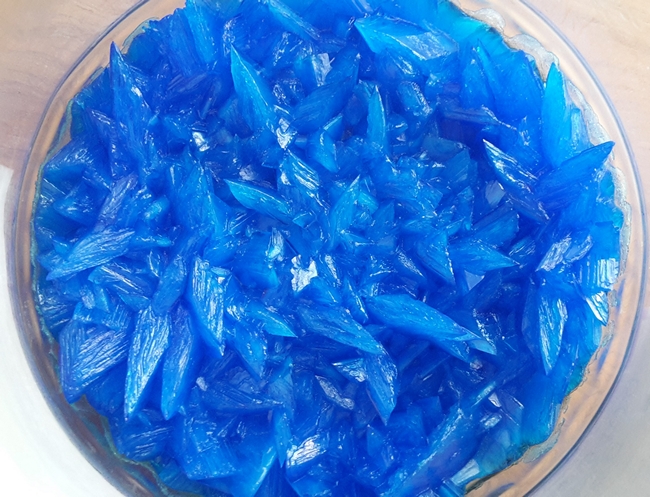
Using copper sulfate against plant diseases (anthracnose, septoria, spotting, phyllosticta, rots):
1. For early spring spraying before bud break against fungal diseases: scab, black rot, fruit rot, cytospora canker, septoria, brown leaf spot, apple and pear anthracnose, plum pockets, cherry diseases, peach leaf curl.
Rate: 100 g per 10 L of water.
2. For disinfection by dipping into the solution for 3 minutes, followed by abundant rinsing with water: roots of seedlings after removing crown gall growths; cuttings of gooseberries and currants, raspberry suckers against anthracnose; strawberry runners against powdery mildew; aerial parts of gooseberries and currants (after pruning diseased parts) against American powdery mildew.
Rate: 100 g per 10 L of water.
3. For soil disinfection by watering against diseases: "blackleg" (damping-off) of cabbage and tomatoes, gray and white rot of tomatoes, fusarium wilt or yellowing of cabbage, radish, turnip, rutabaga.
Rate: 5 g per 10 L of water.
4. For disinfecting wounds on fruit trees, an aqueous solution is prepared at a rate of 100 g per 10 L of water.
To combat crown gall in fruit trees and roses, dip the root collar (after removing galls) for 2-3 minutes in a 1% solution, followed by rinsing with water.
5. For spraying before planting: potato tubers against late blight.
Rate: 2 g per 10 L of water.
6. For spraying during the growing season:
Late blight of tomato, potato: rate - 20 g per 10 L of water.
Using copper sulfate as a fertilizer: apply copper sulfate once every 5-6 years in early spring or autumn (rate: 1 g per 1 m²). Before use, crush the crystals well and mix with soil. For foliar feeding of growing plants, the dose is 1-2 g of copper sulfate per 10 L of water (one teaspoon holds 5-6 g).
Using copper sulfate to prepare Bordeaux mixture.
"Bordeaux mixture" has been used for over a hundred years as one of the most effective chemical treatments against garden diseases. It is best to treat fruit trees and shrubs before bud break.
Bordeaux mixture is also excellent for treating flowers, as its main action is destroying scab and fungal diseases.
Preparation: the mixture must be prepared in a glass or plastic container (metal utensils must be strictly avoided!).
First, dilute the copper sulfate separately – 100 grams in a small amount of warm water, then bring the solution up to 5 liters. Do the same with the lime: slake 100 g of quicklime in a small amount of water, then bring the volume up to 5 liters. The resulting milk of lime should be strained. Then comes the crucial moment: slowly, in a thin stream, add the aqueous copper sulfate solution into the lime solution while constantly stirring. If done correctly, the liquid should turn a beautiful sky-blue color.
Bordeaux mixture should not be stored; it must be used immediately.
Important note: the resulting mixture must have a neutral or alkaline reaction. You can test this with a simple iron nail. Dip it into the solution; if a red copper coating forms on it after three minutes, your solution is highly acidic. In this case, add a little more lime solution to your Bordeaux mixture (mixing carefully and thoroughly).
Alternative - "Burgundy mixture"...
If there is no lime, but you have sodium carbonate (washing soda), you can prepare Burgundy mixture. This variant appeared in Europe slightly later than Bordeaux mixture, as soda became cheaper and more accessible...
Precautions: when working, observe general safety requirements and personal hygiene rules; use gloves, goggles, a respirator, or a mask. After work, wash your hands and face thoroughly with soap and rinse your mouth. If you experience a headache, unpleasant metallic taste in the mouth, nausea, vomiting, salivation, etc., consult a doctor immediately!
How to prepare a solution.
❖ If you want to get a 1% solution of any substance, you dissolve 10 g of the substance in 1 L of water (or 100 g in 10 L). Accordingly, a 2% solution contains 20 g of the substance in 1 L of water (200 g in 10 L), and so on.
❖ If it is difficult to measure a small amount, take more, prepare a so-called mother solution, and then dilute it.
Take 10 g, prepare a liter of a 1% solution, pour off 100 ml, bring it to 1 L with water (dilute it 10 times), and a 0.1% solution is ready.
❖ To prepare 10 L of a copper-soap emulsion, dissolve 150-200 g of soap in 9 L of soft (preferably rain) water. Separately, dissolve 5-10 g of copper sulfate in 1 L of water. Then, slowly pour the copper sulfate solution in a thin stream, constantly stirring (!), into the soap solution. The result is a beautiful greenish liquid.