


Your shopping cart is empty!
Greater Celandine
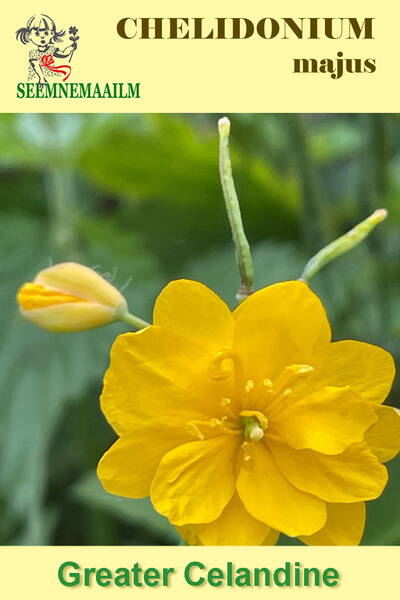
Eco seeds
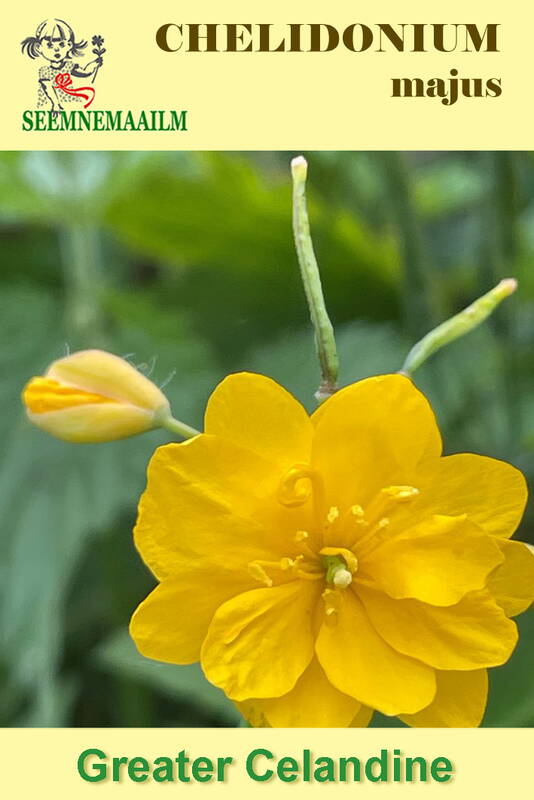
Greater Celandine — Chelidonium majus.
A folk cosmetologist!
A perennial from the Poppy family (Papaveraceae).
Origin: Europe, Western Asia, Eastern USA.
Flowering plant height: 50 cm.
Flower color: golden.
Natural flowering period: May — September.
Soil requirements: dry, well-drained, moderately fertile.
Hardiness zones: Z4—Z8.
1.0 g = 1700 seeds.
A plant of traditional Chinese and folk medicine. Used externally for various skin diseases, and internally for liver and gallbladder diseases, tuberculosis, oncology, and gout.
The herb contains alkaloids, carotenoids, flavonoids, and heart-stimulating substances. Celandine has antispasmodic, choleretic, anti-inflammatory, and bactericidal effects. The herb is harvested during flowering and dried at +50—60°C. Teas and alcoholic tinctures are used for medicinal purposes.
Agrotechnics: seeds are sown in autumn in seedling beds or in February—March for seedlings. Seeds require preliminary stratification: sow at a depth of no more than 0.5 cm, moisten with a spray bottle, cover with glass, and place in the refrigerator (+5—7°C). Keep crops in these conditions for 10—15 days, then transfer to room conditions. Maintain humidity and ventilation. At +18—20°C, seedlings appear in 10—14 days. If there is no germination, repeat the “cold-warm” cycle.
Seedlings are pricked out in the 2—3 true leaves stage. Planted outdoors after 4—6 weeks. Prefers sunny spots or light partial shade with loose, non-acidic soil. Can grow in one place for 5—7 years.
A folk cosmetologist!
A perennial from the Poppy family (Papaveraceae).
Origin: Europe, Western Asia, Eastern USA.
Flowering plant height: 50 cm.
Flower color: golden.
Natural flowering period: May — September.
Soil requirements: dry, well-drained, moderately fertile.
Hardiness zones: Z4—Z8.
1.0 g = 1700 seeds.
A plant of traditional Chinese and folk medicine. Used externally for various skin diseases, and internally for liver and gallbladder diseases, tuberculosis, oncology, and gout.
The herb contains alkaloids, carotenoids, flavonoids, and heart-stimulating substances. Celandine has antispasmodic, choleretic, anti-inflammatory, and bactericidal effects. The herb is harvested during flowering and dried at +50—60°C. Teas and alcoholic tinctures are used for medicinal purposes.
Agrotechnics: seeds are sown in autumn in seedling beds or in February—March for seedlings. Seeds require preliminary stratification: sow at a depth of no more than 0.5 cm, moisten with a spray bottle, cover with glass, and place in the refrigerator (+5—7°C). Keep crops in these conditions for 10—15 days, then transfer to room conditions. Maintain humidity and ventilation. At +18—20°C, seedlings appear in 10—14 days. If there is no germination, repeat the “cold-warm” cycle.
Seedlings are pricked out in the 2—3 true leaves stage. Planted outdoors after 4—6 weeks. Prefers sunny spots or light partial shade with loose, non-acidic soil. Can grow in one place for 5—7 years.

* Mother Nature gifts us with many wonders!
However, people do not always notice these miracles. Celandine was considered the oldest medicinal plant by the Greeks, who noticed it bloomed with the arrival of swallows and faded with their departure. Hence, they named it “swallow herb” (chelidon = swallow).
It is highly toxic, and all herbal medicine books advise consulting a doctor before use. Nevertheless, folk medicine has accumulated significant experience.
What causes such miraculous properties? Its chemical composition. The aerial part contains up to 2.3% alkaloids (chelidonine, sanguinarine, etc.), up to 4.3% organic acids, flavonoids, vitamins A and C, and essential oils.
Celandine is used both in folk medicine and homeopathy, particularly for liver diseases. Folk herbalists recommend it for skin diseases (warts, calluses, psoriasis) using fresh juice.
It also helps animals heal wounds, and in the garden, dried herb powder repels flea beetles, aphids, and thrips.

The herb, herb juice, and roots are used for medicinal purposes.
! POISONOUS.
The entire plant contains alkaloids and toxic compounds. It possesses anti-inflammatory, wound-healing, and cauterizing effects. The juice is traditionally used to treat warts, papillomas, and certain skin conditions.
! It must be remembered that you must consult a doctor before using celandine.
Incorrect or excessive use can lead to poisoning, manifested by nausea, vomiting, colic, diarrhea: even a fatal outcome is possible.
! External use is contraindicated for individuals suffering from epilepsy, bronchial asthma, angina pectoris, and certain neurological syndromes