


Your shopping cart is empty!
Fitoverm (aversectin, 2 g/l)
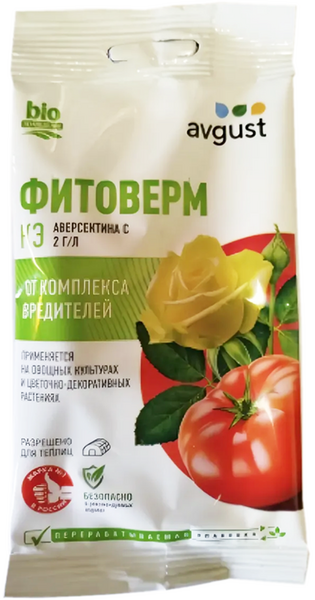
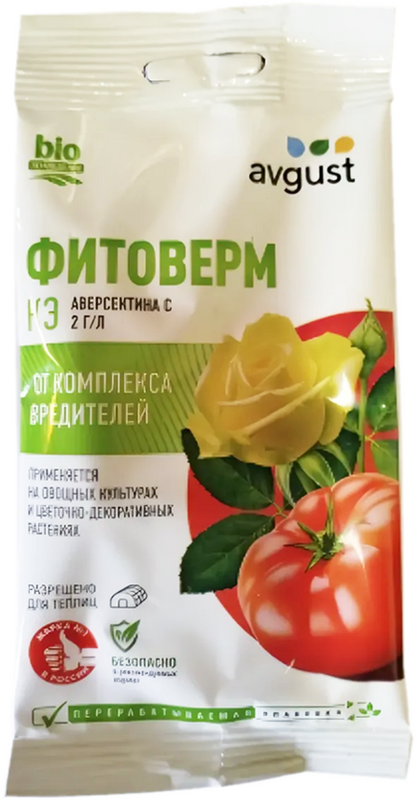
Fitoverm - emulsion concentrate of aversectin C (2 g/l) for protecting plants from gnawing and sucking insect pests.
A 4th generation biological product based on the metabolic products of soil microorganisms. It destroys all types of herbivorous mites, Colorado potato beetle, cabbage whites, cabbage loopers (scoops), sawflies, leafrollers, codling moths, geometer moths, thrips, and all types of aphids. It does not pollute the environment, quickly decomposing in the soil. The death of pests occurs 2-3 days after treatment, and the maximum effect is achieved on days 5-7.
"Fitoverm" does not pollute the environment, decomposing quickly in water and soil. The waiting period from the last treatment to harvest is no more than 3 days.
"Fitoverm" is a practically indispensable preparation for protection against pests of currants, gooseberries, raspberries, apple trees and other fruit trees, tomatoes, flowers (both in the garden and indoors), especially considering that the use of many chemical preparations is allowed no later than 20 days before harvest.
"Fitoverm" has a wide spectrum of action: against more than 20 species of insect pests, including the Colorado potato beetle, cabbage white butterfly, cabbage looper, spider mite, apple codling moth, weevils, thrips, and all types of aphids.
Works well even in hot weather, unlike many traditional preparations.
Method of application: preparation of the working solution — pour 1-2 litres of water into a bucket, open the ampoule or measure out a certain amount of the preparation with a dispenser (strictly in accordance with the table below) and pour into the water, mixing thoroughly, after which bring the working solution to the required volume and mix again.
Attention! Generic instructions often mention mixing "up to 10 L", but for many pests (thrips, aphids), the concentration must be much higher (see table). Diluting one small ampoule (2-4 ml) in 10 L of water will be ineffective against most pests except the Colorado beetle. Follow the dosages in the table!
Table: Usage Regulations for Fitoverm (2 g/l)
A 4th generation biological product based on the metabolic products of soil microorganisms. It destroys all types of herbivorous mites, Colorado potato beetle, cabbage whites, cabbage loopers (scoops), sawflies, leafrollers, codling moths, geometer moths, thrips, and all types of aphids. It does not pollute the environment, quickly decomposing in the soil. The death of pests occurs 2-3 days after treatment, and the maximum effect is achieved on days 5-7.
"Fitoverm" does not pollute the environment, decomposing quickly in water and soil. The waiting period from the last treatment to harvest is no more than 3 days.
"Fitoverm" is a practically indispensable preparation for protection against pests of currants, gooseberries, raspberries, apple trees and other fruit trees, tomatoes, flowers (both in the garden and indoors), especially considering that the use of many chemical preparations is allowed no later than 20 days before harvest.
"Fitoverm" has a wide spectrum of action: against more than 20 species of insect pests, including the Colorado potato beetle, cabbage white butterfly, cabbage looper, spider mite, apple codling moth, weevils, thrips, and all types of aphids.
Works well even in hot weather, unlike many traditional preparations.
Method of application: preparation of the working solution — pour 1-2 litres of water into a bucket, open the ampoule or measure out a certain amount of the preparation with a dispenser (strictly in accordance with the table below) and pour into the water, mixing thoroughly, after which bring the working solution to the required volume and mix again.
Attention! Generic instructions often mention mixing "up to 10 L", but for many pests (thrips, aphids), the concentration must be much higher (see table). Diluting one small ampoule (2-4 ml) in 10 L of water will be ineffective against most pests except the Colorado beetle. Follow the dosages in the table!
Table: Usage Regulations for Fitoverm (2 g/l)
| Crop | Pest | Dosage (per 1 Litre of water) |
| Houseplants and flowers | Spider Mite | 2 ml |
| Houseplants and flowers | Aphids (all types) | 4-8 ml |
| Houseplants and flowers | Thrips | 8-10 ml |
| Cucumbers, Tomatoes, Peppers (Greenhouse) |
Spider Mite | 1-2 ml |
| Cucumbers, Tomatoes, Peppers (Greenhouse) |
Aphids | 6-8 ml |
| Cucumbers, Tomatoes, Peppers (Greenhouse) |
Thrips | 10 ml |
| Cabbage | Caterpillars | 4 ml |
| Potatoes | Colorado Potato Beetle | 1 ml |
| Currant, Raspberry | Mites, Leafrollers, Aphids | 2 ml |
| Apple, Fruit trees | Mites, Leafrollers, Moths | 1.5 - 2 ml |
Processing recommendations: spray plants with a freshly prepared solution in dry, calm weather, preferably in the morning (before 10 am) or in the evening (6-10 pm), evenly wetting the leaves, 4-6 hours before rain. The optimal temperature for processing is from +12°C to +25°C. Do not spray against the wind. Speed of impact — 6-8 hours after treatment in a greenhouse, 8-16 hours in open ground. Protects plants in a greenhouse for 7-20 days after treatment; on open ground crops (in the absence of precipitation within 6 hours after treatment) — 7-20 days depending on the dose and type of pest.
Not phytotoxic.
Do not mix with other preparations (especially alkaline ones)!
* Extensive trials of "Fitoverm" were conducted by specialists from the Plant Protection Research Institute. Observations showed that it reduces the number of leaf-eating pests on apple trees and blackcurrants by 94-100%. Against mites on apple trees and blackcurrants, the effectiveness of "Fitoverm" was 96-100%.
It caused 100% mortality of bud weevils and suppressed the development of apple aphids and currant shoot aphids by 75-85%.
Two applications of "Fitoverm" on blackcurrants — immediately after flowering and two weeks before the berries began to ripen — made it possible to completely prevent damage from the currant gall mite and leafrollers, and by 86% from currant shoot aphids.
A big plus of this preparation is the fact that it absolutely does not pollute the environment, since it quickly decomposes into harmless components (for warm-blooded animals) both in water and in soil (no more than 3 days).