


Your shopping cart is empty!
Petunia "Gioconda Mini Pink Dreams" F1
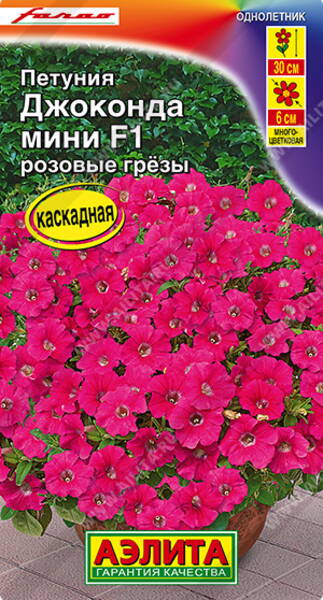
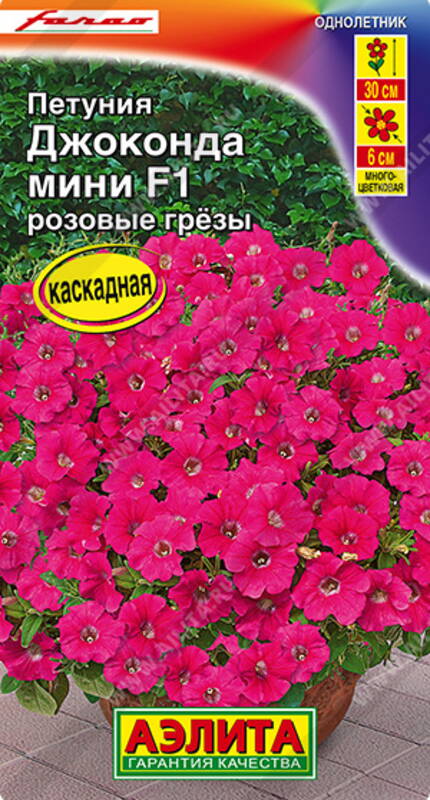
Petunia "Gioconda Mini Pink Dreams" F1 - Petunia multiflora nana compacta.
The lush and generous blooming of the "GIOCONDA MINI" F1 petunia creates a cheerful mood!
The hybrid forms plants with a neat, compact bush 25-30 cm high and a flower diameter of 5-6 cm. The bush remains attractive throughout the season, never exposing its center, because it has the genetic ability to branch well from the very base.
The richest flowering is achieved thanks to the male sterility gene: the plants do not produce seeds, but strive for this, producing more and more flowers...
Even after a slight frost, GIOCONDA MINI F1 recovers quickly and blooms tirelessly. The flowers are not damaged by strong winds and are resistant to rain. The hybrid will decorate sunny and slightly shaded flower beds, garden containers, and balcony boxes. By maintaining optimal growing conditions (11-hour daylight and temperature +20...+22°C), you can keep the plants blooming all year round (!).
Sowing for seedlings from February to April. Seeds in pellets! Sowing is superficial, without embedding (seeds germinate in the light!), under glass or film to maintain constant humidity until full emergence. The pellets must dissolve upon sowing! February sowings require additional lighting.
Seedlings appear on the 5-6th day. Pricking out in the phase of 1-2 true leaves. Planting hardened seedlings in the ground at the end of May.
The lush and generous blooming of the "GIOCONDA MINI" F1 petunia creates a cheerful mood!
The hybrid forms plants with a neat, compact bush 25-30 cm high and a flower diameter of 5-6 cm. The bush remains attractive throughout the season, never exposing its center, because it has the genetic ability to branch well from the very base.
The richest flowering is achieved thanks to the male sterility gene: the plants do not produce seeds, but strive for this, producing more and more flowers...
Even after a slight frost, GIOCONDA MINI F1 recovers quickly and blooms tirelessly. The flowers are not damaged by strong winds and are resistant to rain. The hybrid will decorate sunny and slightly shaded flower beds, garden containers, and balcony boxes. By maintaining optimal growing conditions (11-hour daylight and temperature +20...+22°C), you can keep the plants blooming all year round (!).
Sowing for seedlings from February to April. Seeds in pellets! Sowing is superficial, without embedding (seeds germinate in the light!), under glass or film to maintain constant humidity until full emergence. The pellets must dissolve upon sowing! February sowings require additional lighting.
Seedlings appear on the 5-6th day. Pricking out in the phase of 1-2 true leaves. Planting hardened seedlings in the ground at the end of May.
* When to sow?
It depends on when you need ready-made plants. And also on your capabilities: the earlier you sow, the more supplementary lighting will be required. You should proceed from the fact that the minimum development period for a young, formed plant is 3 months. It is optimal to sow seeds in February, but you can also do it in April, only then the plant will reach its maximum power by the end of the summer.
How to sow?
At the first stage, we use fine-dispersed soil with a minimum content of nutrients. Light stimulates germination, so we do not cover the seeds with soil. It is better to sow in small cassettes to do without pricking out, but you can also do it the traditional way. The plants should be in a small volume until the root system completely fills the entire space and can be easily removed from the cell (3-4 rosettes of leaves). After this, transplant into 8-10 cm pots.
Petunia is sensitive to humidity and aeration. At this stage, the plants must go through a "wet/dry" cycle daily (the color of the substrate changes from black to brown).
Temperature.
At the first stage after germination, it is +18...+20 degrees, and after transplanting into 10 cm pots, it is better to lower it to +16...+18 to enhance the growth of lateral shoots. During final growing, the temperature should rise again.
Light.
This is one of the main components. It is necessary to use supplementary lighting for 14 hours a day, gradually increasing the day to 14-20 hours. At home, you can use fluorescent lamps. In the future, for the successful growth of adult plants, sunlight is needed: the more, the better. During spring frosts, the baskets can be placed in a greenhouse with cucumbers and tomatoes.
Final transplanting.
As soon as the weather permits. In large containers and baskets, 1-3 plants each. Vases "on a leg" are well suited. But young plants can be damaged by strong winds, therefore, a free suspension, the so-called ampels, still remains the best option.
Fertilizers.
At the initial stage (13-2-13-6(Ca)-3(Mg)) complex at a concentration of 25 - 35 ppm. In the future, the concentration increases to 150 - 200 ppm. You can use German liquid complex fertilizers for flowers. When the plants become powerful enough, feeding can be done with every watering.
Growth features.
Cascade petunias grow much faster than regular ones. If there is enough light, then following the basal shoot, lateral ones growing horizontally begin to develop rapidly. If there is little light or several plants develop close to each other, the lateral shoots grow worse and stretch not sideways, but upwards. In this case (after placing the plant in normal conditions outdoors), the shape of the bush normalizes over time. At this stage, many try to carry out pinching. Such practice does not lead to a positive result, the only consequence is a delay in development. These hybrids have sufficient genetic potential and do not require agrotechnical techniques characteristic of old ampel varieties.