


Your shopping cart is empty!
Petunia "Gioconda mini Orange" F1
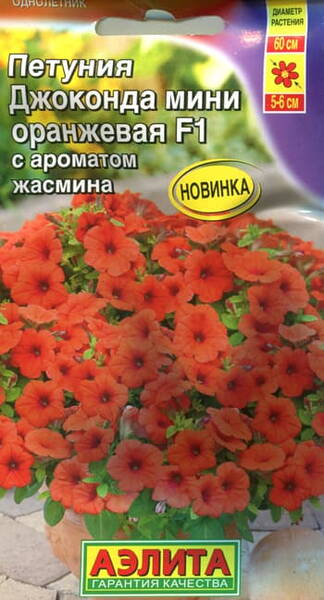
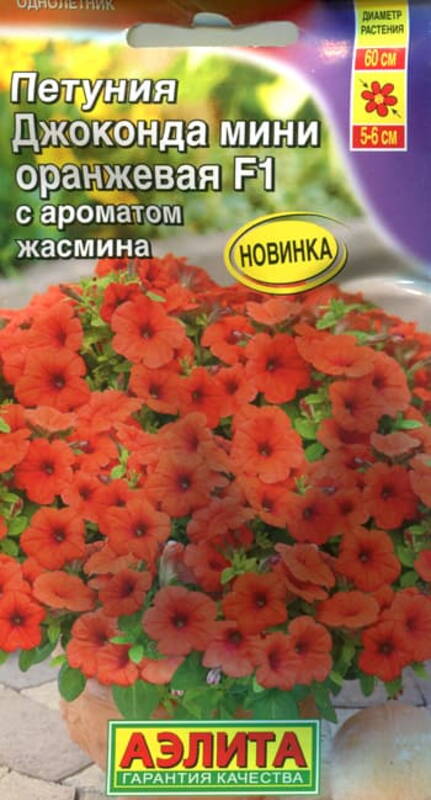
Petunia "Joconda Mini Orange" F1 - Petunia multiflora nana compacta.
New petunia with a unique flower color and a delicate jasmine aroma!
Plants are compact, highly branched, 20-25 cm high and 40-50 cm wide. They do not require pinching or shaping. Flowers are numerous, Ø 5-6 cm, do not set seeds due to the male sterility gene. The hybrid is resistant to rain, wind, heat and cold. Highly resistant to gray mold. It is great for container culture, landscaping and landscape design in open ground.
New petunia with a unique flower color and a delicate jasmine aroma!
Plants are compact, highly branched, 20-25 cm high and 40-50 cm wide. They do not require pinching or shaping. Flowers are numerous, Ø 5-6 cm, do not set seeds due to the male sterility gene. The hybrid is resistant to rain, wind, heat and cold. Highly resistant to gray mold. It is great for container culture, landscaping and landscape design in open ground.
The bush retains its attractiveness throughout the season, never becomes bare in the center, as it has a genetic ability to branch well from the very base.
The richest flowering is achieved due to the male sterility gene: plants do not form seeds, but strive for this, producing more and more flowers...
Even after a slight frost, JOCONDA MINI F1 quickly recovers and blooms tirelessly. Flowers are not damaged by strong winds and are resistant to rain. The hybrid will decorate sunny and slightly shaded flower beds, garden containers, and balcony boxes. Maintaining optimal growing conditions (11-hour daylight and a temperature of +20+22°С), you can keep the plants blooming all year round (!).
Sowing for seedlings from February to April. Seeds in granules! Sowing is superficial, without embedding (seeds germinate in the light!), under glass or film to maintain constant humidity until full germination. Granules must dissolve during sowing! February sowings require additional lighting.
Shoots appear on the 5-6th day. Picking in the phase of 1-2 true leaves. Planting hardened seedlings in the ground at the end of May.
* Despite its popularity (especially in urban flower beds), petunia has recently rarely appeared in our flower beds. Many consider it too banal, and others do not want to bother with seedlings every year...
However, you are unlikely to find another flower that not only has so many different shades and shapes, but also blooms all summer and autumn (until the very frosts), without requiring almost any attention!
In addition, petunia looks great in balcony boxes, hanging baskets and flower pots (especially spectacular in this case are ampel varieties). Recently, various forms of hybrid petunias have been mainly used (these can be both compact bushes 20-45 cm high and ampel varieties, the length of the stems of which reaches 75 cm). The color of the flowers can be very different, but striped two-color petunias, as well as double varieties, look especially original.
In addition, all petunias are divided into two large classes: multiflorous (flower diameter about 6 cm) and large-flowered (up to 12 cm in diameter). The former are more unpretentious and need only a sunny location. Large-flowered - more thermophilic and demanding to growing conditions, their flowers suffer more from prolonged rains.
Petunia is quite drought-resistant, but blooms better with regular watering. With an excess of fertilizers, you will get a lot of greenery and few flowers.
Seeds are sown at home at the end of March, without covering them with earth, but only pressing them into the soil. At a temperature of about twenty degrees, seedlings appear in 7-14 days. Seedlings should be kept at a temperature of at least eighteen degrees, otherwise the plants will not bush well. At the end of May, the seedlings must be hardened by exposing them to the street during the day.
It is necessary to plant petunia in place only after the last frosts.
It blooms 60-80 days after emergence. In order for flowering to continue all summer, the resulting ovaries must be removed immediately, preventing the formation of seeds. If in August the petunias are very elongated, and the buds remain only on the tops of the shoots, cut the plants almost at the base. After that, water and fertilize them well - after a few weeks, new lateral shoots will form and the petunia will bloom again. Especially successful specimens can be transplanted into pots in the autumn and placed on the window for continued flowering. In February, cuttings can be cut from them, rooted and planted in a flower bed in the spring.