


Your shopping cart is empty!
Radish "Zeljonaja Boginja"
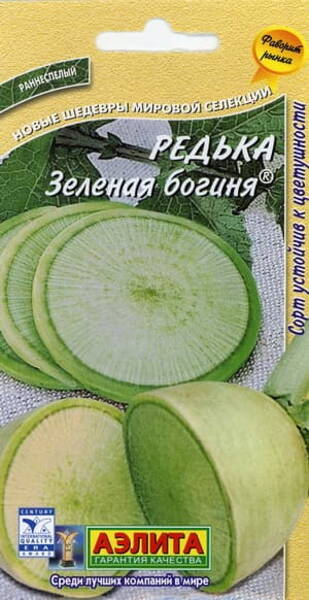
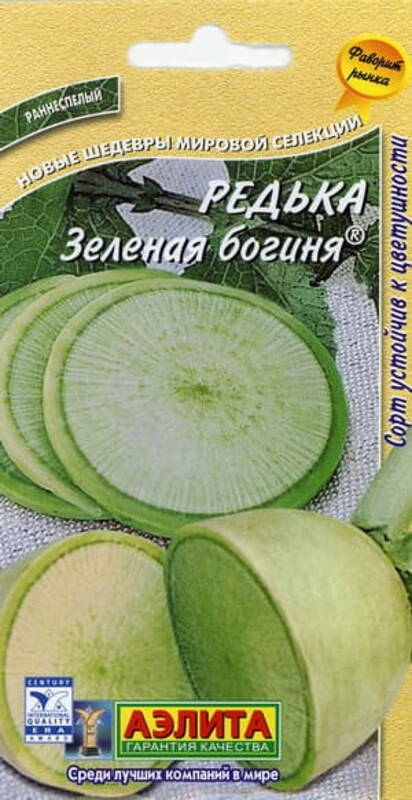
Radish "Green Goddess".
Strengthens the immune system.
A new early-ripening variety distinguished by a piquant taste (with the lowest amount of mustard oils) and a high content of trace elements, mineral salts, and 8 essential amino acids. Due to its mild effect, it can be gladly recommended for children's and healthy diet nutrition.
Roots are round in shape, tapering downwards, with an attractive green skin and pale green flesh color. The flesh is tender, crispy, very juicy, with a mildly spicy flavor.
It stores well without losing its taste qualities and does not become flabby. The variety is resistant to bolting.
Agrotechnology.
Radish prefers light soils rich in organic matter. Soil preparation begins in the fall by applying humus or compost, as well as mineral fertilizers.
Sowing is carried out early in the spring or at the end of June. Seeds are sown in furrows located at a distance of 35-40 cm from each other. Sowing depth is 1-2 cm.
Seedlings are thinned out, leaving about 10 cm between plants. Radish seedlings should be periodically treated with a mixture of tobacco dust and ash in a 1:1 ratio.
Further care consists of loosening and regular watering. The radish is fed three times over the entire growing season. Radishes are harvested as they mature.
Strengthens the immune system.
A new early-ripening variety distinguished by a piquant taste (with the lowest amount of mustard oils) and a high content of trace elements, mineral salts, and 8 essential amino acids. Due to its mild effect, it can be gladly recommended for children's and healthy diet nutrition.
Roots are round in shape, tapering downwards, with an attractive green skin and pale green flesh color. The flesh is tender, crispy, very juicy, with a mildly spicy flavor.
It stores well without losing its taste qualities and does not become flabby. The variety is resistant to bolting.
Agrotechnology.
Radish prefers light soils rich in organic matter. Soil preparation begins in the fall by applying humus or compost, as well as mineral fertilizers.
Sowing is carried out early in the spring or at the end of June. Seeds are sown in furrows located at a distance of 35-40 cm from each other. Sowing depth is 1-2 cm.
Seedlings are thinned out, leaving about 10 cm between plants. Radish seedlings should be periodically treated with a mixture of tobacco dust and ash in a 1:1 ratio.
Further care consists of loosening and regular watering. The radish is fed three times over the entire growing season. Radishes are harvested as they mature.