


Your shopping cart is empty!
Sorrel "Belleville"


Sorrel "Belleville".
The earliest greens from your garden!
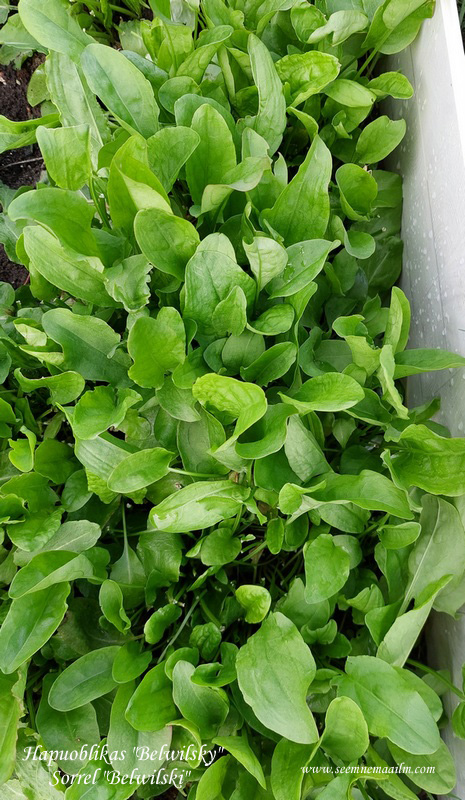
An early-ripening variety, giving the first harvest just 45-50 days after the start of spring regrowth. The leaf rosette is raised, leaf length up to 14 cm. The variety is valued for its resistance to bolting.
Sorrel is a perennial, winter-hardy crop, demanding of moisture but shade-tolerant. It grows excellently on fertile, slightly acidic, or neutral soils.
Main characteristics:
Sown early in spring or summer to a depth of 1.0-1.5 cm with row spacing of 20-25 cm.
Cutting begins when the leaves reach a length of 10 cm. A total of 4-5 harvests are carried out per season with an interval of 2-2.5 weeks.
The yield of greens is high – about 7 kg/m².
Application: used fresh (in salads and soups), for canning and freezing. Can be grown as a pot culture. Roots in the form of decoction and powder are used in folk medicine.
Important: In the year of sowing, the first cutting is carried out 2-2.5 months after germination. Flower stalks must be regularly removed. The last mass cutting is carried out no later than mid-August for successful overwintering of plants.
The earliest greens from your garden!
An early-ripening variety, giving the first harvest just 45-50 days after the start of spring regrowth. The leaf rosette is raised, leaf length up to 14 cm. The variety is valued for its resistance to bolting.
Sorrel is a perennial, winter-hardy crop, demanding of moisture but shade-tolerant. It grows excellently on fertile, slightly acidic, or neutral soils.
Main characteristics:
Sown early in spring or summer to a depth of 1.0-1.5 cm with row spacing of 20-25 cm.
Cutting begins when the leaves reach a length of 10 cm. A total of 4-5 harvests are carried out per season with an interval of 2-2.5 weeks.
The yield of greens is high – about 7 kg/m².
Application: used fresh (in salads and soups), for canning and freezing. Can be grown as a pot culture. Roots in the form of decoction and powder are used in folk medicine.
Important: In the year of sowing, the first cutting is carried out 2-2.5 months after germination. Flower stalks must be regularly removed. The last mass cutting is carried out no later than mid-August for successful overwintering of plants.
Cultivation: secrets of success.
Sorrel is a perennial herbaceous plant from the Buckwheat family. It is one of the earliest green crops, yielding a vitamin harvest from open ground in early spring.
It is very cold-resistant, overwinters without shelter, withstands frosts down to -7-10℃. Seeds begin to germinate at +2+3°C, but uniform shoots appear at +16+18°C. With sufficient soil moisture, it tolerates heat well.
Sorrel loves moisture. With a lack of it, the leaves become coarse, smaller, and the plant quickly bolts. Shade-tolerant, but for early and vitamin-rich greens, it is better to choose sunny, well-warmed areas. Grows in one place for 3-4 years.
Sowing and care:
Weed-free, moist areas that are freed from snow early are chosen for sorrel. Organic matter (10-15 kg/m²) is applied under digging in autumn. Better to sow in rows with row spacing of 40-50 cm.
1.0 g = 300-400 seeds.
Seeding rate 0.5-1.0 g/m², depth 2-3 cm. Sown in early spring (best time) or summer. Shoots (after 5-10 days) are desirable to cover from flea beetles with light material. Thinned twice: first leaving 15 cm, then (after 15-20 days) – 30-35 cm.
In spring, the soil is loosened and fed with phosphorus and potassium (20-30 g/m²).
Harvesting:
Harvested when leaf length is 10-12 cm. With spring sowing – in the same year, with summer sowing – next spring. The last cutting – 20-30 days before the end of the season. After each cutting – loosening, watering, removal of flower stalks.
Cut leaves in the morning while it is cool – they store longer.
For an extra-early harvest, film covers are used – this accelerates the harvest by 2 weeks and increases the yield by 2 times!
In spring, old leaves are removed, complex fertilizer is applied (20-40 g/m²). In the second and subsequent years, the number of cuttings increases to 3-4.
Winter forcing:
Roots of 2-3-year-old plants are dug up in autumn, stored at 0+2°C, and in February planted in a greenhouse or boxes. In 3-4 weeks, fresh greens are ready!
Seed production:
Seeds are collected from plants of 3-4 years of life (only one leaf cutting is done in spring, then allowed to flower). Harvested when inflorescences turn brown, ripened, and threshed.
* Sorrel: benefits and warnings.
Sorrel is the richest source of vitamins C and A (10 leaves cover the daily requirement!), calcium, potassium, magnesium, and folic acid.
Attention: contains a lot of oxalic acid, which is contraindicated in urolithiasis (kidney stones). The younger the leaves, the less acid. Try to harvest before July 1.
How to store:
1. Fresh: in a glass of water (1-2 days).
2. Freezing: wash, dry, pack in a bag/container (stored for a year).
3. Drying: crush and use as a seasoning.
How to cook soup with maximum benefit:
To preserve vitamin C:
- boil water for 5 minutes (removes oxygen – the enemy of vitamin C);
- add salt;
- add sorrel 5 minutes before the end of cooking.
During cooking, the amount of oxalic acid decreases slightly (by 5-15%).