


Your shopping cart is empty!
Sorrel "Broadleaved"


Sorrel "Broadleaved".
Perennial culture.
Early-ripening (40-45 days), high-yielding, and cold-resistant variety, resistant to bolting.
The leaf is large, light green, elongated-oval in shape, with excellent taste qualities.
Sorrel leaves are a source of many essential vitamins and can be used for fresh consumption and processing.
Cultivation.
Sorrel is grown by direct sowing of seeds into the ground. Seeding depth is no more than 0.5 cm. Seedlings appear in 12-15 days.
Further care consists of loosening the soil, regular watering, and feeding with complex mineral fertilizers.
Harvesting of green mass is carried out at intervals of 15-20 days.
Perennial culture.
Early-ripening (40-45 days), high-yielding, and cold-resistant variety, resistant to bolting.
The leaf is large, light green, elongated-oval in shape, with excellent taste qualities.
Sorrel leaves are a source of many essential vitamins and can be used for fresh consumption and processing.
Cultivation.
Sorrel is grown by direct sowing of seeds into the ground. Seeding depth is no more than 0.5 cm. Seedlings appear in 12-15 days.
Further care consists of loosening the soil, regular watering, and feeding with complex mineral fertilizers.
Harvesting of green mass is carried out at intervals of 15-20 days.
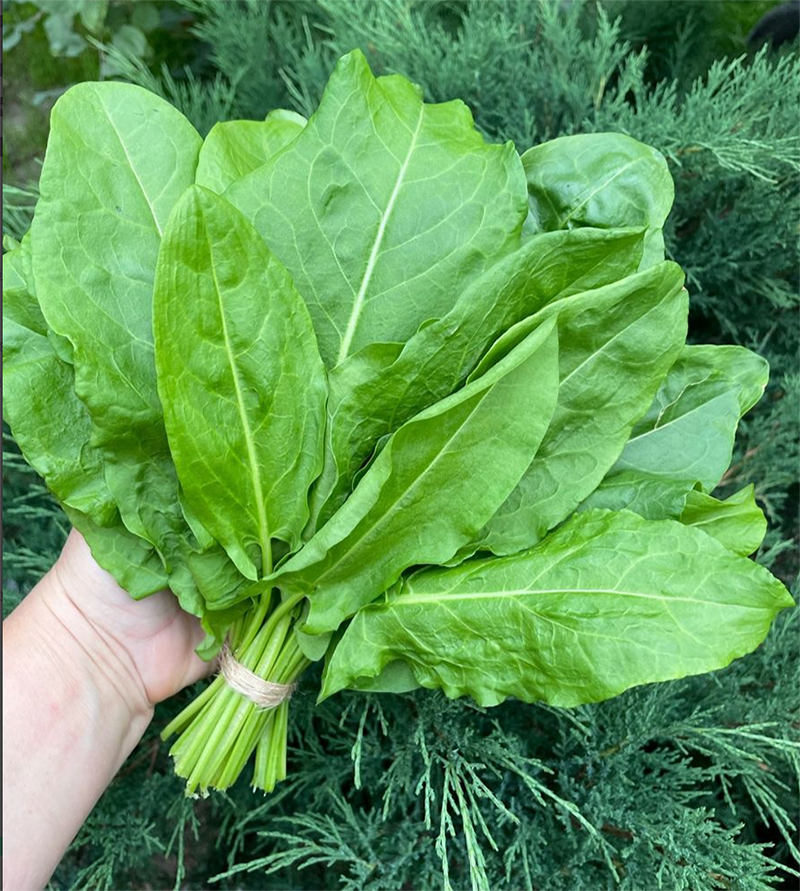
* Sorrel can be sown both in spring and autumn, but in spring, as a rule, there is "no time for sorrel", so we sow it in the autumn, and in the spring only care remains and waiting for refreshing, surprisingly tasty sour leaves...
When the hateful snow begins to melt, and the temperature on the thermometer rises to +3+4 degrees, sorrel begins to grow.
That is why the sunniest bed is chosen for it: the one where snow turns into life-giving moisture fastest.
Before sorrel begins to grow, when the soil is physically ready, shallow loosening can be carried out and covered with a nutritious layer of mulch.
A couple of days later, the first feeding can be carried out (mullein diluted about 5-6 times with water is ideal for this).
It will also not be superfluous if you add potash and phosphorus fertilizers to the resulting mixture (10-15 g per m² is quite enough).
Such feeding can be carried out several times: two, or better three. But as soon as the sorrel leaves begin active growth, feeding should be stopped, as the taste may deteriorate.
By the way, as soon as the plants begin to gain strength, look at them closely: are they too crowded in the garden bed?
If they grow densely, they should be ruthlessly weeded, leaving stronger plants with a distance between them of 5-6 cm.
It is not worth sparing the seedlings, because in thickened conditions you will get weak plants that are no match for those that live on a sufficient nutritional area, since the leaves of such specimens are large and very juicy.
In late April - early May, weeding should begin, as weeds have already grown by this time, and if the soil is moist (after rain or watering), they are pulled out easily and practically with the entire root system – this is a guarantee of less frequent weeding in the future.
In general, weeding, combined with loosening of row spacing to a shallow depth, must be carried out every two weeks.
The second loosening must be combined with the second feeding, and if you decided to leave the sorrel for another year after cutting, you can loosen the soil and feed the plants afterwards. By the way, sorrel that remained from last year can continue to be grown.
Care for such sorrel should begin with the removal of old foliage and stems; an ordinary rake is perfect for this; the main thing is not to delay this event and carry it out while there are no fresh leaves yet, or they are very small.
After removing last year's leaves, it is necessary to start loosening the row spacing, as well as feeding with any complex mineral fertilizer or mullein solution, which will promote active leaf growth.
You can start harvesting sorrel (both winter and grown in a biennial culture) in early June: the leaves will already stretch out to a good ten centimetres.
They can be cut with a knife or pinched off with petioles. The main thing is not to damage the plant, so the petioles should be no more than six centimetres long.
* What nutrition does sorrel need?
In spring, sorrel is fed with any nitrogen fertilizer (3 tablespoons per 10 litres of water), using 1 litre of solution per 1 m² of plantings.
After each cut, nitrogen feeding is repeated; weed infusion can be used instead of mineral fertilizer.
At the end of August, feeding with any potash fertilizer is given (ash is not used, as it neutralizes the soil, and sorrel prefers acidic soils).
Phosphorus is not used in feeding, as it provokes sorrel to bolt (flower).
If the soil was well fertilized with organic matter before planting, mineral fertilizers are not applied at all.
Important: sorrel plantings need not so much watering as regular loosening.
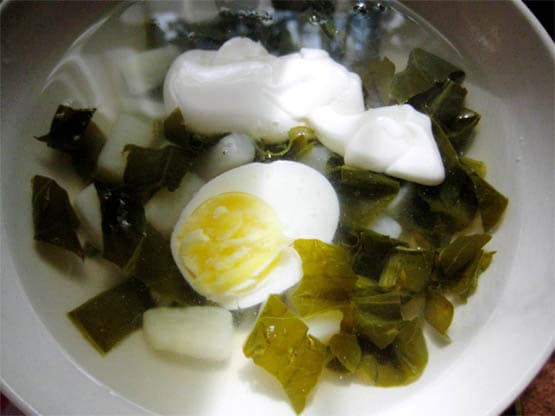
* Sorrel is rich in vitamin C, calcium, potassium, magnesium, and oxalic acid.
Sorrel is the richest source of vitamins C and A. Just 10 sorrel leaves are enough to replenish the body's daily need for these vitamins.
Sorrel contains folic acid, which stabilizes DNA and fights cancer.
Sorrel is a source of calcium, potassium, and magnesium.
The disadvantage of sorrel is that it contains oxalic acid, which, combining with calcium, can form kidney stones. Therefore, sorrel is absolutely contraindicated for people suffering from urolithiasis.
By the way, sorrel is the champion in oxalic acid content: it has more of it than spinach and 25 times more than parsley. But the younger the sorrel, the less oxalic acid it contains.
If you grow sorrel on your plot, try to harvest it before July 1st – the longer sorrel grows, the more oxalic acid accumulates in it.
How to store:
1. Wash fresh sorrel, dry it with a paper towel, put it in a glass of water, and store for 1-2 days.
2. Wash sorrel, dry it with a paper towel, put it in a vacuum container or special cling film, and store in the freezer for about a year.
3. Dry, chop sorrel leaves – and then add as a seasoning to all kinds of dishes.
How to cook:
Treat sorrel as a seasoning and do not overuse it. Add sorrel to salads. If you like sorrel soup – prepare it correctly to get the maximum dose of vitamin C:
- before cooking, boil the water for the soup for 5 minutes – this is necessary so that oxygen, which is the main destroyer of vitamin C, leaves the water;
- then throw a pinch of salt into the water – it will displace the remaining oxygen;
- add sorrel to the soup 5 minutes before the end of cooking – and then the destruction of vitamin C will be minimal.
With all this, the decrease in the amount of oxalic acid during boiling will be insignificant, about 5-15%.
Bot. syn.: Rumex patientia L.
* Leaves, roots, and fruits are used for medicinal purposes.
Sorrel leaves contain flavonoids, lipids, proteins, a small amount of sugars, mineral salts, organic acids, carotene, vitamins B1 and B2, K, PP.
Tannins, vitamin K, and other substances have been found in sorrel roots. In fruits - vitamins C, K, PP, carotene, flavonoids, anthraquinones.
Preparations from sorrel have astringent, haemostatic, diuretic, anti-allergic, antiscorbutic, choleretic, antitoxic, antifungal, and analgesic effects.
Sorrel is used as a remedy that improves digestion, reduces putrefactive fermentation in the intestines, and as a wonderful antiscorbutic remedy.
Healthy recipes with sorrel:
* Sorrel salad with eggs.
Chop washed sorrel leaves, finely chop boiled eggs. Mix everything, salt, season with sour cream.
* Sorrel salad with nuts.
Chop sorrel leaves, mix with crushed walnuts. Add honey.
* Vegetable salad with sorrel.
Finely chop sorrel, add coarsely grated carrots and sliced boiled potatoes. For dressing, use vegetable oil with chopped onions.
* Salad with spinach and sorrel.
Chop spinach and sorrel, add chopped green onions. Prepare a dressing by mixing honey with cranberries. The salad can be garnished with nuts.
* Sorrel salad with olives.
Wash sorrel, green onions, parsley, chop finely. Add sliced olives, salt, and vegetable oil to taste. Then mix everything well and garnish with hard-boiled eggs.
* Green borsch.
Shred beets, stew until tender. Fry roots and onions. Put sliced potatoes into boiling broth, after 10-15 minutes add stewed beets, fried roots, chopped sorrel, and spices. Put sour cream in plates with borsch, you can decorate with slices of hard-boiled eggs.
* Green okroshka (cold soup).
Wash sorrel, boil in salted water, rub through a sieve. Cool the broth with sorrel, add finely chopped green onions rubbed with salt, finely chopped cucumbers, rubbed egg yolk. Serve with sour cream and dill greens.
* Pie filling.
Different types of dough are used for pies: yeast, puff, etc. The filling can be made sweet by adding 100-150 g of sugar per 150 g of sorrel (sometimes this mixture is stewed in a small amount of water until soft).
Or you can prepare a filling without sugar, adding a few leaves of mint or lemon balm to finely chopped sorrel for aroma. In this case, you need to add a little salt.
* Sorrel leaves are harvested for future use by freezing or salting. Then even in winter, you can please yourself and your loved ones with a spring lunch.