


Your shopping cart is empty!
Green vitriol (FeSO4 x 7H2O) Ferrous sulfate (1 kg)
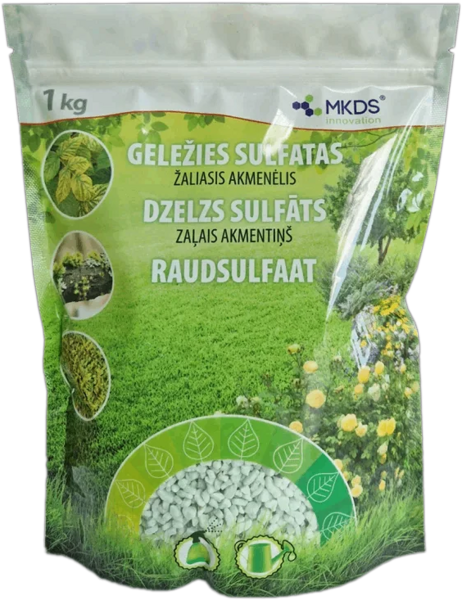
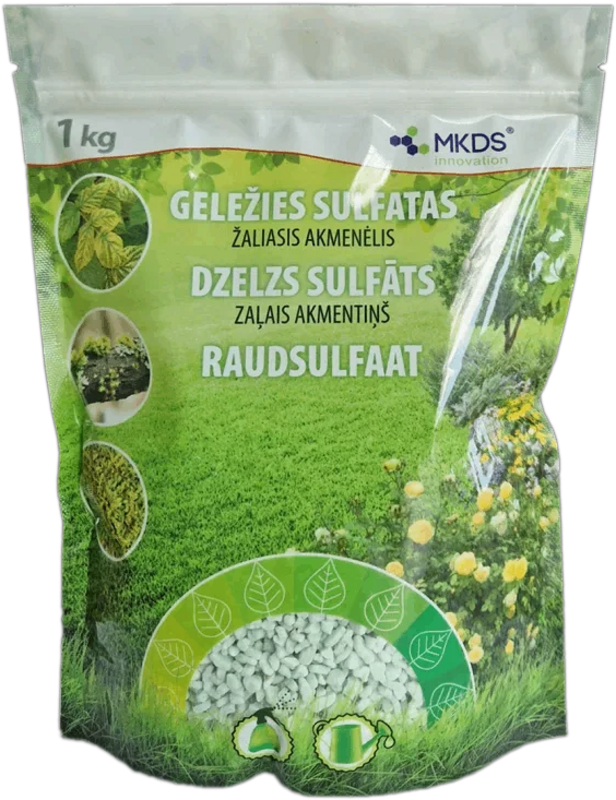
Iron vitriol, ferrous sulfate or Iron(II) sulfate FeSO4.
Almost 200 years ago, it was proven that iron salts are necessary for the normal growth and fruiting of plants (and the warmer the climatic zone, the higher the plants' need for iron). Iron deficiency manifests itself in chlorosis – yellowing of leaves, decreased yields, and in severe starvation, even the death of trees.
Traditionally, the main and most accessible basic iron-containing fertilizer is – iron vitriol (ferrous sulfate).
It contains salts in two forms: iron(II) sulfate – FeSO4 and iron(III) sulfate – Fe2(SO4)3.
Any fertilizers containing iron sulfate in these forms are not recommended for foliar spraying, because in this form they are poorly absorbed by plants and can burn the foliage (moreover, iron is poorly transferred from one part of the plant to another). That is why, with chlorosis, the tips of the shoots with young leaves suffer first. Therefore, iron sulfate is best applied to the roots.
There are iron-containing preparations in a chelated state that can be used for foliar spraying, but they are expensive, so applying them to the root is simply not economically viable (at the same time, chelated fertilizer is better absorbed by plants both during spraying and root watering).
The trick is that the iron ion is bound by some active substance, for example, citric acid, so in this form, the iron is more mobile and is not bound by the soil as quickly.
Gardeners noticed this phenomenon a long time ago and use homemade chelated compositions, increasing the effectiveness of iron sulfate by first dissolving 1-2 spoons of citric acid in a bucket and only then pouring in a tablespoon of iron sulfate (by the way, citric acid neutralizes water hardness, increasing the effectiveness of other fertilizers too, even better than nitrophoska).
For treating trees and shrubs against insect pests and diseases.
For spraying fruit trees and berry bushes, a 3-5% solution of iron sulfate is prepared (300-500 g per 10 liters of water). Spraying is done in early spring (before bud break) or late autumn (after leaf fall), as well as in case of moss appearing on tree trunks and on the lawn.
Lawn spraying.
Moss appears on the lawn if the soil is too dense and poorly ventilated, poor in nutrients, located in the shade, too moist, or acidic.
Iron sulfate helps restore the lawn, making it thick and green. The iron content in ferrous sulfate plays an important role in the biological processes of plants, improving grass growth. Iron sulfate is based on natural minerals and does not harm plants.
To remove moss on the lawn, dissolve 200 g in 10 liters of water and spray over an area of 20 m².
After using iron sulfate, the moss turns black due to an increase in acidity in the topsoil. The blackened moss is removed from the lawn, and soil is added to the resulting "bald spots" and new seeds are sown. To guarantee the elimination of moss, we recommend regularly aerating the lawn (by piercing) and reducing soil acidity with slaked lime.
Application periods: from April to October as needed. It is not recommended to use during a drought and the rainy season.
Almost 200 years ago, it was proven that iron salts are necessary for the normal growth and fruiting of plants (and the warmer the climatic zone, the higher the plants' need for iron). Iron deficiency manifests itself in chlorosis – yellowing of leaves, decreased yields, and in severe starvation, even the death of trees.
Traditionally, the main and most accessible basic iron-containing fertilizer is – iron vitriol (ferrous sulfate).
It contains salts in two forms: iron(II) sulfate – FeSO4 and iron(III) sulfate – Fe2(SO4)3.
Any fertilizers containing iron sulfate in these forms are not recommended for foliar spraying, because in this form they are poorly absorbed by plants and can burn the foliage (moreover, iron is poorly transferred from one part of the plant to another). That is why, with chlorosis, the tips of the shoots with young leaves suffer first. Therefore, iron sulfate is best applied to the roots.
There are iron-containing preparations in a chelated state that can be used for foliar spraying, but they are expensive, so applying them to the root is simply not economically viable (at the same time, chelated fertilizer is better absorbed by plants both during spraying and root watering).
The trick is that the iron ion is bound by some active substance, for example, citric acid, so in this form, the iron is more mobile and is not bound by the soil as quickly.
Gardeners noticed this phenomenon a long time ago and use homemade chelated compositions, increasing the effectiveness of iron sulfate by first dissolving 1-2 spoons of citric acid in a bucket and only then pouring in a tablespoon of iron sulfate (by the way, citric acid neutralizes water hardness, increasing the effectiveness of other fertilizers too, even better than nitrophoska).
For treating trees and shrubs against insect pests and diseases.
For spraying fruit trees and berry bushes, a 3-5% solution of iron sulfate is prepared (300-500 g per 10 liters of water). Spraying is done in early spring (before bud break) or late autumn (after leaf fall), as well as in case of moss appearing on tree trunks and on the lawn.
Lawn spraying.
Moss appears on the lawn if the soil is too dense and poorly ventilated, poor in nutrients, located in the shade, too moist, or acidic.
Iron sulfate helps restore the lawn, making it thick and green. The iron content in ferrous sulfate plays an important role in the biological processes of plants, improving grass growth. Iron sulfate is based on natural minerals and does not harm plants.
To remove moss on the lawn, dissolve 200 g in 10 liters of water and spray over an area of 20 m².
After using iron sulfate, the moss turns black due to an increase in acidity in the topsoil. The blackened moss is removed from the lawn, and soil is added to the resulting "bald spots" and new seeds are sown. To guarantee the elimination of moss, we recommend regularly aerating the lawn (by piercing) and reducing soil acidity with slaked lime.
Application periods: from April to October as needed. It is not recommended to use during a drought and the rainy season.