


Your shopping cart is empty!
Melissa officinalis "Mahito"
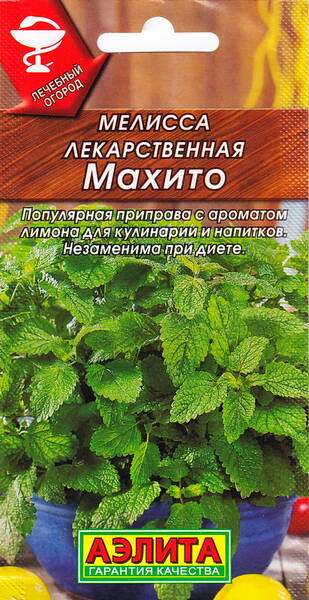
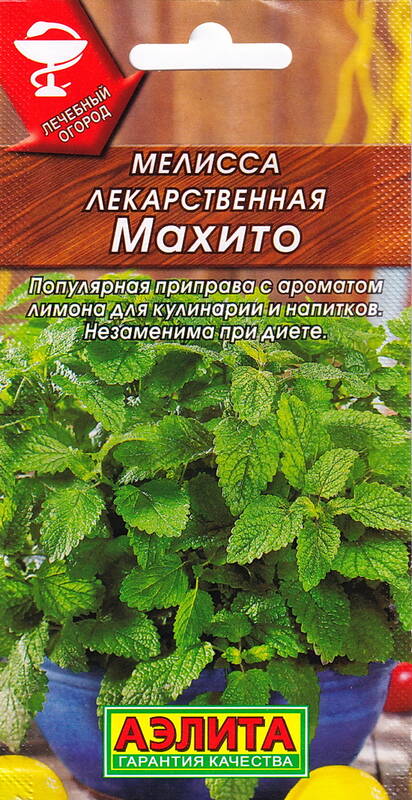
Melissa officinalis "Mahito".
A perennial herbaceous plant 50-60 cm high. The stem is annual, branched, densely leafy. Leaves petiolate, oblong-ovate. Flowers small, corollas lilac-pink or red-violet. Mint is an excellent honey plant.
A perennial herbaceous plant 50-60 cm high. The stem is annual, branched, densely leafy. Leaves petiolate, oblong-ovate. Flowers small, corollas lilac-pink or red-violet. Mint is an excellent honey plant.
Sowing time and scheme.
It is mainly propagated vegetatively: by dividing rhizomes, cuttings and layering (creeping ground shoots), which ensures the alignment of plants and preserves their varietal qualities. Rhizomes are planted in furrows with row spacing of 60-70 cm and covered with earth.
When grown by seedling method, seedlings (cuttings, layers, rhizomes) are pricked into greenhouses or on beds 1 m wide in 3 rows (distance between rows — 30, interval between plants in a row — 20-30 cm). Planting depth — 6-8 cm.
When grown by seedling method, seeds are sown in March, without covering with earth, in boxes, which are placed in greenhouses or a greenhouse.
When grown from seedlings, seedlings are planted in the ground in spring or late summer (August). Cuttings during vegetative propagation are rooted in sand in summer, and by autumn they get good planting material.
Care.
It consists in loosening row spacings and weeding.
Watering.
After planting, mint is watered 2-3 times a week for rapid germination and survival. Watering is especially necessary during a dry growing season.
Top dressing.
During the formation of buds, they are fed with manure (1:10), the consumption of the solution — 0.5 l per 1 m2. During the active growth of the plant, you can feed with mineral fertilizers (in g/m2): ammonium nitrate — 5, superphosphate — 10—15, potassium chloride — 4.
Harvesting.
For fresh consumption, leaves and shoots are cut as needed. Harvesting for harvesting for future use begins the year after planting. Mint is cut at the beginning of flowering, when it contains the largest amount of essential oil. Usually 2 cuts are carried out per season, with good regrowth — 3.
Plants cut from the ground are wilted on the site, dried under a canopy and stored in paper bags at a temperature of +10+15°C. The yield of dry mass is 200 g per 1 m2.
Possible failures.
When cultivating mint, they are extremely rare — mainly in case of non-compliance with agricultural technology. However, it should be remembered that mint spreads quickly throughout the site and can drown out other crops.
.jpg)