


Your shopping cart is empty!
Chinese cabbage "Paket" (Pak-choy)
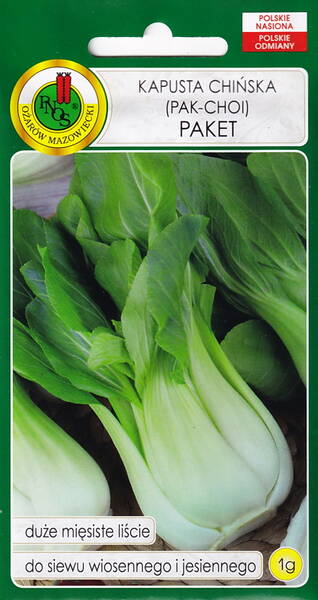
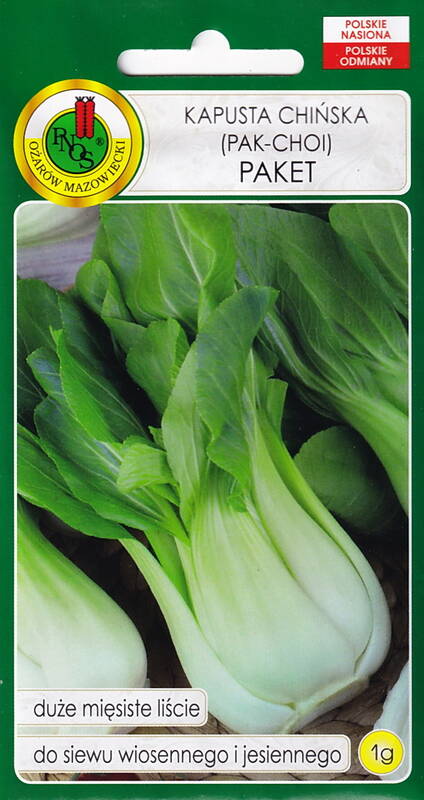
Brassica oleracea var. chinensis
1.30€
Ex Tax: 1.05€
Ex Tax: 1.05€
Chinese Cabbage "Paket" (Pak Choi).
Excellent choice for healthy eating: lose weight quickly and tastily! A vitamin bomb: only 13 kcal and 300% Vitamin C!
An early ripening (45-55 days) variety of non-heading leafy cabbage. This is the ideal choice for those watching their figure and health.
Characteristics:
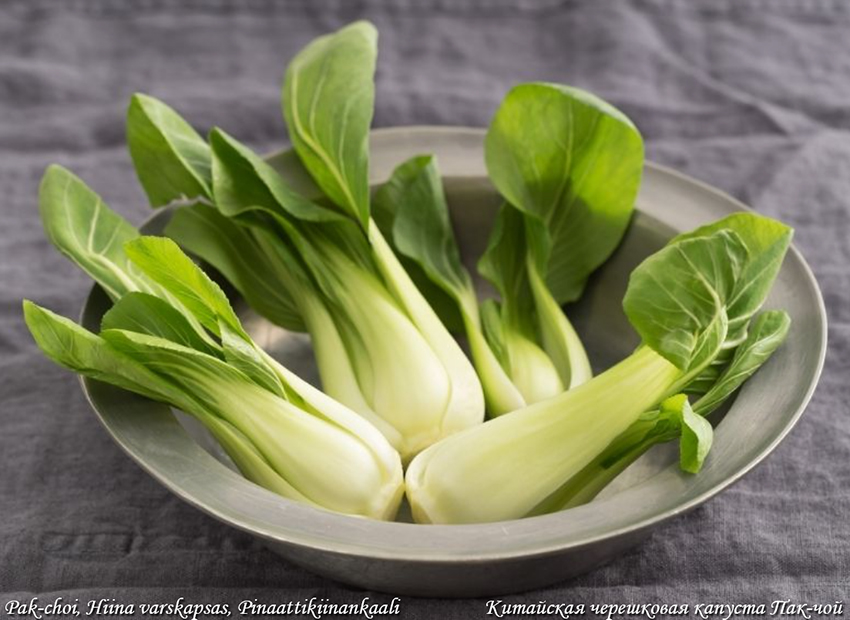
The leaf rosette is compact, upright, 20-40 cm in diameter. Leaves are smooth, dark green, with broad, fleshy, and very juicy white stems (petioles).
The weight of a single plant is impressive — reaching up to 1.2 kg, with 2/3 of the mass being the appetizing crunchy stems.
Variety value and usage:
"Paket" is a culinary chameleon. The taste is a cross between cabbage, lettuce, and spinach, but with a piquant zest. Stems are stir-fried in a wok, braised like asparagus, or eaten fresh. Leaves can replace spinach.
Acts as a body "cleanser": removes toxins and boosts immunity.
Although Chinese cabbage is nutritionally similar to white cabbage, it contains 3 times more Vitamin C.
It possesses the ability to dissolve foreign proteins entering the blood, thus serving as a purifier against harmful microorganisms.
Excellent choice for healthy eating: lose weight quickly and tastily! A vitamin bomb: only 13 kcal and 300% Vitamin C!
An early ripening (45-55 days) variety of non-heading leafy cabbage. This is the ideal choice for those watching their figure and health.
Characteristics:
The leaf rosette is compact, upright, 20-40 cm in diameter. Leaves are smooth, dark green, with broad, fleshy, and very juicy white stems (petioles).
The weight of a single plant is impressive — reaching up to 1.2 kg, with 2/3 of the mass being the appetizing crunchy stems.
Variety value and usage:
"Paket" is a culinary chameleon. The taste is a cross between cabbage, lettuce, and spinach, but with a piquant zest. Stems are stir-fried in a wok, braised like asparagus, or eaten fresh. Leaves can replace spinach.
Acts as a body "cleanser": removes toxins and boosts immunity.
Although Chinese cabbage is nutritionally similar to white cabbage, it contains 3 times more Vitamin C.
It possesses the ability to dissolve foreign proteins entering the blood, thus serving as a purifier against harmful microorganisms.
Agrotechnics:
1. Timing: Sowing in open ground is done in two terms – in spring and in the second half of summer. Summer sowing ensures a higher and better quality harvest. Spring sowing must not be delayed; with daylight longer than 13 hours, there is a high probability of bolting (flowering).
2. Sowing: It is best to sow directly into the ground or into peat pots (the plant does not like transplanting).
Pak Choi is usually sown in early July to mid-summer (this is a more favourable time than early spring sowing). Sow directly into beds in furrows to a depth of 2-3 cm. Then thin out the seedlings. Spacing: 35 cm between rows, 30 cm between plants in the row.
Attention: when sowing in open ground, freshly dug loose soil should be slightly compacted so that the seeds do not sink too deep.
3. Care: Agrotechnics of Pak Choi coincide with growing leafy Chinese cabbage. However, stem cabbage has much less strict soil requirements than heading cabbage or cauliflower.
Like all brassicas, Pak Choi demands regular good watering. It requires regular weeding and soil loosening. During the growing season, Pak Choi should be fertilized 1-2 times with liquid herbal fertilizer or mullein infusion. It is also advisable to fertilize after prolonged rains.
Disease and pest prevention is the same as for other cabbage types. Protect seedlings from flea beetles with ash. Return to the same spot after 3-4 years.
Harvest. Summer-sown Pak Choi is harvested in September before frost.
Yield: up to 18 kg/m² in greenhouses.
Bot. syn.: Brassica antiquorum H.Lev., Brassica campestris subsp. chinensis (L.) Makino, Brassica campestris var. chinensis (L.) T.Ito, Brassica chinensis L., Brassica dubiosa L.H.Bailey, Brassica oleracea var. chinensis (L.) Prain, Brassica rapa var. amplexicaulis Y.Tanaka et Ono, Brassica rapa var. chinensis (L.) Kitam.
The Whole Truth About Nitrates: Busting the Main Myth of Organic Farming.
Think using only manure guarantees nitrate-free veggies? Think again!
Many gardeners are convinced that avoiding "chemicals" ensures an ecologically pure harvest. Alas, this is a dangerous misconception. Nitrates are a natural part of the nitrogen cycle. They have always been there, and always will be: in the soil and in plants. And the plant does not care at all where it gets its nitrogen from — from a granule of saltpeter or from a rotted cow pat.
What are nitrates and why are they dangerous?
Scientifically, these are salts of nitric acid (e.g., ammonium nitrate NH4NO3, calcium nitrate Ca(NO3)2). They dissolve perfectly in water and quickly reach the roots.
Even if you didn't scatter "mineral water" (fertilizers), but generously fertilized the bed with manure, the process of nitrification will still start in the soil, and — voila! — the very same nitrates will accumulate in the vegetables.
What is the threat?
An excess of nitrates in the human body (especially in children) works like a "silent saboteur": it blocks the delivery of oxygen by the blood (turning hemoglobin into methemoglobin) and hits the gastrointestinal tract.
Safe dose: 5 mg per 1 kg of your body weight per day. That is, a person weighing 70 kg can "eat" no more than 350 mg of nitrates.
Where do nitrates hide? (Maximum Permissible Concentration limits in mg/kg):
Accumulation Champions ("risk group"): Lettuce, spinach, parsley, dill (up to 2000), Beetroot (1400), Early cabbage (900).
Middleweights: Zucchini (400), Potatoes (250), Carrots (250), Peppers (200).
The Cleanest: Tomatoes and cucumbers (150), Melons (90), Watermelons (60), Onions (80).
Champions: Fruits and berries (apples, cherries, currants) - accumulate almost no nitrates.
Three "Golden Rules" to reduce nitrates:
1. Moderation. Do not overfeed the soil with nitrogen! Especially on peat soils (the fertilizer dose must be halved there). Apply fertilizers fractionally — a little bit throughout the summer, rather than all at once.
2. Balance is everything. Do not feed plants with nitrogen alone. They need phosphorus and potassium. When the "menu" is balanced, the plant processes nitrates into useful proteins rather than stockpiling them in the leaves.
3. Weather matters too. In a cloudy, rainy summer, photosynthesis slows down, and nitrates accumulate more actively. In such weather, it is better not to eat greens raw, but to process them.
Where is the vegetable's nitrate "warehouse"? (What needs to be cut off):
- Cucumber: maximum in the skin and at the "butt" (closer to the stem).
- Cabbage: the stalk (core) and the upper covering leaves are the "dirtiest" places.
- Carrot: the core accumulates more than the flesh. The root tip is cleaner than the top.
- Zucchini: concentration drops from the stem to the "nose" (flower end).
- Beetroot: cut off the top and the very long tail of the root.
Culinary Life Hack:
Processing works wonders! Fermenting cabbage (sauerkraut) reduces nitrate levels by 2 times. Boiling peeled potatoes — by 3 times (but boiling "in their jackets" helps very little).
Final tip: Don't spare the water! Heavy watering of beds a couple of days before harvesting literally "washes out" excess salts from the plants.