


Your shopping cart is empty!
Pansy "Cats Orange" F1
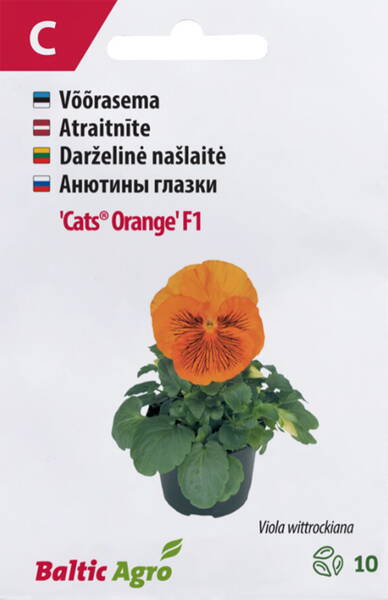
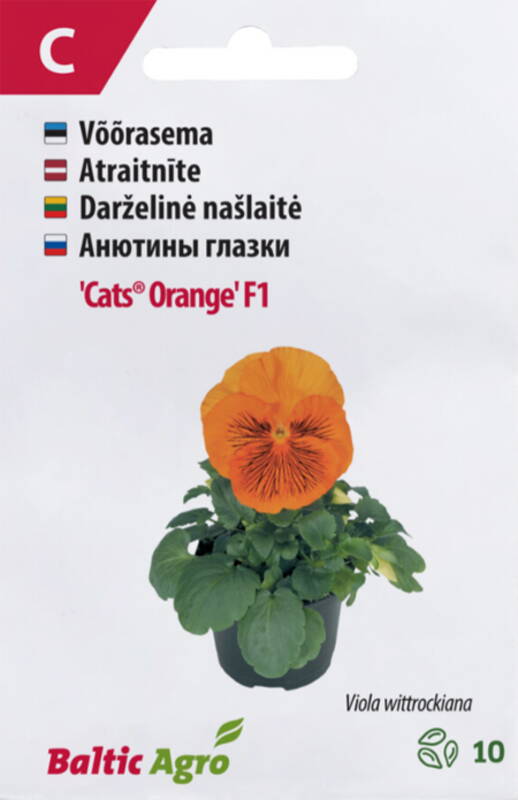
Pansy (Viola) "Cats Orange" F1 - Viola x wittrockiana.
German quality: A unique series of large-flowered violas, memorable for their bright, shimmering shades with contrasting black strokes ("whiskers").
Blooms profusely and continuously from May to September. Plant height 15-18 cm, flowers 6 cm in diameter.
The plant is moisture-loving, cold-resistant, grows well in the sun and partial shade. To obtain plants blooming in the year of sowing, seeds are sown for seedlings in February-March. Seedlings appear in 5-7 days. Seedlings are planted in open ground in late April - early May at a distance of 20 cm. They tolerate transplanting well even when in bloom. When sown in open ground in June-July, flowering occurs in the second year.
Used for planting in flower beds, borders, balcony boxes, and garden vases.
German quality: A unique series of large-flowered violas, memorable for their bright, shimmering shades with contrasting black strokes ("whiskers").
Blooms profusely and continuously from May to September. Plant height 15-18 cm, flowers 6 cm in diameter.
The plant is moisture-loving, cold-resistant, grows well in the sun and partial shade. To obtain plants blooming in the year of sowing, seeds are sown for seedlings in February-March. Seedlings appear in 5-7 days. Seedlings are planted in open ground in late April - early May at a distance of 20 cm. They tolerate transplanting well even when in bloom. When sown in open ground in June-July, flowering occurs in the second year.
Used for planting in flower beds, borders, balcony boxes, and garden vases.
* Viola wittrockiana (Garden Pansy).
Among early and beautifully flowering cultivated plants, they occupy one of the first places in floriculture. A perennial plant grown as a biennial, 15 to 30 cm high. The bush is compact at the beginning of the growing season, then becomes spreading. The main shoot is upright. Fibrous root system. Single flower.
Particular value lies in the early and abundant flowering of the plant. In Estonian conditions, they bloom as early as the end of April.
Propagation: Pansies are mainly propagated by seeds and green cuttings.
Depending on the planned flowering time, sowing is done at different times. To obtain early spring abundant flowering, seeds are sown in the summer of the previous year (late June). To obtain seedlings, they are sown in seedbeds or on well-cultivated ridges, in rows. In the row, seeds are sown sparsely; seedlings appear in 6-14 days.
Care: watering, loosening row spacing. The earth should be moist but not damp/soggy, since crops are severely damaged by fungal diseases (damping-off or "black leg"). Seedlings are pricked out (dived) after 3-4 weeks to other ridges or nursery beds where they must overwinter. Spring sowings of pansies are fed a week after the seedlings take root with complete mineral fertilizer (NPK). Seedlings are planted out in early May for summer flowering and in September for spring flowering.
Pansies in bloom are transplanted into flower beds, pots, or flower boxes. Plantings are systematically weeded and loosened, watered if necessary, and pests are controlled. It is useful to feed seedlings with ammonium nitrate and superphosphate (20-40 g per 1 m²).
To prolong flowering in the summer, all faded flowers (deadheading) are removed, which delays the development of fruits, since plants stop blooming when setting seeds.
On poor, dry, sandy soils, pansies quickly become smaller. On such soils, it is necessary to apply organic fertilizers in the form of compost and humus (5 kg per 1 m²); fresh manure must not be applied.
Large and bright flowers form on pansies in a sunny place. In partial shade, they bloom somewhat longer but poorer; the flowers are smaller and paler. In summer, when pansies finish blooming and lose their decorative effect, they are dug up and replaced with annuals.