


Your shopping cart is empty!
Sweet Pepper "Golden Treasure"

Eco seeds

Sweet Pepper "Golden Treasure".
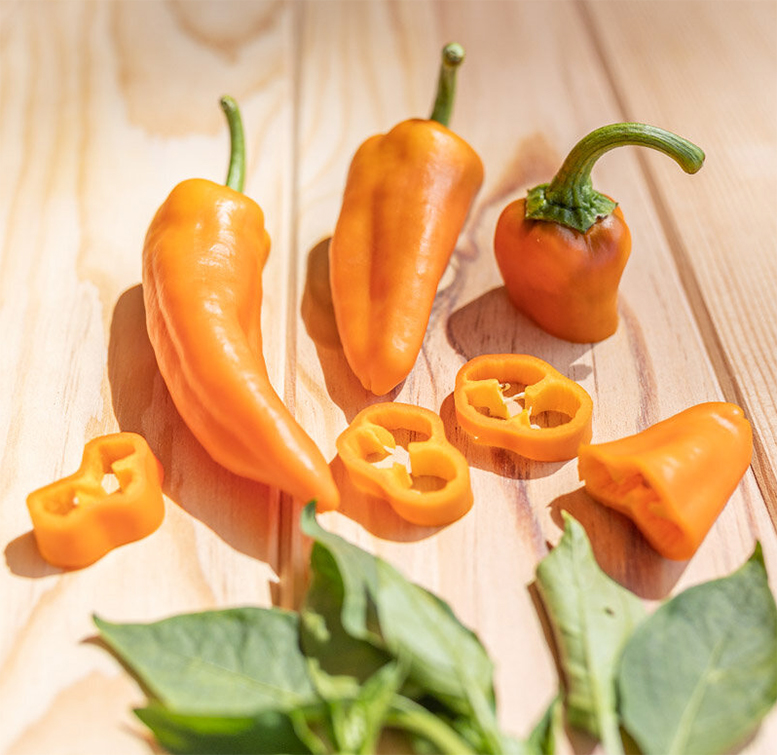
This Italian heirloom variety produces beautiful green fruits that turn yellow-orange upon ripening, becoming elongated and pointed, 20–25 cm in length.
The thin skin hides a thick and very juicy, sweet flesh.
Maturity: Mid-season.
Plant height: 60–100 cm.
Growing Conditions.
Sow for transplants. Seed depth 1 cm. Cover crops with film or glass until germination. Optimal temperature for seed germination is +25°C.
Transplant seedlings when the threat of frost has passed. The crop is heat-loving and demanding of soil fertility and moisture.
Sowing: February (3) - March.
Transplanting: May (2,3) June (1).
Harvest: July – September (1,2).
This Italian heirloom variety produces beautiful green fruits that turn yellow-orange upon ripening, becoming elongated and pointed, 20–25 cm in length.
The thin skin hides a thick and very juicy, sweet flesh.
Maturity: Mid-season.
Plant height: 60–100 cm.
Growing Conditions.
Sow for transplants. Seed depth 1 cm. Cover crops with film or glass until germination. Optimal temperature for seed germination is +25°C.
Transplant seedlings when the threat of frost has passed. The crop is heat-loving and demanding of soil fertility and moisture.
Sowing: February (3) - March.
Transplanting: May (2,3) June (1).
Harvest: July – September (1,2).
If seedlings developed normally during March-April but began to stretch (become leggy) by the end of April, this may happen for two reasons.
* In late April, although the sun shines for a long time, indoor lighting (on the windowsill) is still insufficient, which leads to seedling stretching.
* During this period, you need to monitor the temperature especially carefully - both day and night. The simplest way to regulate temperature is regular ventilation. Peppers, tomatoes, cabbage, and onions require regular ventilation and can withstand slight drafts, but rooms housing cucurbit (pumpkin family) seedlings must be ventilated very carefully, as these crops are very sensitive to drafts. By April, tomato, pepper, and eggplant plants are already quite large and can shade each other, which also leads to stretching. At the first signs of stretching, several measures can be taken to prevent the formation of thin, curved seedlings:
1. Move pots with seedlings further apart, if, of course, the windowsill area allows. Plants should be placed so that their leaves do not touch each other.
2. If seedlings are grown in large boxes, plants can be transplanted into individual pots, and pot-grown seedlings can be potted up into larger containers. This technique will provoke predominant root system growth, and the growth of the aerial part will slow down for a while, as the plants will be better lit and will not stretch as much.
3. You can trim 1 - 2 lower leaves; this will eliminate mutual shading of plants, and besides, plants will form new leaves to replace the removed ones.
4. Simultaneously with all the above measures, slightly reduce watering, but do not allow the plants to wilt.