

Your shopping cart is empty!
Turnip "Petrovskaya 1"
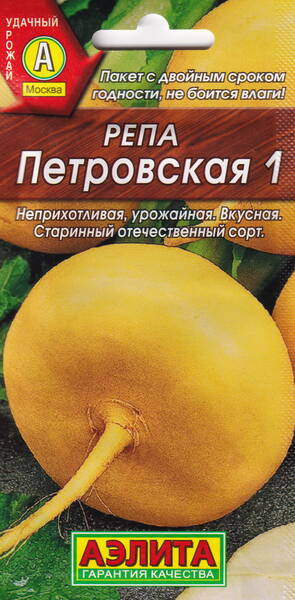
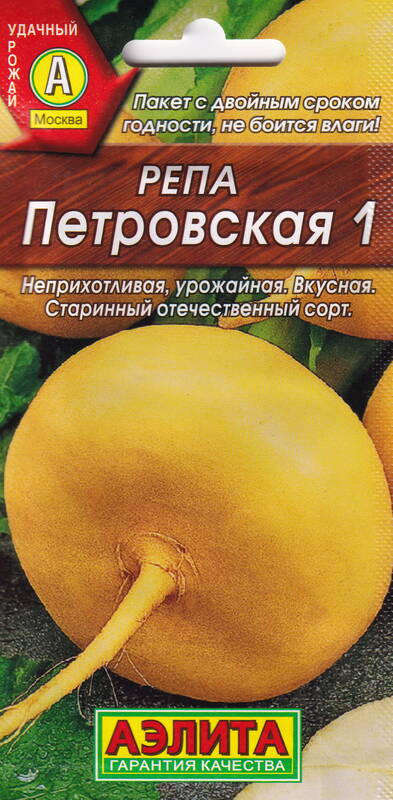
Turnip "Petrovskaya 1".
The most delicious! Stores exceptionally well.
A popular early-maturing variety: 65-75 days from seedling emergence to harvest. The roots are flat-round with a concave base, featuring smooth golden-yellow skin and weighing between 60 and 150 g.
The flesh is juicy, sweet, and rich in vitamins, easily digestible proteins, and carbohydrates. The roots are harvested selectively as they reach 5-8 cm in diameter.
It is wonderful eaten fresh (in salads) or cooked (roasted, stewed). Stable yield: 1.6-3.2 kg/m2.
Growing conditions.
Turnips thrive in fertile, loamy, and sandy-loam soils. Seeds begin to germinate at temperatures as low as +2...+3°C. The crop is cold-resistant, easily tolerating light frosts, but is quite demanding regarding good lighting and consistent soil moisture.
Direct sowing: III - IV.
Thinning seedlings: V.
Harvest: VII - VIII.
The most delicious! Stores exceptionally well.
A popular early-maturing variety: 65-75 days from seedling emergence to harvest. The roots are flat-round with a concave base, featuring smooth golden-yellow skin and weighing between 60 and 150 g.
The flesh is juicy, sweet, and rich in vitamins, easily digestible proteins, and carbohydrates. The roots are harvested selectively as they reach 5-8 cm in diameter.
It is wonderful eaten fresh (in salads) or cooked (roasted, stewed). Stable yield: 1.6-3.2 kg/m2.
Growing conditions.
Turnips thrive in fertile, loamy, and sandy-loam soils. Seeds begin to germinate at temperatures as low as +2...+3°C. The crop is cold-resistant, easily tolerating light frosts, but is quite demanding regarding good lighting and consistent soil moisture.
Direct sowing: III - IV.
Thinning seedlings: V.
Harvest: VII - VIII.
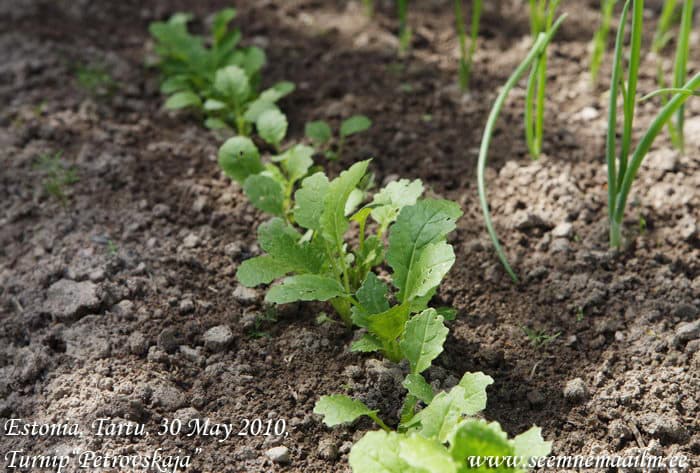
To successfully grow turnips, radishes, and rutabagas, you should allocate moisture-retentive loamy or sandy-loam soils with a neutral or slightly acidic reaction. Turnip is an exception, as it grows quite satisfactorily even in soils with higher acidity (pH 5.0). Dry, sandy soils are completely unsuitable.
Soil preparation for these crops is exactly the same as for other root vegetables. On fertile plots, apply 10-15 g of superphosphate and 15-20 g of potassium fertilizers per square meter during autumn digging, and 10-15 g of ammonium nitrate in the spring. On less fertile soils, mineral fertilizers are mixed with organic ones (3-4 kg of humus per sq. meter). To reduce acidity during autumn soil preparation, it is necessary to add lime (400-500 g/sq. meter). Under turnips, radishes, and rutabagas, fresh manure must never be applied, as this leads to hollow, deformed roots and excessive foliage growth. Consistently high yields are obtained only with an uninterrupted supply of moisture to the plants throughout the entire growing period.
Rutabagas, turnips, and radishes are cold-resistant crops that easily tolerate light spring and autumn frosts. The optimal temperature for growing rutabagas and turnips is +15...+18°C, and for radishes +18...+20°C. In hotter weather, the taste of the roots quickly becomes tough and slightly bitter. The planting site must be sunny. Rutabagas are sown in early spring, no later than May 10-15. Turnips and radishes for summer and autumn consumption are sown at the same time as rutabagas. However, for winter storage, radishes are sown on June 10-15, and turnips on July 10-15. These crops are sown on level ground or in raised beds with a row spacing of 35-40 cm for radishes and rutabagas, and 25-30 cm for turnips. Radishes should not be crowded; the spacing in the row must be 20-25 cm. Seeds are sown at a shallow depth of 1.5-2 cm. Sow only dry seeds. (Interestingly, seedlings can be used for growing rutabagas, but not turnips). Crop care requires periodically loosening the soil between the rows. To repel and combat cruciferous flea beetles, young plants are sprayed with various infusions (garlic, tobacco, etc.) or thickly dusted with ash and tobacco dust. It is crucial to start this in advance to prevent mass pest reproduction. When the first two true leaves form, thinning is mandatory, leaving 6-8 cm between turnip plants, and 13-18 cm between rutabagas and radishes. After thinning, it is beneficial to feed the crops with nitrogen fertilizers: 10-15 g per sq. meter (or slurry diluted 3-4 times). After 20-25 days, a second feeding with phosphorus-potassium fertilizers is carried out at 10 g per sq. meter (potassium fertilizers can successfully be replaced with wood ash — 200 g/sq. meter).
It is best to harvest root crops before severe autumn frosts occur. For dug-up roots, carefully trim the leaves and temporarily heel them into the ground (an 8-10 cm layer) right on the plot. With the onset of steady cool weather, the roots are moved to a cool storage room or cellar. The minimum period before returning the crop to the same garden bed is at least 3-4 years. Unacceptable predecessor crops include cabbage, radish, and other crucifers.
Seed viability shelf life: 4-5 years.