


Your shopping cart is empty!
Carrot "Nantes 5"
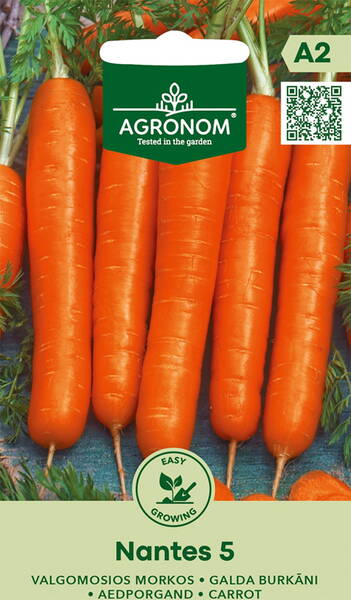
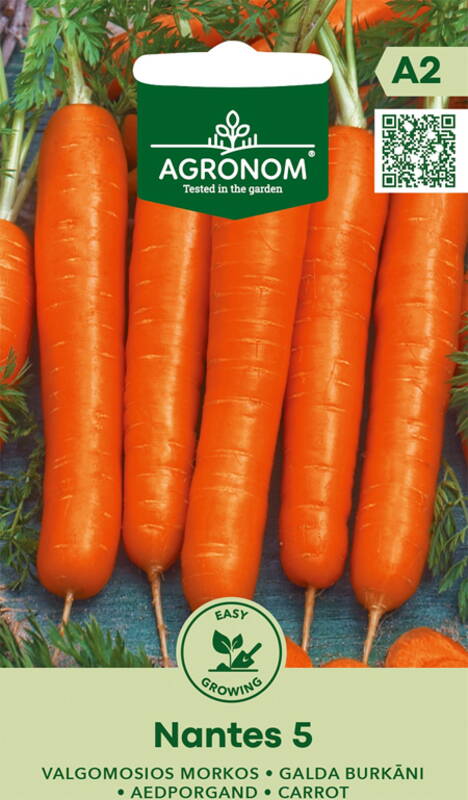
Carrot "Nantes 5" - Daucus carota.
Beautiful, juicy roots.
Mid-season high-yielding variety. Nantes type. Period from germination to harvesting 90-100 days. Roots are cylindrical, very smooth. Length 20-22 cm, weight 150-200 g. Surface is red-orange. Pulp of excellent taste. Recommended for fresh consumption and storage.
Cultivation.
Carrots grow best on light loamy and sandy loam soils. The best precursors are potatoes, onions, tomatoes, cucumbers, legumes. In spring, before sowing, complex mineral fertilizer is applied to the soil. Sowing in late April in furrows to a depth of 3-4 cm. Distance between rows 18-20 cm. 2 weeks after germination, carrots are thinned out. The second thinning is carried out when the roots reach a diameter of 1 cm, leaving 5-6 cm between plants. Further care consists of weeding, loosening, watering. Winter sowing is carried out when the temperature drops to +5°C (second half of October - beginning of November). Seeds are embedded to a depth of 1-2 cm, the surface of the site is mulched with peat.
1.0 g = 800-1000 seeds.
Beautiful, juicy roots.
Mid-season high-yielding variety. Nantes type. Period from germination to harvesting 90-100 days. Roots are cylindrical, very smooth. Length 20-22 cm, weight 150-200 g. Surface is red-orange. Pulp of excellent taste. Recommended for fresh consumption and storage.
Cultivation.
Carrots grow best on light loamy and sandy loam soils. The best precursors are potatoes, onions, tomatoes, cucumbers, legumes. In spring, before sowing, complex mineral fertilizer is applied to the soil. Sowing in late April in furrows to a depth of 3-4 cm. Distance between rows 18-20 cm. 2 weeks after germination, carrots are thinned out. The second thinning is carried out when the roots reach a diameter of 1 cm, leaving 5-6 cm between plants. Further care consists of weeding, loosening, watering. Winter sowing is carried out when the temperature drops to +5°C (second half of October - beginning of November). Seeds are embedded to a depth of 1-2 cm, the surface of the site is mulched with peat.
1.0 g = 800-1000 seeds.
* HARVESTING AND STORAGE.
Selectively (especially combining with the second thinning), carrots are pulled out when the root diameter is 7-10 mm. For winter storage and processing, carrots are harvested as late as possible, but before frost. Roots are dug up and pulled out of the ground, carefully freeing them from soil residues by hand. Roots must not be knocked against each other. The tops are cut to the head, leaving a 2 cm "tail" for seed plants, and immediately removed under a canopy.
Harvesting is best done in dry weather. Carrots sown in winter are not suitable for storage. Carrots of other sowing dates are stored in cellars, basements, etc.
Before storage, the room is well ventilated, cleaned of accumulated debris, and disinfected. For disinfection, a solution of chlorinated lime (bleach powder) settled for 1-2 hours (400 g of lime per 10 l of water) is used. This solution should be sprayed in the room a month before storing products. After disinfection, the room must be ventilated and dried again, wooden parts of the storage whitewashed with lime mixed with copper sulfate (1.5 kg of quicklime and 1.5 kg of copper sulfate per 10 l of water), earthen floors sprinkled with lime. It is necessary to ensure that rodents do not get into the storage: close the ventilation holes with metal meshes with small cells. Discovered holes are tightly packed with stones, broken glass, and poured with cement mortar.
Carrots are best stored in tight boxes with a capacity of 15-20 kg, sprinkling them on top with a small layer of moist sand or light soil. For layering, only freshly dug sand of natural moisture, taken from a depth of at least 1 m (so that it contains a minimum amount of pathogenic microorganisms), is used. Too dry or excessively wet sand is not suitable: in the first case, it takes moisture from the roots, and they will wither, and in the second - it accelerates the rotting process. The suitability of sand is determined as follows: when squeezed in the hand, a lump of sand should break into several pieces, but not crumble.
A small number of roots can be stored in slat boxes, in sand or without sand, as well as in polyethylene bags. Bags of 3-5 kg are placed on racks in 3-4 tiers.
Roots are also well stored in small stacks on the floor or racks. In this case, they are placed in rows and each row is sprinkled with moist sand with a layer of 2-3 cm (roots are placed with the head outward). Sometimes chalk powder or dry slaked lime is added to the sand to prevent the development of diseases at the rate of 1 kg per 50 kg of sand, but the slaked lime must be well mixed with sand, otherwise "burns" of the roots may occur.
There is also a method of storing roots such as clay coating ("glinovanie"): roots are loaded into a metal container with a creamy clay mash, then laid out in boxes with gaps. When the clay remaining on the roots dries, a thin layer forms on the surface, protecting the roots from wilting and the spread of diseases.
If you store carrots in a wooden box, it is good to remember an old recipe: sprinkle the roots with dry onion skins. Another way is to prepare a decoction of onion skins and dip cleanly washed carrots into it before storage, and then dry. Onion skins have bactericidal properties.
* Carrot seeds germinate slowly, and the longer the process, the faster the rows become overgrown with weeds, so it can be very difficult to thin out crop seedlings. Thinning is also made difficult by the fact that due to extremely small seeds, seedlings turn out too dense. Both problems are easily solved. Soak the seeds for six hours in lukewarm water so that they swell. Instead of water, you can (even better) take fennel or chamomile tea, which will help protect the seedlings from putrefactive bacteria. Lay the swollen seeds on a paper towel and let them dry. Then mix them with one or two handfuls of sand and then sow as usual. Even simpler is to pour the seeds into a plastic bag, mix them with moist sand, let them hatch, and then carefully lay them out together with the sand in the grooves on the garden bed.