


Your shopping cart is empty!
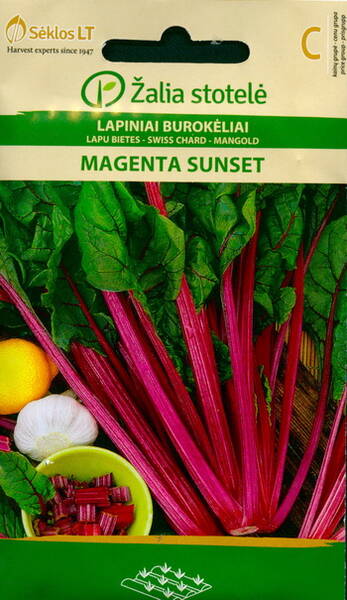
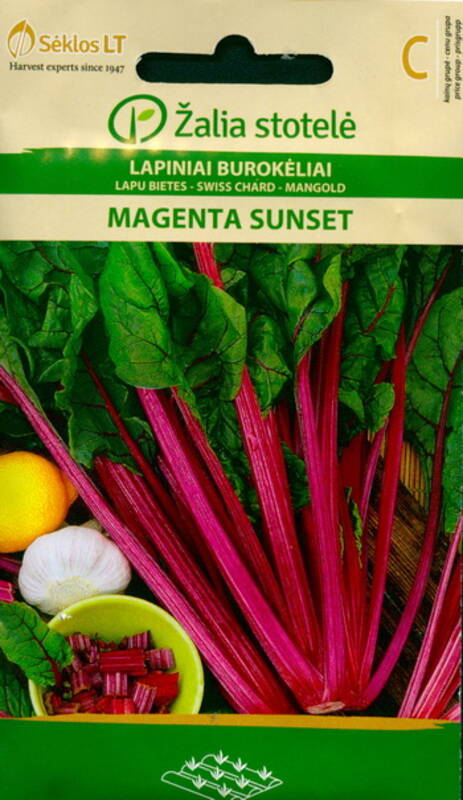
Spinach Beet "Magenta Sunset" (swisschard)
New
Beta vulgaris var. cicla Vog.
1.30€
Ex Tax: 1.05€
Ex Tax: 1.05€
Swiss Chard "Magenta Sunset" (Leaf beet).
1 gram = 40-55 seeds.
* SWISS CHARD (LEAF BEET) — Beta vulgaris var. cicla Vog.
A very valuable vegetable crop.
Swiss chard belongs to a relatively little-known group of vegetables here, although it deserves much wider cultivation. The plants look similar to beetroot, but the leaves and stalks are used for food.
The curly leaf blades are consumed like spinach (leaf chard), and the thick, juicy stalks are prepared like stalk celery or asparagus (stalk chard).
Chard is a biennial plant, belonging to the Amaranthaceae family. In northern regions, it does not overwinter and is cultivated as an annual. This crop can grow in almost any area. It tolerates cold well. It is recommended to grow chard on medium-heavy soils rich in nutrients (especially nitrogen).
Seeds are sown in late April - early May to a depth of 3-4 cm. The seeding rate is 0.5-0.8 g/m2. Row spacing — 50 cm.
In the second half of May, thinning is carried out, leaving 30 cm between plants. During the growing season, the soil around the plants is loosened, and watered in dry weather.
Leaf chard is harvested from early summer while it is still young. Up to 5 cuts are made per season, leaving the young leaves. For stalk chard, the stalks and veins are broken off a little later, from mid-August to autumn. Before severe frosts arrive, the plants are pulled up by the roots and placed in deep cold frames or transferred in boxes to a cellar. Newly developing leaves can then be harvested right up until winter.
Chard is a very valuable vegetable crop: the leaves and stalks contain sugar, protein, carotene, vitamins C1, B1, B2, P, P1, PP.
Chard is also rich in calcium, phosphorus, and iron salts. The plant has a diuretic, mild laxative, anti-scorbutic, and analgesic effect. Chard is very useful for sclerosis. Consuming chard juice lowers blood pressure. In addition, in folk medicine, chard juice mixed half and half with honey is used for colds.
1 gram = 40-55 seeds.
* SWISS CHARD (LEAF BEET) — Beta vulgaris var. cicla Vog.
A very valuable vegetable crop.
Swiss chard belongs to a relatively little-known group of vegetables here, although it deserves much wider cultivation. The plants look similar to beetroot, but the leaves and stalks are used for food.
The curly leaf blades are consumed like spinach (leaf chard), and the thick, juicy stalks are prepared like stalk celery or asparagus (stalk chard).
Chard is a biennial plant, belonging to the Amaranthaceae family. In northern regions, it does not overwinter and is cultivated as an annual. This crop can grow in almost any area. It tolerates cold well. It is recommended to grow chard on medium-heavy soils rich in nutrients (especially nitrogen).
Seeds are sown in late April - early May to a depth of 3-4 cm. The seeding rate is 0.5-0.8 g/m2. Row spacing — 50 cm.
In the second half of May, thinning is carried out, leaving 30 cm between plants. During the growing season, the soil around the plants is loosened, and watered in dry weather.
Leaf chard is harvested from early summer while it is still young. Up to 5 cuts are made per season, leaving the young leaves. For stalk chard, the stalks and veins are broken off a little later, from mid-August to autumn. Before severe frosts arrive, the plants are pulled up by the roots and placed in deep cold frames or transferred in boxes to a cellar. Newly developing leaves can then be harvested right up until winter.
Chard is a very valuable vegetable crop: the leaves and stalks contain sugar, protein, carotene, vitamins C1, B1, B2, P, P1, PP.
Chard is also rich in calcium, phosphorus, and iron salts. The plant has a diuretic, mild laxative, anti-scorbutic, and analgesic effect. Chard is very useful for sclerosis. Consuming chard juice lowers blood pressure. In addition, in folk medicine, chard juice mixed half and half with honey is used for colds.
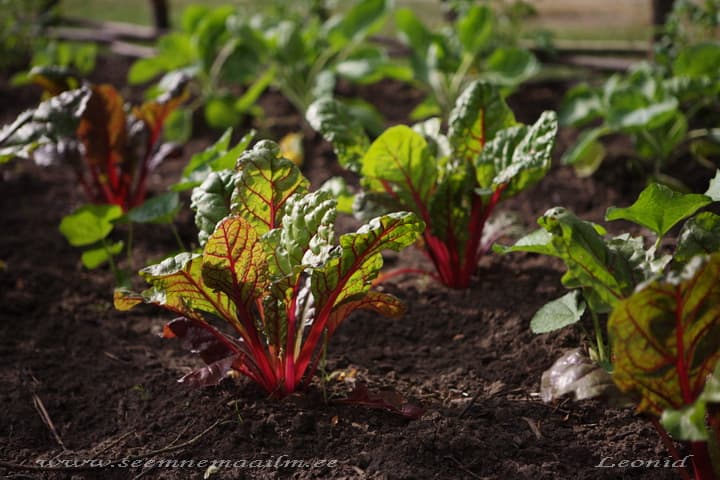
Chard (Leaf Beet).
* Preparation of chard seeds for sowing.
Seeds checked for germination are soaked in one of the following nutrient solutions:
— dilute 1/4 teaspoon of boric acid and 0.5 teaspoon of nitrophoska or nitroammophoska in 1 liter of warm water (+30°C); keep seeds in cloth bags for 12 hours;
— dilute 1 teaspoon of superphosphate in 1 liter of warm water (+30°C); keep seeds in the solution for 24 hours;
— dilute 1 teaspoon of baking soda in 1 liter of water; keep seeds in the solution for 24 hours;
— dilute 1 tablespoon of wood ash in 1 liter of water; keep seeds in the solution for 24 hours.
After soaking the seeds in any of the chosen solutions, take them out, rinse with water, cover with a damp cloth, and keep for 2-3 days. To prevent the seeds from drying out, moisten them as needed, ensuring the temperature does not drop below +20°C.
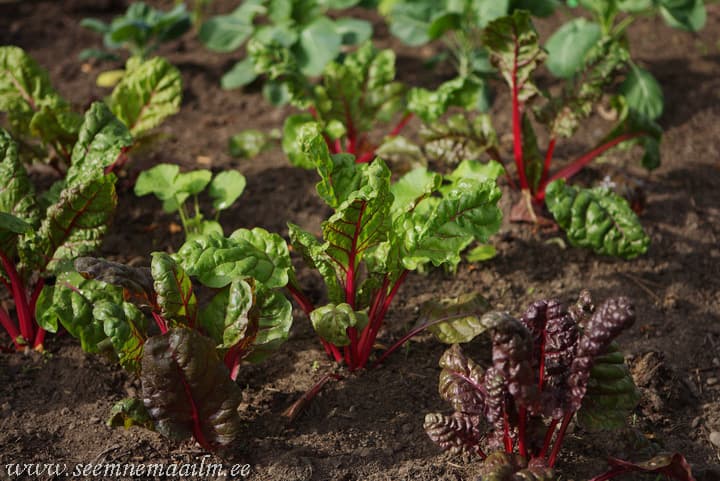
Site preparation and sowing seeds in the ground.
Chard is not very demanding on the soil. However, it prefers sandy loam, light and medium loamy soils. As for acidity — slightly acidic or neutral. Poor sandy and heavy clay soils are not entirely to chard's liking.
This crop does not require manure but uses it very well, so it can be grown in both the first and second year after application. It is very important to loosen the soil deeply in the autumn, as leaf beet has a very long root.
Beetroot occupies the bed throughout the gardening season. It cannot be sown for two consecutive years in the same place; it should not be grown after spinach and sugar beet. The best predecessors are potatoes, cucumbers, and onions, under which organic fertilizers were applied. The bed is prepared 6-10 days in advance. It is limed: 2 cups of dolomite flour or 1 cup of slaked lime (or chalk) is added per 1 sq. m. Before sowing, 1-2 cups of wood ash and microelements are added per 1 sq. m. For this, take 1 tablet of microelements (crush into powder), 1 teaspoon of magnesium sulfate, 0.5 teaspoon of boric acid, mix everything with 1 cup of sand, and scatter evenly over 1 sq. m of the bed. On average, there are 70 seed clusters in 1 g of seeds. This amount is enough for an area of 1 sq. m. Row spacing depends on the purpose of cultivation. If leaves are harvested, the distance between rows should be 25-30 cm; if stalks — no less than 40 cm.
Leaf beet is sown in furrows or by the nest method. The distance between "nests" is — 15-20 cm for leaf varieties and 40 cm for stalk varieties. Seeding depth — 2-3 cm.
Chard is a cold-resistant plant. Seeds begin to germinate at a temperature of +6...+7°C. However, frosts (down to -3°C) can damage seedlings. The optimal temperature regime for plant growth and development is +17...+23°C. Chard is sown annually, but if covered with earth and spruce branches, it can overwinter in the ground. New shoots will appear in the spring.
Leaf beet can be grown as a second crop. In this case, it is sown in late August — early September in exactly the same way as in April. For the winter, the plants are sprinkled with soil and covered with pine needles. The following year, leaves are harvested until mid-summer, before the plant forms a seed stalk.
Care, watering, feeding, and harvesting.
Chard is not very demanding in terms of care. Since the seed of leaf beet is a cluster infructescence containing 2-3 or more seeds enclosed in a common shell, chard crops need thinning. The first thinning is carried out when 2-3 true leaves develop (15 cm is left between plants in a row). The second thinning is done two weeks after the first. The distance between plants during the thinning of stalk varieties is left at 40 cm, for leaf varieties — 25-30 cm. After the second thinning, it is advisable to feed the chard (1-2 g of urea, 1-2 g of superphosphate, 2 g of potassium salt per 1 sq. m). Alternatively, you can use any ready-made nutrient mixture at a rate of 2-4 g per 1 sq. m. The vegetation period of leaf varieties is — 2 months, stalk varieties — 3 months. During vegetation, chard needs regular watering and loosening (although we note that its soil moisture requirements are moderate).
Attention! Regular watering promotes the formation of juicy, large leaves and tender stalks.
Harvesting is carried out in several stages. First, the lower leaves are cut off. However, some of the lower leaves must be left on the plant so that it is not depleted.
Attention! When cutting leaves, be careful — do not damage the central growing point !
It is not recommended to cut more than 1/4 of all the plant's leaves at a time. For the leaves to grow better in the future, it is advisable to feed the chard with nitrogen fertilizers after each harvest.
Plants are fed at a rate of 100-150 g per 1 sq. m. This rate is applied in 4-5 doses as a 0.3% nitrogen solution. After each harvest, be sure to feed and water the plants abundantly (15-20 liters per 1 sq. m). And after watering, when the earth dries up a little, loosen it.
If you have chosen leaf varieties of chard, use young, not fully unfolded leaves. They are prepared in the same way as spinach. They should be cut 1-2 cm from the root, without touching the core leaves. Before harvesting stalk varieties, you should wait until the leaves have fully unfolded.