


Your shopping cart is empty!
Tatar Bread-plant "Akkord"
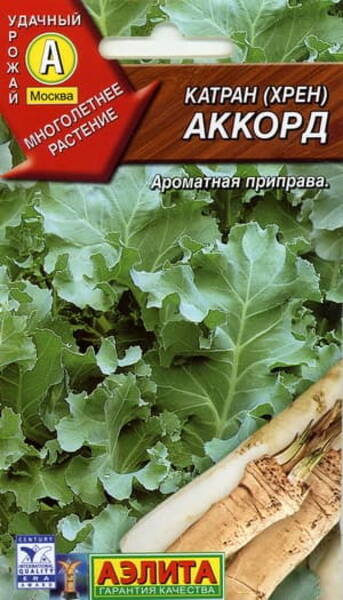
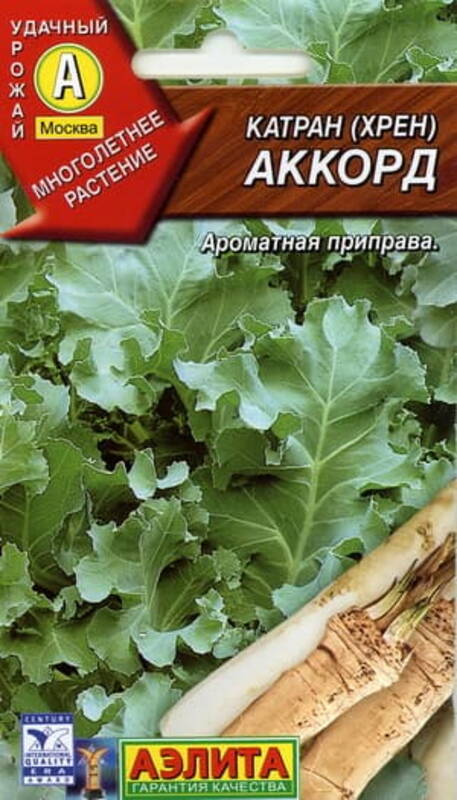
Катран "Аккорд" (Tatar Horseradish) - Crambe tatarica.
Improved analogue of horseradish.
In food, katran root crops are used, which are similar to horseradish in taste. The pungent taste and smell of katran are due to the presence of essential oil. Chemical composition of root crops: dry matter – 37-43%; sugar – 11-14%; protein – 61-63 mg per 100 g of dry matter; of the ash elements, potassium and phosphorus are the most abundant.
Some types of katran (sea and Tatar) are suitable for forcing in winter. Bleached young leaves and petioles are eaten boiled; in Transcaucasia, unripe fruits and leaves, peeled, are eaten raw, as they are very rich in vitamin C.
Plant life cycle: from sowing to seed ripening, each plant passes separately. Depending on the zone and growing conditions, this takes from two to five years.
The leaves are large, entire, pinnately dissected or notched-lobed, pubescent with simple hairs or bare. The leaves contain substances that stimulate (in large quantities - inhibit) plant growth. An acceleration of the growth of the above-ground mass of radish, lettuce and onions was noticed when the aisles of these crops were mulched with katran leaves. By the time of the onset of persistent frosts, the leaves die off. The main root shortens and pulls the head 1–3 cm into the soil, which contributes to greater winter hardiness of the plant.
In the second year of life, katran begins to grow immediately after the soil thaws. By the end of the 1st decade of May, plants form a large rosette of leaves (6–10 pieces), some of them proceed to flowering. The beginning of flowering is observed in the 1st decade of June. The stem is 80–150 cm high, erect, branched, bare or pubescent with simple hairs.
The flowers of katran are bisexual, which are collected in a loose raceme.
The fruit is an indehiscent two-membered silicle of pale yellow color.
The valves of the fruit are strong and do not separate from the seed, therefore the fruits serve as seed material.
When ripe, the seeds go into a state of deep dormancy, i.e. do not germinate in the most favorable conditions. Germination is observed only after a long stay in cold soil.
The root system of katran is pivotal. The main root can reach a depth of 2 m or more. The root crop of all species is grayish-white, cylindrical in shape, slightly branched, reaching 30–35 cm in length.
Katran is a frost-resistant plant, undemanding to heat and at the same time heat-resistant. In the conditions of the Leningrad region, for example, it does not freeze out even in severe winters. Seeds begin to germinate at a temperature of +3+4°С, but until the average daily air temperature is above +5+7°С, seedlings grow slowly. Seedlings tolerate frosts down to –5–6°С.
The optimum temperature for the growth and development of katran is +18+25°С.
In the field, plant growth is observed from the time the soil thaws until persistent late autumn frosts.
Katran is photophilous and does not tolerate shading. An abundance of light is especially important in the initial period of plant growth. Soils with a high level of groundwater (especially waterlogged and lowland areas) are unsuitable for growing katran, especially in a two-year culture.
Possessing a powerful root system, plants easily tolerate short-term drought. Katran does not tolerate increased acidity. On acidic soils, the roots are severely affected by keel, which sharply reduces the yield. The optimum soil reaction (pH) is 6.5–7.0.
When selecting a site for cultivation, highly fertile soils with a deep and loose arable layer are chosen.
In no case should katran be sown after plants from the Cabbage family, as it is severely affected by keel and cabbage fly.
With insufficient power of the arable horizon, as well as with excessive soil moisture in spring and autumn, sowing katran on ridges gives the best results. Seeds are sown in spring or autumn.
Due to the fact that katran root crops can germinate only at a reduced temperature, stratification is used for spring sowing. To do this, the seeds are soaked in water at room temperature (+18+20°С), then mixed with moistened sand (1 part seeds and 3 parts sand), sifted through a sieve with holes smaller than the diameter of the seeds. The mixture is poured into wooden boxes, which are placed in a cold basement or buried in the soil to a depth of 15–20 cm, where they are left for the entire winter.
Before sowing, the stratified seeds are dried, cleaned of sand and sown early in the spring. The plot for sowing is prepared in the autumn. Autumn sowing with dry seeds is successful on structural soils that do not become waterlogged and do not form a dense crust after rain and snow (soils not clogged with sow thistle and couch grass).
Stratification takes place in the soil. In spring and autumn sowing, the soil is treated to a depth of 50 cm.
Katran responds well to the application of organic and mineral fertilizers.
Seeds are sown into the ground in rows with row spacing of 70 cm and a distance of 30–40 cm in rows. The seeding rate is up to 100 g per 10 m2. The depth of incorporation in spring sowing is 1-1.5 cm, in autumn sowing – 2-3 cm. After emergence, the soil in the rows is loosened, the plants are thinned out. Loosening and weeding should be carried out systematically. With prolonged absence of rain, watering is necessary.
In the initial period of katran growth, it is useful to give a top dressing with a solution of mullein or manure slurry with the addition of superphosphate (30 g per 10 liters of water).
Katran is harvested late in the autumn: plants easily tolerate slight frosts, and root crops continue to grow at the end of the growing season. They are dug up with garden forks or staples.
Improved analogue of horseradish.
In food, katran root crops are used, which are similar to horseradish in taste. The pungent taste and smell of katran are due to the presence of essential oil. Chemical composition of root crops: dry matter – 37-43%; sugar – 11-14%; protein – 61-63 mg per 100 g of dry matter; of the ash elements, potassium and phosphorus are the most abundant.
Some types of katran (sea and Tatar) are suitable for forcing in winter. Bleached young leaves and petioles are eaten boiled; in Transcaucasia, unripe fruits and leaves, peeled, are eaten raw, as they are very rich in vitamin C.
Plant life cycle: from sowing to seed ripening, each plant passes separately. Depending on the zone and growing conditions, this takes from two to five years.
The leaves are large, entire, pinnately dissected or notched-lobed, pubescent with simple hairs or bare. The leaves contain substances that stimulate (in large quantities - inhibit) plant growth. An acceleration of the growth of the above-ground mass of radish, lettuce and onions was noticed when the aisles of these crops were mulched with katran leaves. By the time of the onset of persistent frosts, the leaves die off. The main root shortens and pulls the head 1–3 cm into the soil, which contributes to greater winter hardiness of the plant.
In the second year of life, katran begins to grow immediately after the soil thaws. By the end of the 1st decade of May, plants form a large rosette of leaves (6–10 pieces), some of them proceed to flowering. The beginning of flowering is observed in the 1st decade of June. The stem is 80–150 cm high, erect, branched, bare or pubescent with simple hairs.
The flowers of katran are bisexual, which are collected in a loose raceme.
The fruit is an indehiscent two-membered silicle of pale yellow color.
The valves of the fruit are strong and do not separate from the seed, therefore the fruits serve as seed material.
When ripe, the seeds go into a state of deep dormancy, i.e. do not germinate in the most favorable conditions. Germination is observed only after a long stay in cold soil.
The root system of katran is pivotal. The main root can reach a depth of 2 m or more. The root crop of all species is grayish-white, cylindrical in shape, slightly branched, reaching 30–35 cm in length.
Katran is a frost-resistant plant, undemanding to heat and at the same time heat-resistant. In the conditions of the Leningrad region, for example, it does not freeze out even in severe winters. Seeds begin to germinate at a temperature of +3+4°С, but until the average daily air temperature is above +5+7°С, seedlings grow slowly. Seedlings tolerate frosts down to –5–6°С.
The optimum temperature for the growth and development of katran is +18+25°С.
In the field, plant growth is observed from the time the soil thaws until persistent late autumn frosts.
Katran is photophilous and does not tolerate shading. An abundance of light is especially important in the initial period of plant growth. Soils with a high level of groundwater (especially waterlogged and lowland areas) are unsuitable for growing katran, especially in a two-year culture.
Possessing a powerful root system, plants easily tolerate short-term drought. Katran does not tolerate increased acidity. On acidic soils, the roots are severely affected by keel, which sharply reduces the yield. The optimum soil reaction (pH) is 6.5–7.0.
When selecting a site for cultivation, highly fertile soils with a deep and loose arable layer are chosen.
In no case should katran be sown after plants from the Cabbage family, as it is severely affected by keel and cabbage fly.
With insufficient power of the arable horizon, as well as with excessive soil moisture in spring and autumn, sowing katran on ridges gives the best results. Seeds are sown in spring or autumn.
Due to the fact that katran root crops can germinate only at a reduced temperature, stratification is used for spring sowing. To do this, the seeds are soaked in water at room temperature (+18+20°С), then mixed with moistened sand (1 part seeds and 3 parts sand), sifted through a sieve with holes smaller than the diameter of the seeds. The mixture is poured into wooden boxes, which are placed in a cold basement or buried in the soil to a depth of 15–20 cm, where they are left for the entire winter.
Before sowing, the stratified seeds are dried, cleaned of sand and sown early in the spring. The plot for sowing is prepared in the autumn. Autumn sowing with dry seeds is successful on structural soils that do not become waterlogged and do not form a dense crust after rain and snow (soils not clogged with sow thistle and couch grass).
Stratification takes place in the soil. In spring and autumn sowing, the soil is treated to a depth of 50 cm.
Katran responds well to the application of organic and mineral fertilizers.
Seeds are sown into the ground in rows with row spacing of 70 cm and a distance of 30–40 cm in rows. The seeding rate is up to 100 g per 10 m2. The depth of incorporation in spring sowing is 1-1.5 cm, in autumn sowing – 2-3 cm. After emergence, the soil in the rows is loosened, the plants are thinned out. Loosening and weeding should be carried out systematically. With prolonged absence of rain, watering is necessary.
In the initial period of katran growth, it is useful to give a top dressing with a solution of mullein or manure slurry with the addition of superphosphate (30 g per 10 liters of water).
Katran is harvested late in the autumn: plants easily tolerate slight frosts, and root crops continue to grow at the end of the growing season. They are dug up with garden forks or staples.
* Katran is a perennial herbaceous plant from the cruciferous family, very similar to horseradish.
It was known to the ancient Greeks and Romans.
The birthplace of katran is the foothills of Crimea and the Kerch Peninsula, where it is very often found in the wild. In the flora of the former Union, there are about 20 species of katran, but in culture among amateur gardeners, only steppe katran is mainly found.
Katran is very characterized by the variety of life cycles. In the same area, some plants of the same age may enter fruiting, while others may not bloom for a long time. By the way, it is the latter plants that give the largest root crops.
Katran is very similar to horseradish in use, in nutritional and taste qualities, but has a number of valuable advantages. Katran has a powerful smooth root crop weighing up to 500-600 g or more (horseradish has 100-150 g), the shape of its roots is very convenient for processing. Katran reaches marketable sizes by the end of the first year of vegetation. Its root crops are much juicier and tastier than horseradish, richer in chemical composition, and are perfectly stored in the basement in winter. In addition, growing katran is much cheaper, since the cost of obtaining seed material is much less.
The root of katran is pivotal, cylindrical, slightly branched, fleshy, up to 50 cm long or more, up to 7 cm in diameter, weighing up to 600 g or more. The pulp is white with a creamy tint, juicy. The root penetrates into the soil to a depth of more than 1 meter, so it never freezes.
In the first year of life, the plant forms a very powerful basal rosette of leaves. The leaves are large, petiolate, 60-90 cm long, fleshy, green and bluish with a waxy coating. They are toothed with a notch along the edges. In the 2-3rd year, the plant forms flowering shoots up to 140 cm high.
Katran seeds are similar to cabbage seeds, covered with a dense shell. They do not ripen at the same time and differ significantly from each other in size; small seeds usually do not give seedlings.