


Your shopping cart is empty!
Tobacco "Golden Burley"
Eco seeds
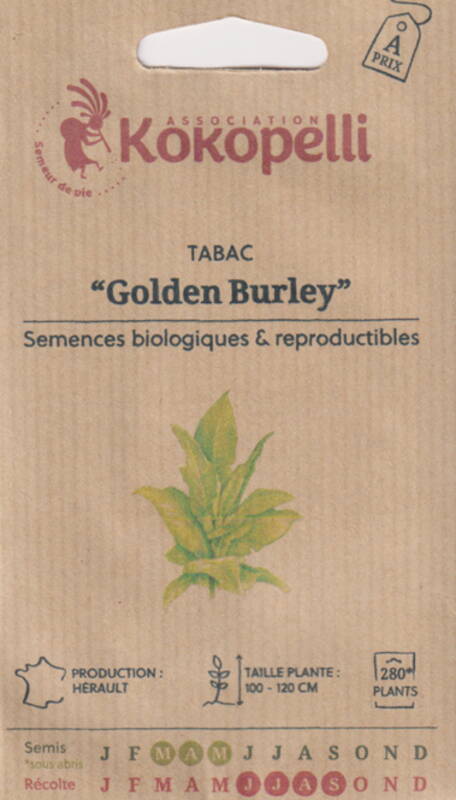
Smoking tobacco "Golden Burley" - Nicotiana tabacum.
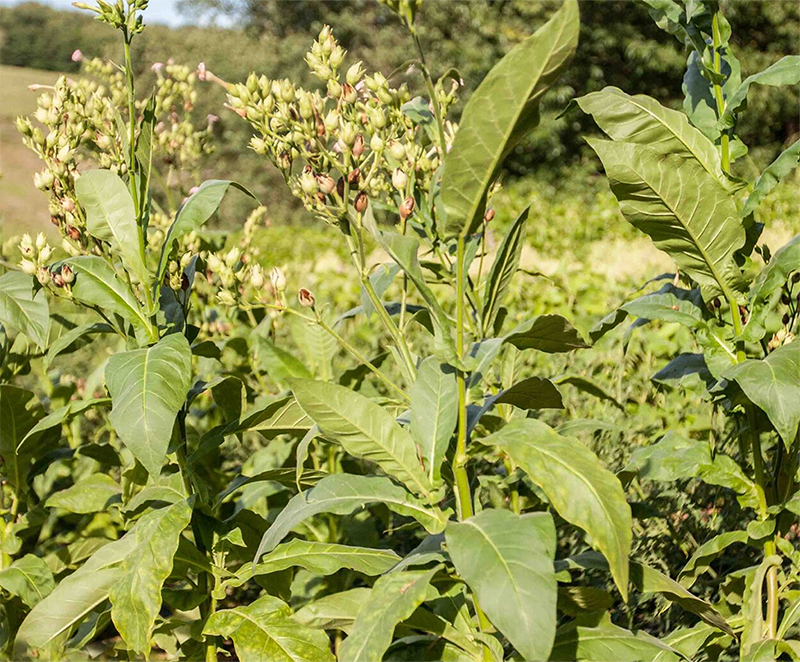
A variety 100-120 cm high, which forms leaves 60-75 cm long and 30 cm wide. When ripe, the leaves turn bright yellow, and after drying they become light brown and have a strong aroma and medium nicotine content.
A variety 100-120 cm high, which forms leaves 60-75 cm long and 30 cm wide. When ripe, the leaves turn bright yellow, and after drying they become light brown and have a strong aroma and medium nicotine content.
For a tobacco seed to germinate and the sprout to become strong enough, it takes exactly 45 days. The process takes place either in the open air in special nurseries covered with straw to protect from external influences, or in laboratories under the strict control of specialists. Recently, this method has been used much more often: seedlings emerge in small pots (one plant in each) on a tray through which a special nutrient solution flows along a groove. The diameter of a tobacco seed is 0.1-0.6 millimeters. Planting such a seed is not an easy task. In order not to mix anything up, a special gun is used for planting seeds. When the seedlings reach a height of 13-15 centimeters, they are planted on plantations — traditionally this happens in mid-September. From this moment on, the tobacco bush needs daily care — weeding, loosening, and a lot of other labor-intensive operations. For normal growth, tobacco requires the most loose soil possible. Before sowing, planters repeatedly plow the field, using animals for this — usually specially trained buffaloes. The use of machinery is not recommended, as it can lead to excessive compaction of the soil.
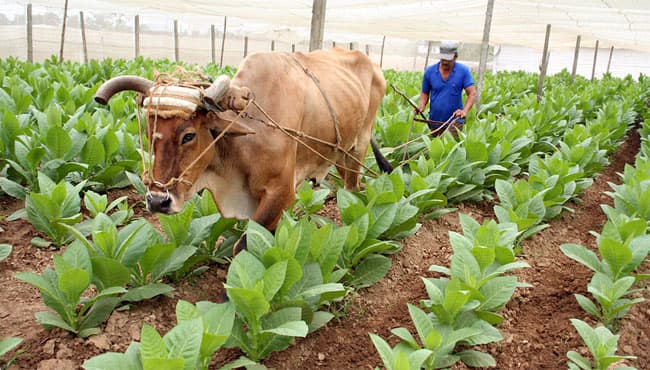
Tobacco bushes of varieties intended for cigar wrappers are grown in the shade — the lack of sun makes their leaves especially thin and tender. The entire plantation is covered with a special cloth — 10-20 days after the seedlings are planted in the ground. A wire mesh is stretched under the cloth — the plants are tied to it.
Tobacco bushes, the leaves of which will be used for filler and binder, are grown in the open air. After the tobacco bush grows to the required size, plantation workers pinch off the top bud to stop the plant's growth and concentrate all the nutrients and force the development of leaves — to be suitable for the production of cigars, they must be as large and juicy as possible.
After the bud is pinched off, the accelerated growth of shoots begins, which strive to intercept the flows of nutrients coming from the roots from the leaves — to prevent this from happening, the tobacco grower must visit each plant several times and remove them during the time remaining before the harvest. Just like the upper bud and shoots, inflorescences are also removed.
Inflorescences are left only on special plants intended for seed production for the next season. Such bushes grow separately from all others — in laboratories, in sterile conditions, under the special control of specialists. The seeds obtained from such bushes make up Cuba's gold reserve — they are kept in a special storage and only before the start of the season are they given to selected tobacco growers.
Harvesting begins about 40 days after planting the seedlings and takes place in several stages. The height of a bush grown under the sun is about 170 centimeters, on which 14 or 16 leaves are arranged in pairs. The height of a bush grown in the shade can reach 280 centimeters (a plant deprived of the sun really reaches for it), and the number of leaves is 20 pieces.
First of all, the largest lower leaves are plucked. A bush with plucked lower leaves continues to grow for a few more days so that the remaining leaves have time to develop. The middle leaves are removed from the bush, a few more days pass, and those that grow even higher are plucked — they turn out to be the most rich and juicy. The upper leaves of the bush are called "ligero", the middle ones - "seco", and the lower ones - "volado".
Each of these leaves has its own function in a cigar. It takes 3-4 weeks to collect all the leaves from one plant. The entire period between planting seeds and harvesting takes 15-17 weeks.
* The older – the better.
The improvement of tobacco over time is not a psychological effect, not an idle speculation, and not a superstition. Over time, very specific changes occur in tobacco that improve its taste tenfold.
It's no secret that all tobaccos improve over time, but not all blends perfect themselves to the same degree. For example, highly flavored tobaccos improve imperceptibly, since the sugar in such tobaccos is introduced from the outside, and not formed naturally. In such aromatics, a noticeable astringent chemical flavor may appear over time. Its source is the food additives used to flavor and moisturize tobacco. These are safe, natural sweeteners, but they greatly degrade the complex and rich taste that gradually manifests itself in natural tobacco.
Many aromatic blends basically consist of Black Cavendish. This variety is the result of a process in which the raw tobacco (usually low-quality Virginia and Burley) is heated with steam and saturated with flavorings. Usually, low-grade raw materials are used, since premium tobacco does not improve after flavoring. (Indeed, after all, you shouldn't add sugar to good wine, pour ketchup on a tender fillet, and use an air freshener in the garden...)
However, this does not mean that there are no premium aromatic blends (aromatics).
For example, in "Danish" style aromatics, which include many Peter Stokkebye blends, very good quality tobacco is used, which is only slightly sweetened.
Small companies producing their own blends – those that do not produce millions of kilograms of tobacco for sale in supermarkets – tend to use better quality tobacco, even in their aromatics. Such tobaccos may improve over time, at least compared to aromatics made from poorer quality tobaccos and with more flavoring.
English and Balkan blends – containing Turkish tobaccos (including Latakia) – also improve with aging. But Latakia changes slightly over time, remaining relatively constant after smoking.
The Perique variety, which undergoes an intensive process of pressing and fermentation before entering the blend, behaves quite differently. With improper aging, Perique deteriorates, but with proper storage and in combination with Virginia, the result is excellent. The most noticeably improved by prolonged aging is flue-cured Virginia in various variants, due to its high sugar content. For comparison: flue-cured Virginia, Turkish (Latakia, etc.), Maryland, and Burley contain 22.09%, 13.39%, 0.21%, and 0.21 percent sugar, respectively.
It is interesting to note that the high sugar content in Virginia (as opposed to Burley) is manifested during curing.
Many chemical processes occurring in tobacco during curing continue to occur during aging, even after the tobacco blend has been formulated and packaged. Of course, the mechanism is no longer exactly the same. During aging, microorganisms play a major role, breaking down sugar into a large number of flavor and aroma components. That is why high-sugar tobaccos are preferred for aging.
In any case, post-production tobacco aging is a slow continuation of the curing process. During growth, tobacco stores a significant amount of starch in its leaves. Thus, it retains essential carbohydrates.
After the death of the plant, carbohydrates in the form of starch are converted into sugar. In turn, sugar breaks down to form carbon dioxide, which escapes into the atmosphere. But the difference between Virginia and Burley is significantly more than just a genetic difference between two plants.
The main difference is manifested during their curing. After harvesting, Burley leaves are taken to a barn. There the tobacco slowly "ages" (this is what tobacco chemistry calls the process of curing and dying. It's not exactly the same thing, but pretty close). Over a long period of time, starch turns into sugar, and then into carbon dioxide. Therefore, the sugar content in Burley is relatively low. In flue-cured tobaccos, the initial starch content is noticeably high, and the sugar amount is correspondingly low. When smoking, starch gives an unpleasant, harsh, burnt, pungent taste. The curing process changes the starch/sugar ratio in the tobacco.
In the curing barn, tobacco leaves turn yellow at a relatively low temperature - around +38°C. Most of the starch is converted to sugar at this stage.
But in the case of flue-cured drying, instead of stretching this yellowing process over months, as is usually the case with Burley, you quickly raise the temperature and the tobacco dries out. This leads to a halt in fermentation. Because the chemical processes are stopped, the sugar is not converted into carbon dioxide. The idea is to maintain the maximum amount of sugar while keeping the respiration process - converting sugar to carbon dioxide - to a minimum, using all the available starch from which sugar is formed. With proper curing, you will get a tobacco containing little starch and up to 25 percent sugar, which plays a major role in flavor formation. Now you can process the tobacco, blend it and pack it. It can already be smoked, but you are unlikely to like its taste.
Blends made from Virginia varieties have a sharp astringent taste and tend to smoke hot if not aged for a while. That is why most manufacturers age their tobacco for at least six months before sending it for sale.
At this stage, we have cured and blended tobacco, aged for an acceptable time. So why are we going to continue aging it? Tobacco is much like wine. Both tobacco and wine are natural organic products containing significant amounts of tannic and other acids. The taste of wine softens and becomes more complex over time, just as the taste of tobacco does. Fermentation processes occur in both products. According to Dr. David Danehower of the University of North Carolina, the acceptable aging time for flue-cured cigarette tobacco is one to five years, but "pipe and cigar tobaccos take significantly longer to mature".
Pipe and cigar tobacco are the fine wines of the tobacco industry. But what exactly happens in a tin of tobacco locked in your closet for 10 to 30 years?
Read more (in Estonian): The older, the better