


Your shopping cart is empty!
Tomato "Black Sea Man"
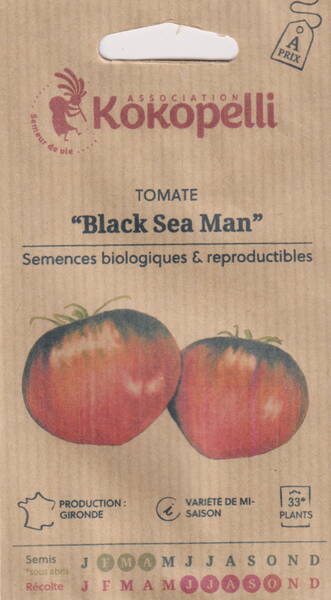
Eco seeds
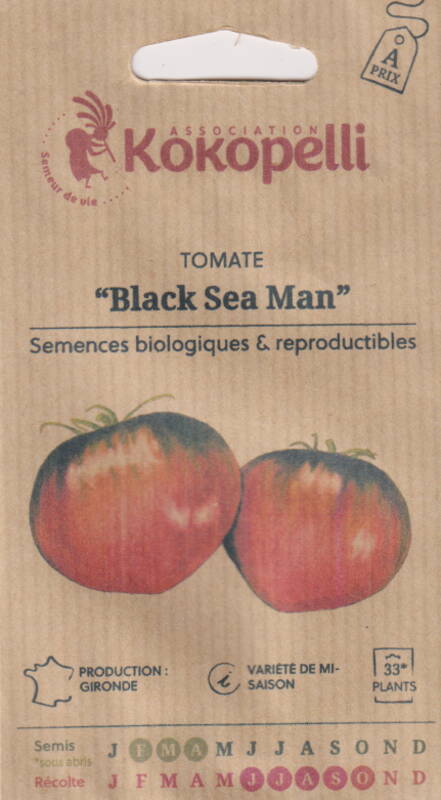
Tomato "Black Sea Man".
Original color and a sweet taste.
A mid-season (105-110 days) salad variety suitable for cold frames and film greenhouses.
The plant is semi-determinate, 1.3-1.5 m tall. Clusters contain 3-5 fruits. Requires staking and pruning (removal of sideshoots).
The fruits are flat-round, dark burgundy with a purple-violet hue, weighing from 150-180 up to 250-300 g. They are multi-chambered, juicy, very delicious, meaty, and have few seeds.
Original color and a sweet taste.
A mid-season (105-110 days) salad variety suitable for cold frames and film greenhouses.
The plant is semi-determinate, 1.3-1.5 m tall. Clusters contain 3-5 fruits. Requires staking and pruning (removal of sideshoots).
The fruits are flat-round, dark burgundy with a purple-violet hue, weighing from 150-180 up to 250-300 g. They are multi-chambered, juicy, very delicious, meaty, and have few seeds.
Value of the variety: large fruit size, original coloration, and excellent taste qualities.
Recommended for fresh consumption. Salad purpose.
The fruit is large and flat-round in shape.
To achieve maximum fruit size, it is necessary to:
- plant no more than three plants per 1 sq.m;
- add a tablespoon of superphosphate and potassium sulfate mixture to the prepared hole when transplanting;
- water during the growing season only in cases of severe drought;
- train the plant to 1-2 stems, leaving no more than 3-4 trusses per stem;
- apply a root feeding of magnesium sulfate during fruit formation.
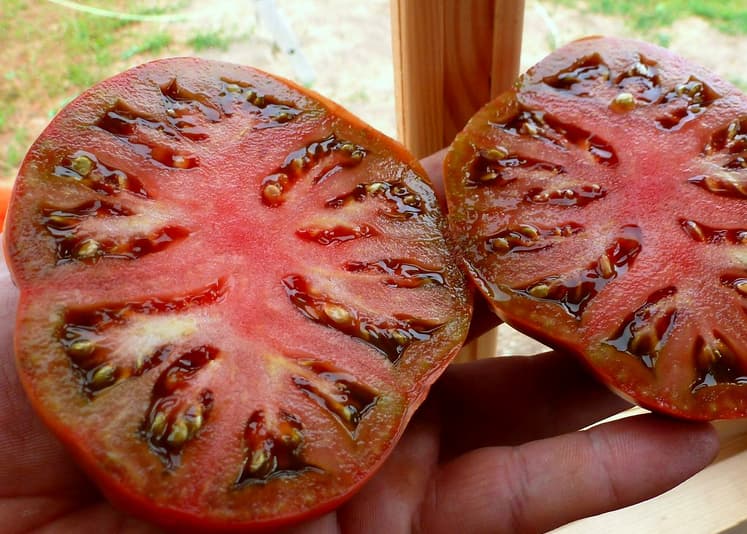
Tomato "Black Sea Man": Heirloom tomato, Non-hybrid, Untreated, Non GMO.
7 rules for a high tomato harvest.
1. "Traditional". Remove suckers, leaving no more than 1-2 of the strongest shoots on each bush: excess suckers do not yield a proper harvest, but rob the bush of nutrients and water. This will also increase light access and air circulation in the greenhouse.
2. "Innovative". As soon as the fruits have set and reached their variety size, remove the old leaves below each truss of tomatoes (but not above it!). This improves ventilation, helps tomatoes turn red faster, and protects them from fungal diseases.
3. "Cucumber-style". Just like with cucumbers, timely pick fruits that have reached the right size and started to turn color - this way you will guarantee their safety from late blight and give the subsequent tomatoes a chance to grow.
4. "Pinching". For all eggplant varieties and tall (indeterminate) tomato varieties, pinch off the growing tips in mid-to-late July. This will stop the growth of green mass, increase the harvest, and accelerate the ripening of already set fruits.
5. "Caring". Tie a large bush to a sturdy support. Or to the top of the greenhouse trellis by gently wrapping the stem with twine.
Support heavy trusses that have many fruits. Fruits on the lower branches must not touch the ground: lay down dry hay, sawdust, or straw as mulch.
6. "Stimulating". Foliar feeding stimulates the formation of new fruits, accelerates the ripening of existing ones, and helps resist infections and diseases.
During the budding period, it is beneficial to spray tomatoes with a weak solution of boric acid, and 2 weeks later - with a urea solution to support the foliage.
7. "Fertilizing". During active fruiting, tomatoes especially need potassium - a root feeding of potassium sulfate or wood ash infusion will help here.
If the plant has pale green leaves, is unnaturally stretched, and produces a poor yield, it is a sign of light and nitrogen deficiency - in this case, feed it once a month with an organic solution: cow manure (1:7) or chicken manure (1:12). But if the plant looks lush and healthy, feed it sparingly so it doesn't produce only foliage.
Any liquid solution should be used at a rate of: one bucket (10 liters) per 10-15 plants.