


Your shopping cart is empty!
Wild tobacco "Kessu" (Strong tobacco, Makhorka)
Eco seeds
Wild tobacco "Kessu" (Makhorka) - Nicotiana rustica L.
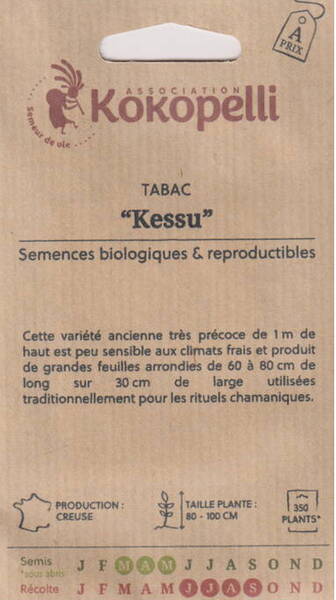
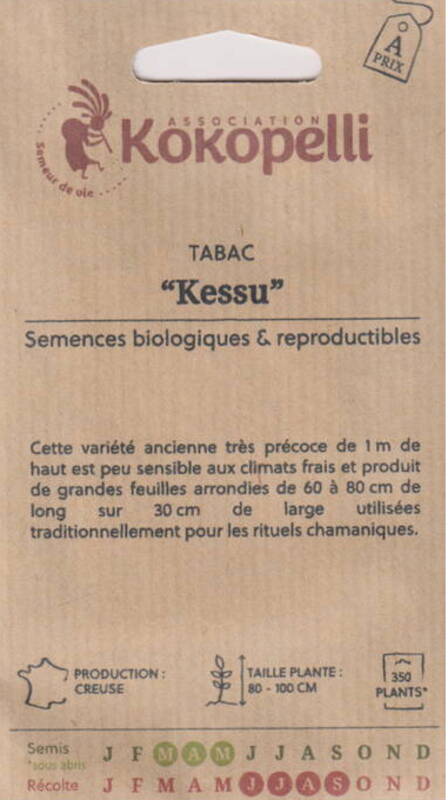
This ancient, ultra-early ripening variety is characterized by high resistance to cool climates. It forms large rounded leaves 60 to 80 cm long and 30 cm wide, which are traditionally used in shamanic rituals.
Plant height: from 80 to 100 cm. Foliage: pointed.
History and origin: a powerful sacred variety native to Finland. It has been used for centuries in shamanic practices due to its unique properties and ability to produce a reliable harvest even in harsh northern conditions.
This ancient, ultra-early ripening variety is characterized by high resistance to cool climates. It forms large rounded leaves 60 to 80 cm long and 30 cm wide, which are traditionally used in shamanic rituals.
Plant height: from 80 to 100 cm. Foliage: pointed.
History and origin: a powerful sacred variety native to Finland. It has been used for centuries in shamanic practices due to its unique properties and ability to produce a reliable harvest even in harsh northern conditions.
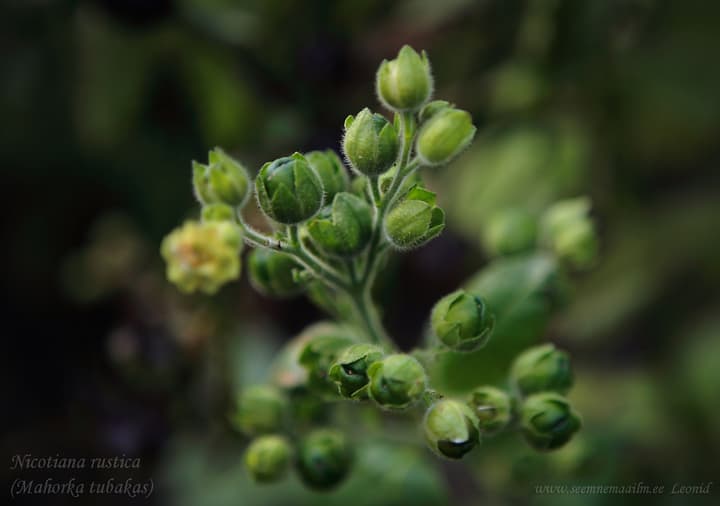
Makhorka (Nicotiana rustica) – an annual plant of the Solanaceae (Nightshade) family.
The root of makhorka is a taproot, strongly developed. The stem is erect, ribbed, with a loose pith, up to 1.2 m high. The leaves are petiolate, cordate or ovate, with a wrinkled surface, light or yellow-green in color. There are 12-20 leaves on the stem. Leaves and stems are covered with short capitate hairs that emit a specific odor. The inflorescence – a panicle. The flowers are bisexual, green or yellowish-green, pentamerous, with bracts.
Makhorka – is a self-pollinating plant, but cross-pollination is also observed. The fruit – a bivalve multi-seeded capsule.
Seeds are small, brown or cream-colored. Weight of 1000 seeds = 0.25-0.35 g.
Makhorka is cultivated to produce smoking grain, snuff, and chewing tobacco. The dry leaves of this plant contain 5-15% nicotine and 15-20% organic acids, including 10% or more citric acid. Makhorka stems contain somewhat less of the listed substances. A significant part of makhorka raw material goes into the production of nicotinic (vitamin PP) and citric acids used in the food and textile industries. A fatty oil (35-40%) is obtained from makhorka seeds, used in the production of paints, varnishes, and soap. Makhorka – is a long-day plant. Moving north, its development accelerates, which makes it possible to grow this crop even in the Arctic Circle.
However, compared to other long-day crops, it is more thermophilic. Makhorka seeds begin to germinate at a temperature of +7+8°C. The most favorable temperature for growth and development is – +20+25°C. Makhorka is sensitive to low temperatures and is damaged by frosts of –2…–3°C. The crop requires constant sufficient moisture supply: even with short-term water stress, the quality of the raw material deteriorates. The best soils for makhorka – are loamy chernozems, sandy loam, and loamy sod-podzolic soils.
Agrotechnical features.
The best predecessors for makhorka – are winter grains, corn, root crops, legumes, perennial grasses, and vegetable crops. Makhorka should not be placed after melons, potatoes, hemp, and sunflowers, which share common diseases and pests with it. Makhorka – is a good predecessor for many field crops.
The plant is demanding on the level of soil fertility. To form 1 ton of dry leaves and stems, makhorka consumes: nitrogen – 24 kg, phosphorus – 10 kg, potassium – 35 kg. A yield of dry leaves and stems of 3-3.5 t/ha is considered good.
Makhorka can be grown in 2 ways: by seedlings and by sowing seeds directly in the field.
Seedling culture is of great importance for northern regions, requiring increased costs for growing and planting seedlings. But it can occupy lowland areas flooded by high water, as well as insufficiently structured soils. Direct sowing succeeds better in elevated areas with light structured soils. Makhorka seedlings are grown in the same way as tobacco seedlings, in hotbeds or on soil beds.
Seed sowing rate: in hotbeds – 1.5-2 g/m²; on warm beds – 2-2.5 g/m²; on cold beds – 2.5-3 g/m².
In old industrial practices, before sowing, the seeds were dressed in a weak formalin solution (safe fungicides are used now) and germinated at a temperature of +25+28°C for 3-4 days. When sowing, they are mixed with clean sand in a ratio of 1:40. Planting 1 hectare of makhorka requires, depending on the variety, 30-45 m² of hotbeds or 45-60 m² of warm beds. Seedling care consists of maintaining the most favorable temperature (+18+20°C), thinning the plants, 2-3 top dressings, watering, and hardening. Seedlings ready for planting have 5-6 true leaves and reach a height of 8-12 cm. Growing seedlings in hotbeds takes 30-35 days, and on beds – 40-45 days. For makhorka, it is most effective to plant seedlings early, after spring frosts, when the upper soil layer warms up to +10°C.
Seedlings are planted with a row spacing of 60-70 cm and a distance between plants of 25-30 cm. Planting density of makhorka: large-leaved varieties – 60-70 thousand plants per hectare; medium-leaved – 70-80 thousand/ha; small-leaved – 80-90 thousand plants/ha. The planting density of direct-sown makhorka is the same as that of seedlings.
The first loosening of row spacings is carried out at the beginning of emergence to a depth of 5-6 cm, the second – 8-10 days after the first to a depth of 6-8 cm.
Thinning of makhorka begins with the appearance of two true leaves. With wide-row sowing with a row spacing of 60 cm, the cut width is 20 cm, the bouquet length – 10 cm, the distance between bouquet centers – 30 cm. After 2-3 days, the plants are thinned, leaving 3-5 well-developed ones. The final thinning is carried out after 10-12 days, when the plants have 5-6 leaves, leaving one best plant.
Simultaneously with thinning, the first top dressing is given. After thinning, row spacings are loosened (2-3 times) and plants are fed. Before the first or second inter-row cultivation, 2-3 lower leaves are removed from both planted and sown crops (cleaning of makhorka).
Topping (removal of inflorescences) should be carried out during budding, and suckering – when side shoots grow 5-7 cm.
Makhorka is harvested in one go as whole plants upon reaching technical ripeness, which is characterized by the fragility of the leaves and their sagging. Ripe leaves emit a strong peculiar smell. If harvesting is delayed, makhorka can be damaged by autumn frosts. For faster drying of mature makhorka, 3-4 days before harvesting, its stems are cut from top to bottom (splitting), leaving the lowest part 5-6 cm long intact so the plants do not lodge. Splitting reduces the drying period by 10-12 days and reduces the loss of dry matter.
Makhorka is harvested in dry, sunny weather by hand. It is chopped at the root, leaving no stumps. The chopped plants remain in the field for wilting, which is completed when the leaves become soft and do not break when bent. From the field, makhorka is transported to drying rooms, where it is languished at a temperature of +30+40°C for 20-24 hours. For languishing, makhorka is stacked with butts outward in stacks. After languishing, makhorka is dried for 25-30 days in well-ventilated rooms to a standard humidity of 35%.
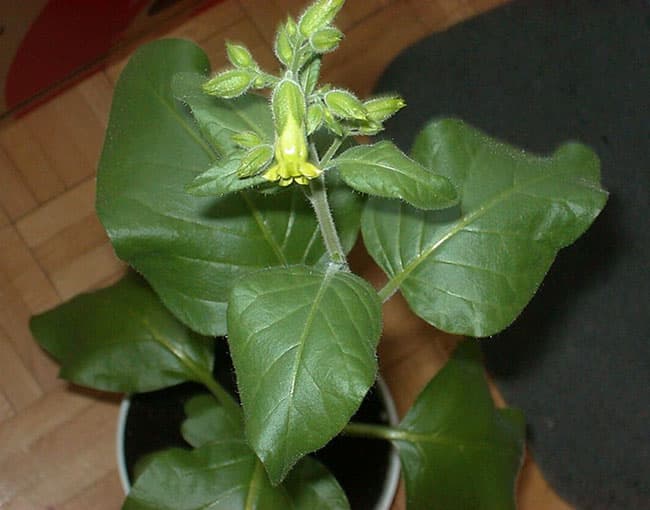
Nicotiana rustica Kessu seeds: buy in Europe Grow the legendary Kessu wild tobacco in your garden. This ultra-early, cold-resistant heritage plant adds a unique botanical aesthetic and serves as a wonderful natural pest repellent for your peaceful sanctuary.
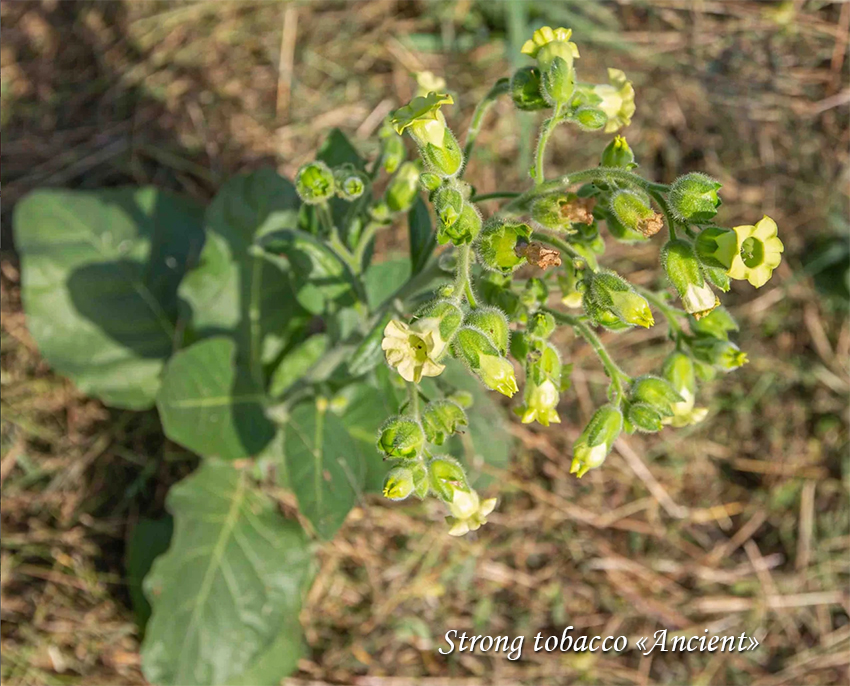
An annual plant, about 90-120 cm high. The leaves are large, wrinkled, light or dark green, reaching economic maturity 60-90 days after planting seedlings in a permanent place. During the growing season, an average of 20 high-quality leaves can be harvested from one plant.
The leaves contain several times more nicotine than most varieties of smoking tobacco.
Makhorka is grown for the manufacture of smoking granules, chewing and snuff tobacco, as well as for protecting plants from pests. Makhorka leaves contain about 5-15% nicotine, which is much higher than most smoking tobacco varieties.
The plant is heat-loving, prefers loamy or sandy loam soils, and requires constant moisture supply (drought reduces the quality of the raw material).
Sowing for seedlings is carried out in late March-April. Before sowing, the container is filled with slightly moist soil (three parts sandy loam turf soil and one part well-rotted and sifted humus), the surface is compacted and leveled. The seeds are evenly distributed over the surface, slightly pressed into the substrate, moistened from a spray bottle, and covered with a film. The crops are placed in a bright, warm place, watered through a tray, and ventilated every day (lifting the film for 30 minutes).
Young plants are planted in open ground in mid-late May at a distance of 50-70 cm. When 2-3 flowers open in the inflorescence, topping (removal of the inflorescence) is carried out; at the same time, some of the upper leaves are also removed. When side shoots grow to 5-7 cm, suckering is performed. 8-12 powerful leaves are left on the plant for ripening.
Makhorka is harvested as whole plants in the phase of technical maturity of the middle tier leaves (30-40 days after topping). Technically mature leaves are characterized by dense tissue, sag to the ground, become covered with light yellow spots, and acquire brittleness.
1.0 g = 700 seeds.
Makhorka (Aztec Tobacco) (Nicotiana rustica) is an annual plant of the Nightshade family.
The root of makhorka is a taproot, highly developed. The stem is erect, ribbed, with a loose core, up to 1.2m high. The leaves are petiolate, heart-shaped or ovate, with a wrinkled surface, light or yellow-green in color. There are 12-20 leaves on the stem. The leaves and stems are covered with short capitate hairs that emit a specific odor. The inflorescence is a panicle. The flowers are bisexual, green or yellowish-green, five-parted, with bracts.
Makhorka is a self-pollinating plant, but cross-pollination is also observed. The fruit is a bivalve multi-seeded capsule.
The seeds are small, brown or cream. Weight of 1000 seeds = 0.25-0.35 g.
Makhorka is cultivated to obtain smoking granules, snuff, and chewing tobacco. The dry leaves of this plant contain 5-15% nicotine and 15-20% organic acids, including 10% or more citric acid. The stems contain slightly less of these substances. A significant part of makhorka raw materials goes to the production of nicotinic (vitamin PP) and citric acids used in the food and textile industries. A fatty oil (35-40%) is obtained from the seeds, used in the production of paints, varnishes, and soap. Makhorka is a long-day plant. When moving to the north, its development accelerates, which makes it possible to grow this crop even in the Arctic.
However, compared to other long-day crops, it is more heat-loving. Makhorka seeds begin to germinate at a temperature of +7+8°C. The most favorable temperature for growth and development is +20+25°C. Makhorka is sensitive to low temperatures and is damaged by frosts of -2...-3°C. The crop requires a constant, sufficient moisture supply: even with short-term water stress, the quality of the raw material deteriorates. The best soils for makhorka are loamy chernozems, sandy loam, and loamy sod-podzolic soils.
Agrotechnical features.
The best predecessors for makhorka are winter grains, corn, root crops, legumes, perennial grasses, and vegetable crops. It should not be placed after melons, potatoes, hemp, and sunflowers, which share common diseases and pests. Makhorka is a good predecessor for many field crops.
The plant is demanding on the level of soil fertility. To form 1 ton of dry leaves and stems, makhorka consumes: nitrogen - 24 kg, phosphorus - 10 kg, potassium - 35 kg. A good yield of dry leaves and stems is 3-3.5 t/ha.
Makhorka can be grown in 2 ways: by seedlings and by sowing seeds in the field.
Seedling culture is of great importance for northern regions, requiring increased costs for growing seedlings and planting them. Seedlings are grown in the same way as tobacco seedlings, in hotbeds or on soil beds.
Seeding rate: in hotbeds - 1.5-2 g/m²; on warm beds - 2-2.5 g/m²; on cold ones - 2.5-3 g/m².
In old industrial practices, before sowing, seeds were treated in a weak formalin solution (today, safe modern fungicides are used) and germinated at a temperature of +25+28°C for 3-4 days. When sowing, they are mixed with clean sand in a ratio of 1:40. Care for seedlings consists of maintaining the most favorable temperature (+18+20°C), thinning plants, feeding 2-3 times, watering, and hardening. Ready-to-plant seedlings have 5-6 true leaves and reach a height of 8-12 cm. It takes 30-35 days to grow seedlings in hotbeds, and 40-45 days on beds. It is most effective to plant makhorka seedlings early, after spring frosts, when the topsoil warms up to +10°C.
Seedlings are planted with a row spacing of 60-70 cm and a distance between plants of 25-30 cm. Planting density: large-leaved varieties - 60-70 thousand plants per hectare; medium-leaved - 70-80 thousand/ha; small-leaved - 80-90 thousand plants/ha. The planting density of direct-sown makhorka is the same as that of transplanted makhorka.
The first inter-row loosening is carried out at the beginning of the emergence of seedlings to a depth of 5-6 cm, the second - 8-10 days after the first to a depth of 6-8 cm.
Thinning begins when two true leaves appear. 3-5 well-developed plants are left in clusters, and later thinned to one best plant.
Topping (removal of inflorescences) should be carried out during budding, and suckering - when side shoots grow to 5-7 cm.
Makhorka is harvested in one step as whole plants upon reaching technical ripeness, characterized by the brittleness of the leaves and their sagging. Ripe leaves emit a strong, specific odor. If harvesting is delayed, makhorka can be damaged by autumn frosts. For faster drying, 3-4 days before harvesting, the stems are split from top to bottom, leaving the lowest part intact. This reduces the drying period by 10-12 days.
Makhorka is harvested in dry, sunny weather manually. It is chopped at the root. The chopped plants remain in the field for wilting until the leaves become soft. Then they are transported to drying rooms, where they are languished at +30+40°C for 20-24 hours. After languishing, makhorka is dried for 25-30 days in well-ventilated rooms to a standard humidity of 35%.
* Makhorka is more unpretentious and less demanding on heat than regular tobacco: it grows perfectly from the Arctic Circle to the southern regions of Europe.
In a year, a smoker consumes an average of 7.5—8.0 kg of tobacco. Under favorable conditions, from 0.01 ha, 30-40 kg of dry leaves can be obtained. The mass of one dry leaf in small varieties is 0.8—1.5 g. During the season, 25-33 technically mature leaves form on the plant.