


Your shopping cart is empty!
Yarrow "Letnjaja Skazka" F2 (variety mix)
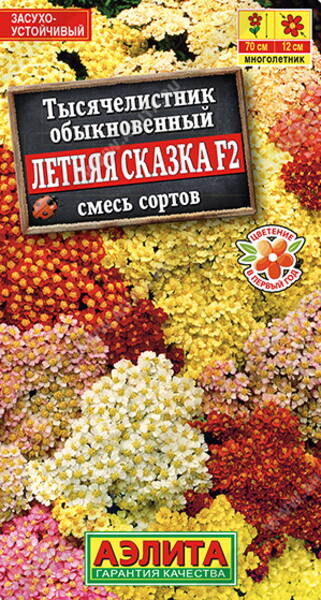
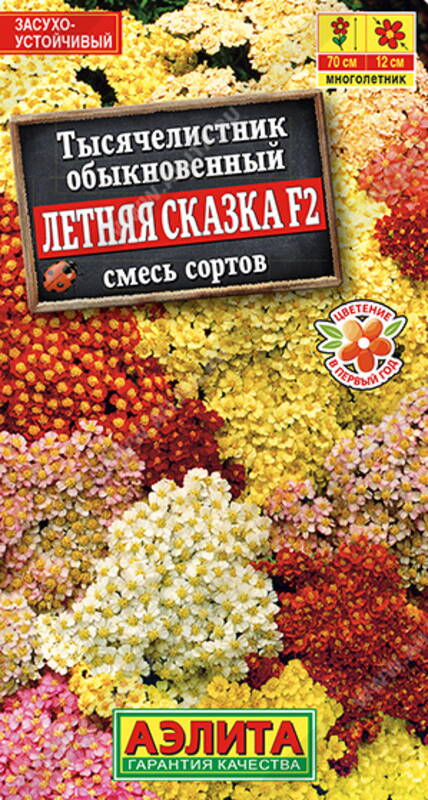
Yarrow "Summer Tale" F2 (variety mix) - Achillea millefolium.
Ideal for hot, dry, and sunny areas!
A drought-resistant perennial with a rich palette of colors and lacy foliage. Valued for its unpretentiousness and abundant, prolonged blooming. Requires no special care.
Bushes up to 70 cm high are ideal for natural-style flower beds, mixed borders, and rock gardens. Corymbose inflorescences Ø 10-12 cm are suitable for cutting and dried bouquets. Regular removal of faded flowers promotes continuous blooming. Easily reproduces by self-seeding. A hard pruning after the first bloom is recommended to keep the bushes compact.
Yarrow is not demanding on the soil, but prefers well-drained, sunny, calciferous areas. When grown through seedlings, it blooms in the first year. You can sow directly into the open ground in spring or before winter, at the end of October.
Ideal for hot, dry, and sunny areas!
A drought-resistant perennial with a rich palette of colors and lacy foliage. Valued for its unpretentiousness and abundant, prolonged blooming. Requires no special care.
Bushes up to 70 cm high are ideal for natural-style flower beds, mixed borders, and rock gardens. Corymbose inflorescences Ø 10-12 cm are suitable for cutting and dried bouquets. Regular removal of faded flowers promotes continuous blooming. Easily reproduces by self-seeding. A hard pruning after the first bloom is recommended to keep the bushes compact.
Yarrow is not demanding on the soil, but prefers well-drained, sunny, calciferous areas. When grown through seedlings, it blooms in the first year. You can sow directly into the open ground in spring or before winter, at the end of October.
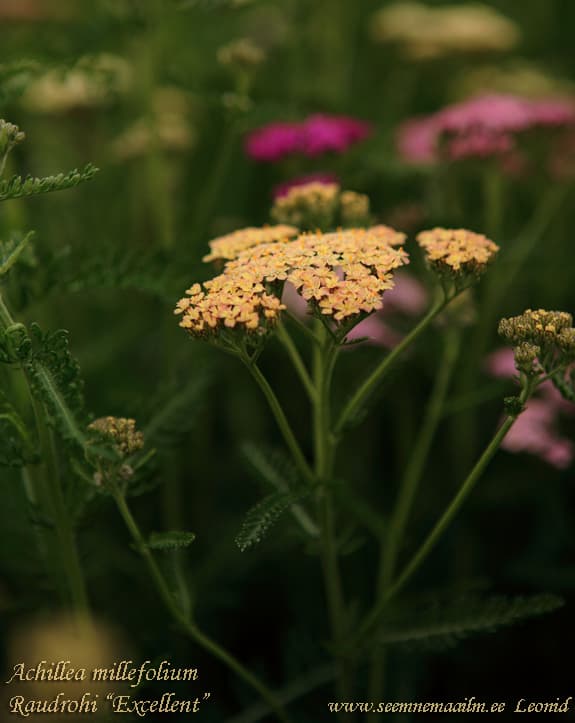
Common Yarrow (color mix) - Achillea millefolium.
A perennial rhizomatous plant from the Asteraceae family, 50-70 cm high. The stems are straight, numerous with lacy leaves that give the plant additional decorative appeal.
Blooms in July-August. The inflorescences are dense, up to 15 cm in diameter, of various colors. The plant is cold-hardy, drought-resistant, grows well in open or slightly shaded areas, and is undemanding to the soil. Seeds are sown in spring or before winter.
Used for group plantings, tall borders, and for cutting. Yarrow can be used in winter bouquets; when dried, it retains the color of its inflorescences well.
Name: in honor of Achilles — the mythological hero of the Trojan War, whose mentor, the centaur Chiron, healed his wounds with one of these plants. It grows wild in the European part of Russia, the Caucasus, Western and Eastern Siberia, the Far East, and Western Europe. A perennial plant. The stems are straight, 70-80 cm high, forming a loose bush. The leaves are arranged alternately, twice or thrice pinnately dissected with numerous lanceolate segments, the lower ones — on petioles, the upper ones — sessile, with a peculiar smell when rubbed. Baskets up to 0.7 cm in diameter are collected in dense corymbose inflorescences. The wrapper leaves are oblong with a brown, membranous edge. Ray flowers are white, pink, or purple, tubular — yellow. Blooms from July for 40-45 days. Bears fruit. In cultivation since 1440.
Location: grown in open or slightly shaded places.
Soil: unpretentious to the soil, grows better on nutritious, slightly moistened, calciferous soils. The exception is cushion-forming yarrows. They require well-drained (otherwise they will rot during winter or spring) poor and loose soil with sand.
Care: responds well to fertilizers and top dressing.
Reproduction: by seeds, as well as by dividing the bush, which must be done every 2-3 years. Can be propagated in summer by green cuttings.
Use: for group plantings, mixed borders, and cutting. Fernleaf yarrow is used for winter bouquets. Low-growing species are planted in the rock garden (for example, Achillea serbica), and tall ones, reaching a height of 1.5 m, like Achillea filipendulina with flat inflorescences of small yellow baskets, are used as solitary background elements. Some undemanding species of yarrow can be successfully used to fill places around the rock garden where other plants do not take root.
Partners: yarrows have horizontally arranged inflorescences and are used as a balancing element for flower beds in which the emphasis is on spike-like plants. All yellow-flowered yarrows are a good contrast for bright blue flowers, harmonious with plants of warm shades, and extremely attractive against a background of silvery foliage. Pastel-colored yarrows will look good against the background of plants with bronze foliage and among other flowers of the same delicate shades. Bright red and bright pink varieties look great in the company of blue and purple flowers, as well as against a background of silvery foliage.
Bot. syn.: Achillea lanulosa Nutt.