


Your shopping cart is empty!
Bigleaf lupine "Alye Parusa"
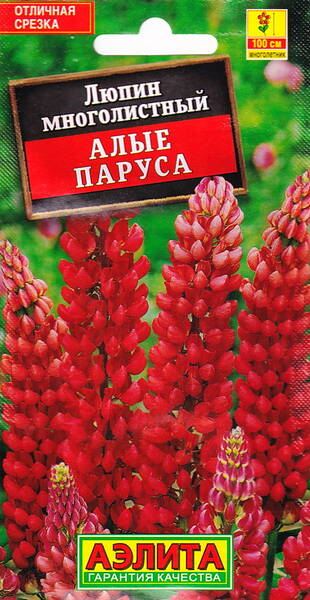
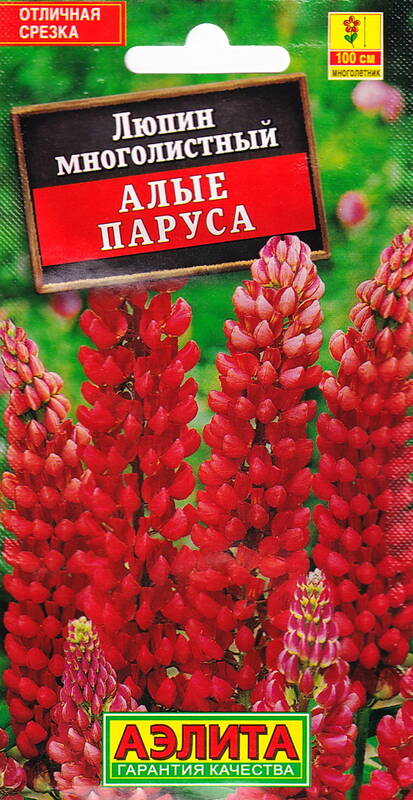
Large-leaved Lupine "Scarlet Sails" - Lupinus polyphyllus.
Excellent for cutting!
A perennial herbaceous plant with slender, pyramidal spikes of delightful bright red flowers protruding above openwork foliage. The flowers bloom sequentially from the bottom up and delight the eye from June to September. This is one of the most unpretentious perennials. It forms powerful multi-stemmed bushes 90-100 cm high. The moth-like flowers are gathered in large, spectacular inflorescences 30-40 cm long. Grown in mixed borders with other perennials, singly and in groups, and also perfectly suited for cutting.
Agrotechnics.
The plants are cold-resistant and drought-resistant. Lupines are completely undemanding to soil fertility, as they themselves perfectly enrich the soil with nitrogen, but they grow best on soils with good drainage and prefer sunny places. The root is taproot, so only young seedlings tolerate transplanting well.
Seeds are sown directly to a permanent place at the earliest possible date (in April) or before winter (in late October) to a depth of 2-3 cm with a spacing of 20-25 cm. Watering only under the root is recommended. Regular top dressing with phosphorus-potassium fertilizers ensures the most lush flowering. If faded inflorescences are removed in a timely manner, the plant will bloom a second time in August.
Excellent for cutting!
A perennial herbaceous plant with slender, pyramidal spikes of delightful bright red flowers protruding above openwork foliage. The flowers bloom sequentially from the bottom up and delight the eye from June to September. This is one of the most unpretentious perennials. It forms powerful multi-stemmed bushes 90-100 cm high. The moth-like flowers are gathered in large, spectacular inflorescences 30-40 cm long. Grown in mixed borders with other perennials, singly and in groups, and also perfectly suited for cutting.
Agrotechnics.
The plants are cold-resistant and drought-resistant. Lupines are completely undemanding to soil fertility, as they themselves perfectly enrich the soil with nitrogen, but they grow best on soils with good drainage and prefer sunny places. The root is taproot, so only young seedlings tolerate transplanting well.
Seeds are sown directly to a permanent place at the earliest possible date (in April) or before winter (in late October) to a depth of 2-3 cm with a spacing of 20-25 cm. Watering only under the root is recommended. Regular top dressing with phosphorus-potassium fertilizers ensures the most lush flowering. If faded inflorescences are removed in a timely manner, the plant will bloom a second time in August.
Bot. syn.: Lupinus alilatissimus C. P. Sm., Lupinus apodotropis Heller.
* Lupine Diseases.
Fusarium wilt. Among lupine diseases, this is the most dangerous. Both seedlings and adult plants fall ill. The disease is characterized by browning and rotting of tissues, roots, and the root collar, along with browning of leaves and fruits, and wilting of the entire plant. The tissues of the root system of such plants become softened. In moist, warm weather, the formation of pinkish pads (the spore-bearing organs of the fungus) is observed on the surface of affected plants, especially on cotyledons and the root collar of seedlings. The disease is detected in the form of small foci, which gradually increase in size. In the middle of the focus, plants often die out completely. Fusarium wilt manifests itself with particular force in areas where lupine follows lupine, which is explained by the gradual accumulation of infection in the soil from year to year. With proper crop rotation, the infection rate is insignificant, and the disease can only arise as a result of introducing the infection with seeds. The parasite survives as mycelium and chlamydospores for several years in the soil, from where it moves to the root system of plants and their aerial organs. Fusarium wilt of lupine is widespread and occurs everywhere.
Control measures: Crop rotation. Destruction of diseased plants. Sowing with healthy seeds. Breeding and using resistant varieties of lupine.
White rot (Sclerotinia). In addition to lupine, it affects zucchini, peas, tobacco, hemp, sunflowers, carrots, and other crops. Adult plants fall ill, most often in the second half of summer. The disease is characterized by the appearance of colorless, watery areas on affected plants, which grow rapidly with the formation of white, cotton-like fungal mycelium on the surface and inside the affected organs. Simultaneously with the development of the mycelium, black, nodular sclerotia of the fungus are formed, immersed in the cotton-like accumulation of mycelium. Under the influence of the pathogen, the top of the stem quickly dies, the leaves droop, and the plant dries up. The fungus overwinters as sclerotia in the soil, or the latter are preserved with seeds as a mechanical impurity. Sclerotia in the soil germinate in the spring, and ascospores are formed by the fungus. The fungal mycelium, infecting the root system and aerial organs, grows and gradually spreads to neighboring healthy plants. White rot is widespread in many horticultural areas and can be found everywhere.
Control measures: Crop rotation, in which the preceding crop is cereals or other plants not affected by sclerotinia. Deep plowing. Cleaning seeds from fungal sclerotia. Removal of isolated diseased plants or primary foci.
Powdery mildew is a widespread disease of lupine. With early development, it can spread throughout the plantation and cause almost 100% infection of plants. The disease is characterized by the appearance on the leaf surface of a white, loose, cobweb-like coating covering the leaf blade, which hinders respiration and leads to premature leaf drop and general suppression of the entire plant. The white powdery coating is the mycelium of the fungus and the organs of conidial sporulation. The spores of the parasite are easily carried by the wind, settle on healthy plants, and cause their infection. Over time, small black dots appear on the surface of the white coating, representing the perithecia (fruiting bodies) of the parasite, which overwinter on fallen leaves, preserving the infection until spring.
Control measures: Timely removal of plant residues, use of fungicides at the first signs of the coating, compliance with agricultural techniques.