


Your shopping cart is empty!
Daikon "Agata" (summer radish)
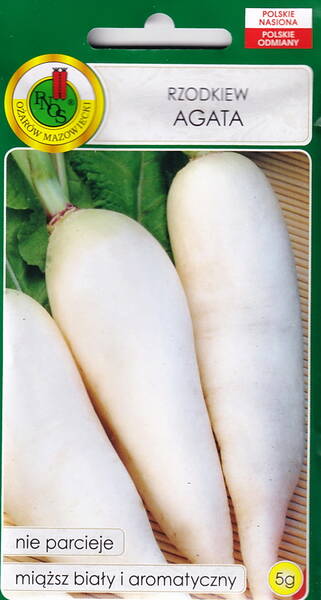
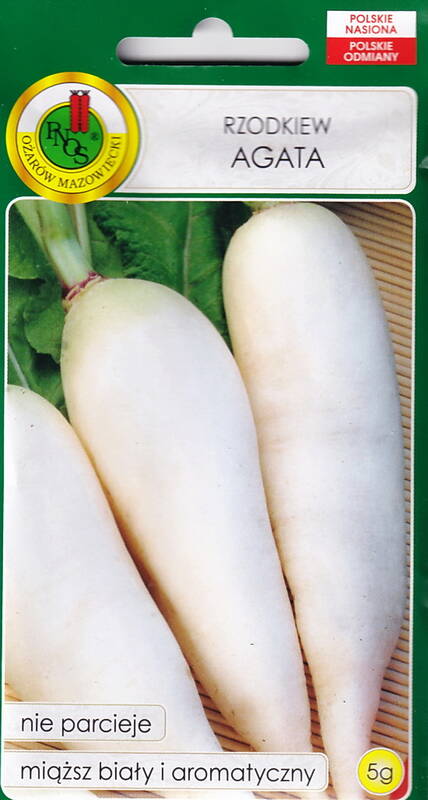
Daikon "Agata" (Summer Radish, Japanese Radish).
Juicy, tender, with snow-white flesh. Stores excellently!
An early ripening variety (50-60 days), a real find for healthy eating enthusiasts.
Unlike regular radishes, Daikon contains no mustard oils, so it lacks the sharp pungent taste and does not overstimulate heart activity.
Characteristics:
Roots are long (approx. 25 cm), massive (200 g), and cylindrical in shape.
The flesh is snow-white, very juicy, with a delicate flavour. The variety resists becoming pithy: it does not overgrow quickly and retains its crunch.
Variety value:
Universal use: suitable for fresh vitamin salads in summer and for long-term winter storage.
Agrotechnics:
1. Soil: It is strictly forbidden to apply fresh manure! This leads to hollow centers in the root and excessive branching ("bearded" roots).
2. Sowing: For summer consumption, sow in May. For winter storage — in mid-June (10th-15th). Sow dry seeds to a depth of 1.5-2 cm.
3. Spacing: Daikon hates overcrowding! Distance between rows 35-40 cm, in the row — 20-25 cm.
4. Protection: Protect seedlings from flea beetles by dusting with ash or tobacco dust.
5. Harvest: Harvest roots before frost, trim the tops, and store in a cool place.
Minimum rotation period before returning to the same spot is 3-4 years. Unacceptable predecessors: cabbage, radish.
Juicy, tender, with snow-white flesh. Stores excellently!
An early ripening variety (50-60 days), a real find for healthy eating enthusiasts.
Unlike regular radishes, Daikon contains no mustard oils, so it lacks the sharp pungent taste and does not overstimulate heart activity.
Characteristics:
Roots are long (approx. 25 cm), massive (200 g), and cylindrical in shape.
The flesh is snow-white, very juicy, with a delicate flavour. The variety resists becoming pithy: it does not overgrow quickly and retains its crunch.
Variety value:
Universal use: suitable for fresh vitamin salads in summer and for long-term winter storage.
Agrotechnics:
1. Soil: It is strictly forbidden to apply fresh manure! This leads to hollow centers in the root and excessive branching ("bearded" roots).
2. Sowing: For summer consumption, sow in May. For winter storage — in mid-June (10th-15th). Sow dry seeds to a depth of 1.5-2 cm.
3. Spacing: Daikon hates overcrowding! Distance between rows 35-40 cm, in the row — 20-25 cm.
4. Protection: Protect seedlings from flea beetles by dusting with ash or tobacco dust.
5. Harvest: Harvest roots before frost, trim the tops, and store in a cool place.
Minimum rotation period before returning to the same spot is 3-4 years. Unacceptable predecessors: cabbage, radish.
CULINARY SECRETS WITH ORIENTAL RADISH (DAIKON).
Japanese radish roots are used both fresh (in a variety of salads), boiled (for example, in vegetable and meat soups), fried and even salted or pickled.
Daikon is often stewed with meat or poultry, as it does not go sour when cooked for a long time and absorbs the flavor and juice of all other ingredients. In Japanese cuisine, this vegetable is served as a seasoning for sashimi and sushi rolls, while grated and seasoned with soy sauce, daikon is often used as a seasoning for fried fish. Young leaves of hairless varieties can be added to salads.
Daikon and red cabbage salad.
Daikon - 300 g, carrots - 100 g, red cabbage - 200 g, sour cream and salt - to taste.
Wash daikon and carrots, peel and chop on a coarse grater. Cut red cabbage into thin strips, mix with chopped carrots and daikon, season with sour cream (or mayonnaise) and salt.
Daikon salad with beef.
Daikon - 300 g, lean boiled beef - 200 g, onion - 100 g, vegetable oil - 4 tablespoons, parsley - 2 tablespoons, salt - to taste.
Boiled meat and raw daikon cut into small strips. Cut the onion into thin half rings and fry in oil until golden brown. Place all products in a salad bowl, add salt to taste, garnish with parsley.
Chicken and daikon in red wine sauce.
Chicken thighs (pieces, without skin and bones) - 450 g, salt and pepper - to taste, butter - 2 tablespoons, daikon (2x2 pieces) - 220 g, onion (2x2 pieces) - 1 pc., chicken broth - 375 ml, red wine -125 ml, soy sauce - 1.5 tablespoons, sugar - 1.5 tablespoons.
Season the chicken meat with salt and pepper. In a large skillet, dissolve 1 tbsp. l. butter, brown chicken thighs on all sides over high heat, then remove. Then put the onion and daikon and fry them for 1-2 minutes with vigorous stirring. Pour in the chicken broth, close the lid and bring to a boil. Open the lid, reduce the heat to medium and cook, stirring occasionally, for another 10 minutes. Add red wine, soy sauce and sugar and leave on fire for another 10 minutes. Then put the chicken in and cook for another 5 minutes over low heat until the meat is tender and the liquid level has reduced. Remove the pan from the heat and stir in 1 tablespoon of butter, add salt and pepper to taste.