


Your shopping cart is empty!
Double Moss Rose "Scarlet"
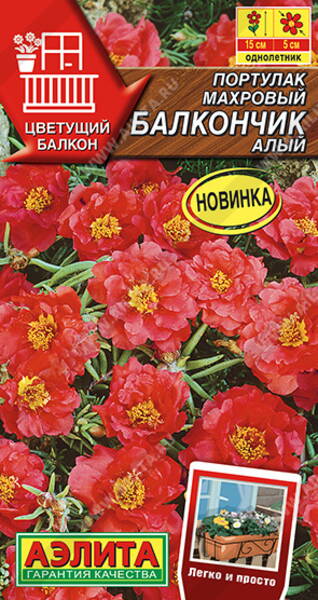

Double Moss Rose "Scarlet" - Portulaca grandiflora double extra.
A magnificent floral "sprinter-carpet".
Good lateral branching, shoots with many flowers and buds hang down beautifully, creating a magnificent look in baskets and containers.
A perennial plant used as an annual in our climate conditions. Forms a bush 15-20 cm high, flowers 4-5 cm in diameter, blooming from July until the frost.
Drought-resistant. Ideal for planting in hot, dry places, under the sun. It grows rapidly, forming a dense carpet of succulent bluish-green leaves and silky double flowers that bloom throughout the summer period.
Moss rose purslane is used for planting in flower beds, borders, as edging plants, and as carpet flower beds. It is ideal for rockeries, planting in containers, low vases, pots, as well as balcony boxes.
Agrotechnics.
Sowing for seedlings in April. Shoots appear in a week. Seedlings do not tolerate high temperatures and excessive moisture. Pricking out in the phase of 1 true leaf. Planting hardened seedlings in open ground in late May - early June with a step of 20-25 cm. The plants tolerate transplanting well.
Heat and light-loving, drought-resistant. Requires light, neutral, drained soils.
A magnificent floral "sprinter-carpet".
Good lateral branching, shoots with many flowers and buds hang down beautifully, creating a magnificent look in baskets and containers.
A perennial plant used as an annual in our climate conditions. Forms a bush 15-20 cm high, flowers 4-5 cm in diameter, blooming from July until the frost.
Drought-resistant. Ideal for planting in hot, dry places, under the sun. It grows rapidly, forming a dense carpet of succulent bluish-green leaves and silky double flowers that bloom throughout the summer period.
Moss rose purslane is used for planting in flower beds, borders, as edging plants, and as carpet flower beds. It is ideal for rockeries, planting in containers, low vases, pots, as well as balcony boxes.
Agrotechnics.
Sowing for seedlings in April. Shoots appear in a week. Seedlings do not tolerate high temperatures and excessive moisture. Pricking out in the phase of 1 true leaf. Planting hardened seedlings in open ground in late May - early June with a step of 20-25 cm. The plants tolerate transplanting well.
Heat and light-loving, drought-resistant. Requires light, neutral, drained soils.
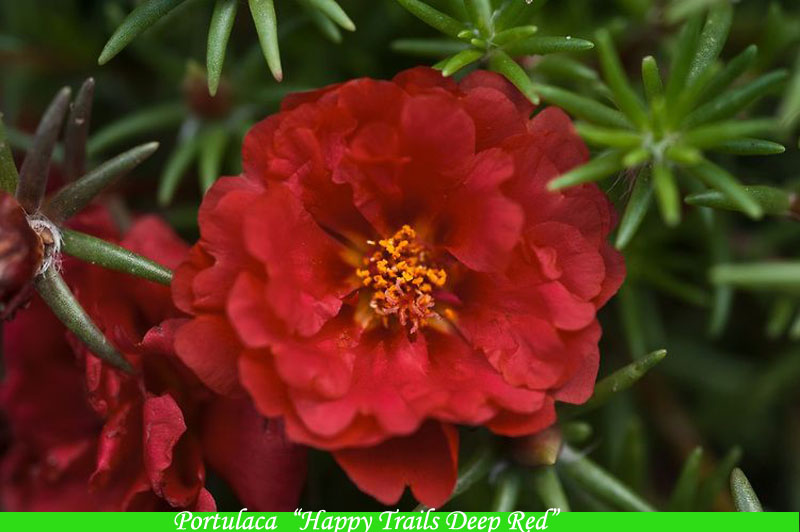
* Large-flowered purslane, commonly known as moss rose — Portulaca grandiflora Hook.
Origin — Argentina, Brazil. A perennial plant used as an annual. Stems are creeping, highly branched, 10-20 cm high, succulent, fleshy, light green, sometimes with a reddish tint. Leaves are fleshy, almost cylindrical, small, bare. Flowers are solitary, simple, semi-double or double, 3-6 cm in diameter, white, yellow, orange, pink and red, of various shades, located at the ends of the stems. Flowers open only on clear, sunny days.
Blooms from June to frost. Bears fruit. The capsules open widely when ripe, so they are collected systematically in the yellowing stage. Seeds retain viability for 3-4 years. In cultivation since 1827. Only garden forms are cultivated.
The corollas of the flowers come in a wide variety of colors, but double varieties are still quite rare. The main reason is that double forms set fewer seeds, since their additional petals are formed not only from stamens, but even from the stigmas of the pistil. If semi-double cultivars with a rose-like petal arrangement have a more or less stable number of petals (15-20), then double, and especially densely double varieties with peony-like flowers, form up to 40-50 petals. In this case, few seeds are produced, they have low germination, and produce weak seedlings. In such plants, it is advised to obtain seeds from the first two or three flowers, which have not yet reached a high degree of doubleness and have a normal pistil.
Location: the plant is heat-loving and drought-resistant. An ultra-light-loving plant, it does not bloom with the slightest shading.
Soil: does not tolerate any fertilizers and grows on dry, sandy, and even stony soil with minimal watering.
Reproduction: seeds are sown for seedlings in February superficially, covered with glass or film, and kept in the light. Shoots appear in 7-14 days. Pricked out into pots with a diameter of 5-6 cm. Tolerates transplanting well. Grown in a dry regime. Planted in their permanent place after the frosts, at a distance of 15-20 cm. Sometimes propagated by cuttings. The germination rate of double forms is generally not very high. High germination of large-flowered portulaca seeds is possible only if the crops are kept in a greenhouse equipped like for sowing cactus seeds with fluorescent lamps, a heater, and a thermostat. In the absence of one, you can use an aquarium or just a plexiglass box covered with plastic wrap. A desk lamp is suitable for additional lighting. The greenhouse maintains a temperature of +25...+35°C. With very bright lighting, it can be even higher. It is better to sow in plastic boxes with drainage holes. The substrate should not contain peat and organic fertilizers, otherwise, the seedlings will either not appear or will die from fungal diseases. It must be sterilized in a water bath beforehand. If supplementary lighting with fluorescent lamps is not equipped, seedlings (as soon as they are freed from the seed coat) must be exposed to a sunny window for the day, and kept under a desk lamp (75-100 W) in the morning and evening (all day in cloudy weather). Until the first pair of true leaves appears, the substrate should be kept moist.
Use: used in flower beds, on rocky alpine slides. Planted in flowerpots, containers, balcony boxes, on top of retaining walls, and between path slabs in the garden. For decorating southern slopes.