


Your shopping cart is empty!
Tomato "Khleb da Sol"
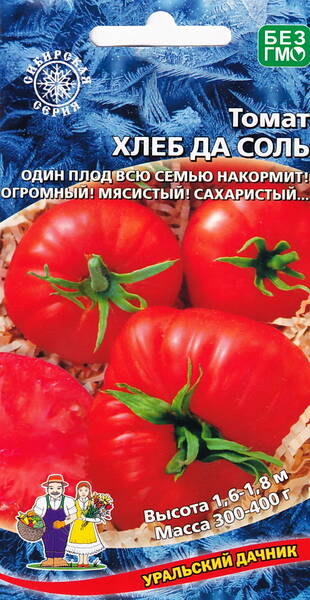
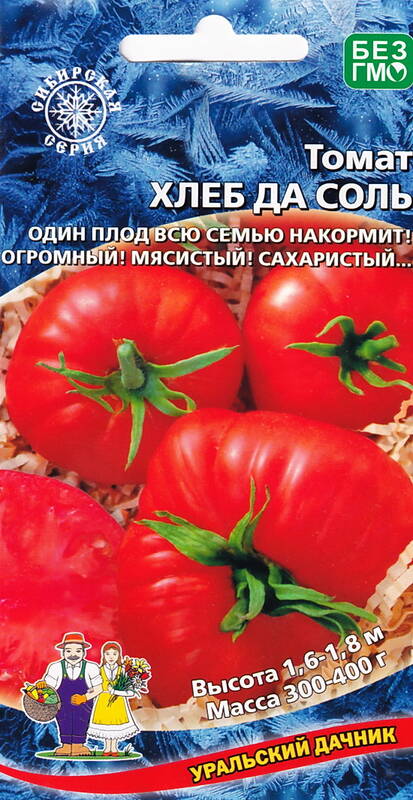
Tomato "Bread and Salt".
Russian Giant! Sugary "watermelon" flesh and weight up to 800 g.
A magnificent tall-growing variety named after the traditional symbol of hospitality. It combines record-breaking fruit size with amazing resistance to weather whims.
Characteristics:
Type: Indeterminate (tall). Requires reliable support.
Fruits: Flat-round, bright red, meaty (Beefsteak type). The flesh is granular on the break (like a watermelon), juicy, and very sweet.
Weight: Average 300-500 g, with thinning — up to 800 g!
Variety value:
1. Taste: Thanks to the high sugar content, this is the best choice for summer salads and thick, sweet tomato juice.
2. Reliability: The variety is resistant to temperature changes and sets fruit even under stressful conditions.
3. Feature: Seedless fruits ("meat fillet") are often formed on the first two trusses.
Agrotechnics:
Sowing for seedlings: late March (depth 1-1.5 cm). Planting out: greenhouse — April/May, outdoors — when the threat of frost has passed.
Secret of giants: Train the plant strictly to 1 stem. Be sure to tie up not only the main stem but also the heavy trusses so they don't break. Want 800 g fruits? Leave no more than 2 ovaries per truss!
Seeds remain viable for 10 years. If the expiration date has passed, simply increase the sowing rate.
Russian Giant! Sugary "watermelon" flesh and weight up to 800 g.
A magnificent tall-growing variety named after the traditional symbol of hospitality. It combines record-breaking fruit size with amazing resistance to weather whims.
Characteristics:
Type: Indeterminate (tall). Requires reliable support.
Fruits: Flat-round, bright red, meaty (Beefsteak type). The flesh is granular on the break (like a watermelon), juicy, and very sweet.
Weight: Average 300-500 g, with thinning — up to 800 g!
Variety value:
1. Taste: Thanks to the high sugar content, this is the best choice for summer salads and thick, sweet tomato juice.
2. Reliability: The variety is resistant to temperature changes and sets fruit even under stressful conditions.
3. Feature: Seedless fruits ("meat fillet") are often formed on the first two trusses.
Agrotechnics:
Sowing for seedlings: late March (depth 1-1.5 cm). Planting out: greenhouse — April/May, outdoors — when the threat of frost has passed.
Secret of giants: Train the plant strictly to 1 stem. Be sure to tie up not only the main stem but also the heavy trusses so they don't break. Want 800 g fruits? Leave no more than 2 ovaries per truss!
Seeds remain viable for 10 years. If the expiration date has passed, simply increase the sowing rate.
* Preparation of tomato seeds for sowing.
First of all, seed calibration, disinfection, and hardening are carried out. To reduce the susceptibility of future plants to diseases, sorted seeds are placed for 10-20 minutes in a 1-2% solution of potassium permanganate (5-10 g of manganese crystals per 1 liter of water). Then they are rinsed and dried.
Heating the seeds before disinfection gives a good effect. To do this, place the seeds in a gauze bag and warm them for 2-3 hours near a stove/heater or dip them in hot water (+60°C) for 20 minutes. For hardening, seeds treated with potassium permanganate are placed in a gauze bag in a glass jar and buried in snow for 3 days or placed in a refrigerator at a temperature of -1 to -3°C.
Sowing:
Tomato seeds are sown in boxes filled with a soil mixture of the following composition: 2 parts compost, 1 part sawdust or peat, 1 part sand. Add to the soil mixture (per bucket): 15 g of ammonium nitrate, 20 g of double superphosphate, 10 g of potassium sulfate, or 2 cups of wood ash.
Pour the mixture into boxes, level it, slightly compact it, water it, and make furrows 1-2 cm deep at a distance of 5-7 cm from each other. Seeds are sown in them at intervals of 3-4 cm from each other (3-5 g per box). Cover the seeds to a depth of 1-1.5 cm.
Before germination, keep the boxes covered at a temperature of +20+25°C, watering in the morning and evening with water heated to +20+25°C. As soon as the seedlings appear, remove the covers and place the boxes by the window during the day, and in a warmer place at night. Water the seedlings once a day: initially with water heated to +22°C, and later with water at room temperature.